
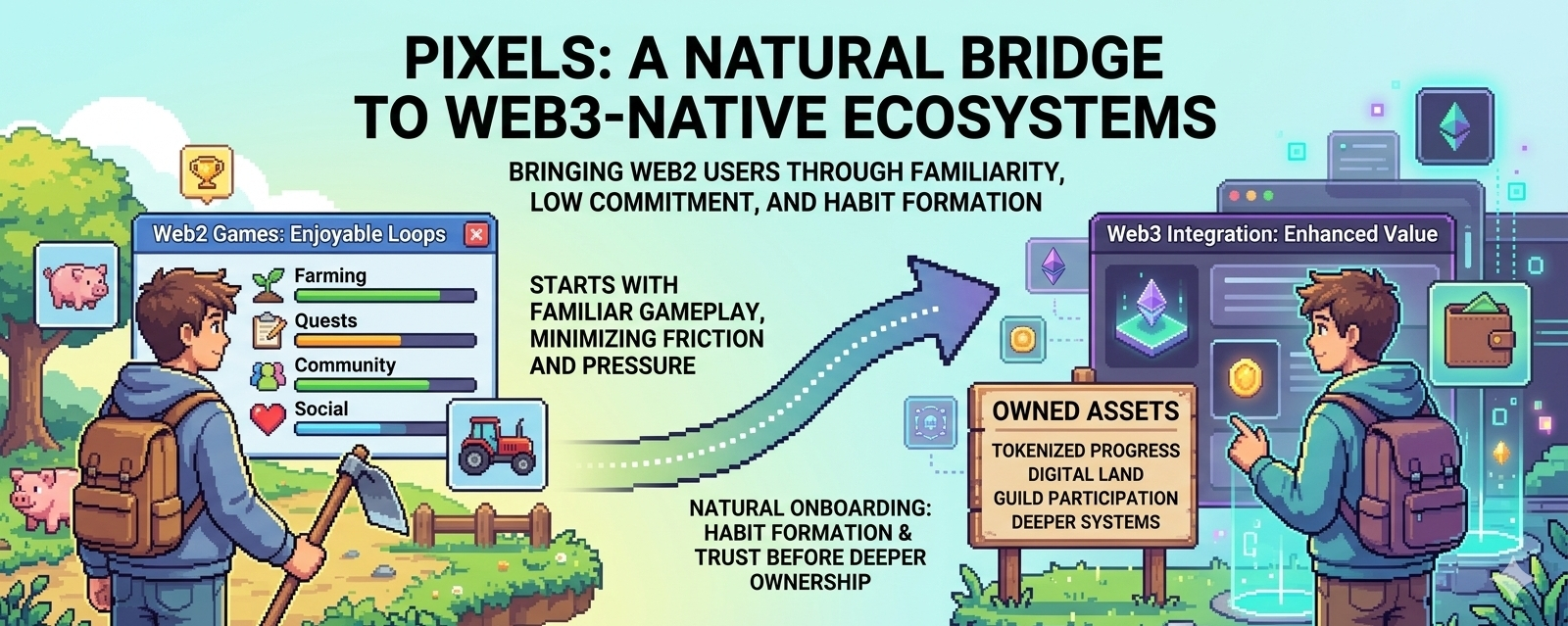
What I find most interesting about Pixels is how naturally it can bring Web2 users into a Web3-native ecosystem without making that transition feel overwhelming. To me, that is the real strength of the project. A lot of Web3 products expect people to care about blockchain before they have even found a reason to care about the experience itself. Pixels takes a very different route. It starts with something much more familiar: a game that feels approachable, social, and easy to understand. That alone gives it a much better chance of connecting with mainstream users.
When I think about most Web2 players, I do not think they are searching for token mechanics, wallet infrastructure, or digital ownership models. Most of them just want something enjoyable. They want a game that feels alive, gives them clear goals, rewards their time, and makes them want to return. That is why Pixels works in a way many other Web3 projects do not. It does not throw the technical side in your face from the first moment. Instead, it leads with gameplay. Farming, gathering, crafting, quests, and progression are all familiar systems. Even if someone has no background in crypto, they can still step into Pixels and immediately understand what they are supposed to do.
I think that kind of entry point matters more than people realize. The biggest problem with bringing Web2 audiences into Web3 has never been awareness. It has been friction. The moment a product feels too technical, too financial, or too dependent on blockchain knowledge, mainstream users lose interest. Most people are curious, but they are not patient. They want something that makes sense quickly. Pixels understands that. It creates a softer landing. It gives players a world they can interact with first, and only later do they begin to notice the deeper systems underneath.
That is why I see Pixels as a genuine bridge instead of just another Web3 game trying to look accessible. It respects how people actually adopt new technology. People rarely move into new ecosystems because someone explains the technology well. They move because the experience feels worth their time. In Pixels, the gameplay loop does most of the onboarding work. Players start with simple routines, build familiarity, and develop a connection to the game before they ever think seriously about ownership, tokens, or the broader ecosystem. That is a much more natural path than asking someone to become “crypto-native” on day one.
What makes this even stronger is the fact that Pixels does not seem to force commitment too early. That is one of the smartest parts of its design. A lot of Web3 gaming projects used to make ownership feel like an entry fee. If you wanted access, you often had to buy something first. That immediately pushed away a huge portion of normal players. Web2 audiences are not used to that kind of pressure, especially at the beginning. Pixels feels more welcoming because participation comes before deeper ownership. A user can play, learn the systems, and decide later whether they want to go further. That makes the experience feel less risky and much more human.
I also think the social side of Pixels plays a major role in its ability to onboard Web2 users. Games do not grow only through mechanics. They grow because people invite each other, communities form, and progress feels more meaningful when it is shared. Pixels has that kind of energy. It feels like a world where players are not just grinding alone. There is social activity, collaboration, guild-style interaction, and a sense that the game has life beyond the individual player. That is important because Web2 users often stay for the community as much as the gameplay. Even if they are unfamiliar with Web3, they will keep showing up if the world feels active and their presence feels connected to others.
Another reason I think Pixels has such strong relevance is that it lowers the intimidation factor around Web3. For many mainstream users, blockchain still feels like something distant, complicated, or overly financial. There is often a mental barrier before they even try a product. Pixels does not try to smash that barrier with technical explanations. Instead, it lets players settle into a familiar routine first. Once they are comfortable, the Web3 aspects begin to feel less foreign. At that point, ownership is no longer an abstract concept. It becomes something tied to their time, progress, and identity inside the game.
That transition is powerful because it changes how people relate to Web3. Instead of feeling like outsiders entering a complex new system, they feel like players exploring a game that simply has more depth than they expected. In my opinion, that is exactly how mass adoption is supposed to happen. Not through pressure, and not through hype, but through comfort. Pixels feels like it understands that comfort has to come first.
I also appreciate that Pixels seems built around habit formation. That is a huge factor when it comes to attracting and keeping Web2 users. People stay in games when the loops feel rewarding and easy to return to. Daily routines, visible progress, small goals, and social presence all help create that attachment. Pixels uses those familiar structures well. A player does not need to understand the broader ecosystem right away because the game itself already gives them enough reason to come back. Over time, that routine creates trust. And once trust is built, players become much more open to exploring the deeper parts of the ecosystem.
What makes the project even more interesting to me is that it feels like more than a single game. Pixels gives the impression of being an entry point into something larger. That is where the Web3-native ecosystem really starts to matter. A user may arrive because the farming loop is easy to enjoy, but eventually they begin to notice that there is more underneath: ownership, social coordination, land utility, token interaction, and participation in a broader network of value. That layered experience is one of the most compelling things about Pixels. It allows players to grow into Web3 instead of being thrown into it.
This is also why I think Pixels has a more realistic model for mainstream adoption than projects that focus too heavily on speculation. Web2 users are not looking to be sold a dream. They want something real. They want gameplay that works, communities that feel alive, and systems that reward time in a meaningful way. If a game feels like it only exists to support token activity, players eventually notice. But when the game itself feels enjoyable and the economic layer grows naturally around it, the relationship becomes much stronger. Pixels seems closer to that second model.
The land and ownership side of Pixels is a good example of this balance. Ownership is there, but it does not have to be the first thing a player worries about. That is exactly how I think Web3 assets should be introduced in gaming. They should feel like an enhancement, not an obligation. A player should first understand why a system matters before being asked to invest in it. Pixels creates that sequence well. It lets ownership become meaningful over time rather than making it feel like a gate.
I also think infrastructure plays a huge role here, even if many users never think about it directly. The smoother the onboarding, the easier the account flow, and the less visible the complexity, the more likely mainstream players are to stay. That invisible support matters a lot. Web2 audiences do not want to feel like every action requires special knowledge. They want the game to work. Pixels benefits from being part of a gaming-focused blockchain environment, and that gives it a stronger foundation for turning curiosity into long-term participation.
At the end of the day, I think Pixels works because it understands something very basic but very important: people do not adopt new ecosystems because they are told to. They adopt them because something about the experience feels enjoyable enough, safe enough, and meaningful enough to keep exploring. Pixels brings Web2 users into Web3 by making the first step feel normal. It does not ask them to change who they are. It simply gives them a game they can understand, a world they can return to, and a path that slowly reveals deeper value.
That is why I believe Pixels has real potential. It does not treat Web3 like the headline. It treats it like the layer that quietly strengthens the experience over time. To me, that is the smartest possible approach. If Web2 users are ever going to move into a Web3-native ecosystem in large numbers, it will not happen because blockchain becomes louder. It will happen because projects like Pixels make blockchain feel less intimidating, less forced, and more naturally connected to the things players already enjoy. That is what makes Pixels so relevant, and that is why I see it as one of the clearest examples of how this transition can actually work.