
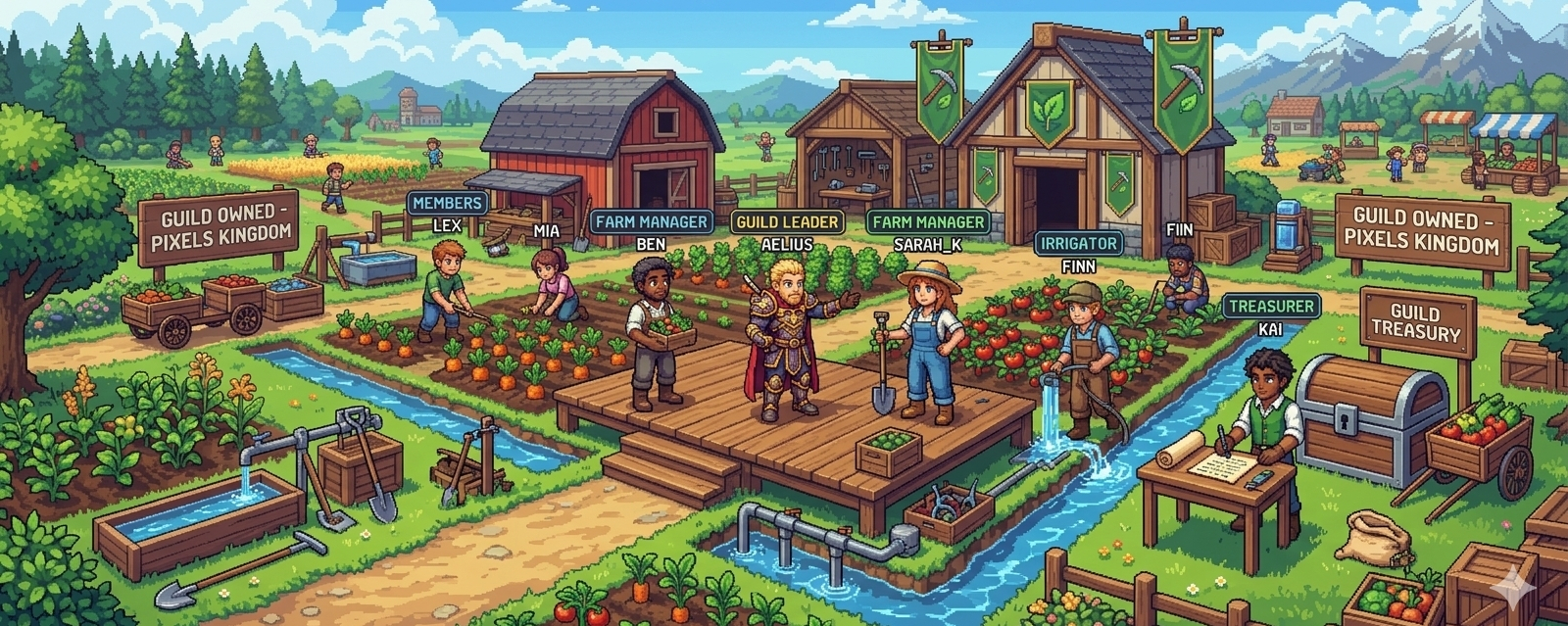
What makes Pixels feel more organized than most Web3 games is not simply the fact that it has guilds. Plenty of games have guilds. The difference is that Pixels actually gives them a job inside the game world. In most Web3 titles, guilds are mostly social wrappers. They exist in Discord, Telegram, or private group chats, while the real game continues without them. Pixels does something smarter. It brings part of that structure into the game itself, and that changes the whole feel of the experience.
That matters because one of the biggest weaknesses in Web3 gaming has always been coordination. A lot of projects talk about community like it is enough on its own. It is not. Community without structure usually turns into noise. The loudest people take control, the most committed players do most of the work, and everyone else just floats around with no clear place in the system. That is where Pixels feels different. It gives social groups more shape, and because of that, the world feels less chaotic.
A big reason is that Pixels does not treat every kind of involvement the same. Most Web3 games are too loose with this. If you hold something, join a server, or show up once in a while, you are treated like part of the group. But real communities do not work like that. There is always a difference between someone who supports a guild, someone who belongs to it, and someone the group actually depends on. Pixels seems to understand that. It creates layers inside guild life, and that alone makes the whole setup feel more believable.
That may sound like a small detail, but it changes everything. Once a game allows a guild to separate casual supporters from active members, the group starts to feel more real. It becomes easier to build trust. Easier to assign responsibility. Easier to reward people who actually contribute. Most Web3 games skip this part and go straight to the language of ownership and community, but ownership without trust does not create order. It just creates loose affiliation.
Pixels gets closer to real online behavior. In any functioning group, some people are just around, some are reliable contributors, and a few are responsible for keeping things running. When a game reflects that reality, the social layer becomes stronger. It stops feeling decorative. It starts feeling useful.
That is why the role system matters so much. Guild roles in Pixels are not just titles sitting on a profile. They create a sense of internal structure. A group can promote people, delegate control, and define who has more responsibility. That gives the guild a backbone. Instead of everyone being technically equal while unofficial power decides everything behind the scenes, the game gives that structure a visible form. It is easier for players to understand where they stand and what they are working toward.
This is where a lot of Web3 games lose the plot. They want to look open and player-owned, so they avoid putting too much structure into the system. But what usually happens is not openness. It is confusion. Players do not know who is responsible. Leaders cannot manage growth properly. Trust becomes personal instead of systemic. The result is a social layer that feels unstable. Pixels does not solve every part of that problem, but it clearly tries to.
The connection between guild roles and land is another reason the game feels more organized. In many Web3 projects, land exists mostly as an asset. It is there to be owned, shown off, and maybe monetized later. Pixels gives land a more practical social function. Once access to space can be connected to guild structure, roles start to mean something. They are no longer cosmetic. They affect who can enter, who can work, who can participate, and who can help manage shared activity. That makes the whole world feel more grounded.
This is one of the strongest choices in the design. A social system becomes believable when it changes actual behavior. If being part of a guild changes what you can do in the world, then the guild has substance. It is no longer just a banner over your name. It becomes a real unit inside the game. Players can feel the difference immediately because structure is no longer abstract. It lives in access, permissions, and responsibility.
That practical side is what sets Pixels apart from the usual Web3 approach. Too often, games in this space talk about guilds like they are building nations, economies, or digital societies, but the actual mechanics do not support any of that. The guild is mostly branding. The game expects players to organize themselves with outside tools, and then pretends that counts as worldbuilding. Pixels feels more mature because it at least tries to put some of that operating system on chain and in game.
There is also something important about commitment here. In many tokenized games, joining a group costs almost nothing in social terms. You can join ten communities, pretend to belong to all of them, and leave the moment incentives weaken. That makes group identity shallow. Pixels makes alignment more deliberate. That creates more seriousness around belonging. It does not magically create loyalty, but it does reduce the empty feeling that comes from people claiming affiliation with no real commitment behind it.
That matters more than many people realize. Web3 gaming has spent years struggling with fake community density. Games show high member counts, active channels, and strong social branding, but under the surface the bonds are weak. Players are there for opportunity, not for shared purpose. The moment the rewards fade, the social layer collapses. Pixels seems to be pushing against that pattern by making guilds function as systems of coordination, not just clusters of attention.
The treasury angle also adds weight to the whole setup. When a guild has some economic center and some internal logic around who controls what, it starts to feel less temporary. Most Web3 communities speak like long-term organizations, but behave like short-term farming groups. Pixels feels like it wants guilds to become more stable than that. Shared incentives, defined roles, and clear access rules do not just create order. They create durability. They give the group a reason to keep existing beyond a single market cycle or event.
What I like most is that this design understands something many Web3 projects miss. Good organization is not about making a system feel corporate or rigid. It is about removing friction. People stay in games when they know how to fit in. They come back when their role makes sense. They care more when contribution is visible and belonging has shape. Pixels taps into that instinct better than most. It gives players different ways to matter, and that makes the world feel more lived in.
That is especially important in a game like Pixels, where the surface is casual and inviting. The farming, social loops, and general tone make it easy to read the game as simple. But underneath that, there is a serious design question being explored: how do you make online groups function without turning the experience into pure labor or pure speculation? That is a hard problem, and it is one of the oldest problems in Web3 games. Pixels is interesting because it is not trying to solve it with yield alone. It is trying to solve it with structure.
You can feel that most clearly during group-based events or periods of competition. That is when weak guild systems usually get exposed. A badge and a group chat are enough when nothing is at stake. But once timing, coordination, and trust actually matter, loose communities start to break. Pixels is better prepared for those moments because it already treats guilds like working parts of the world. A player is not just socially connected to a guild. They are functionally tied into it.
There is also a more human reason this works. People like knowing where they belong. Not everyone wants to lead. Not everyone wants to grind the hardest. Not everyone wants to be a passive holder either. Most players want a place they can understand. A role they can grow into. A group where their presence means something. Pixels gives more room for that than many Web3 games do. It lets participation feel layered, which is much closer to how real communities work.
Of course, the system is not perfect. Some parts still feel like a foundation that has more room to grow. Not every role has the same depth yet. Some distinctions are clearer in structure than in day-to-day gameplay. But honestly, that does not bother me much. I would rather see a game build a strong social framework first and deepen it over time than throw around big community language with nothing underneath it. Pixels at least looks like it understands what the missing piece has been.
From the perspective of someone who has watched Web3 gaming repeat the same mistakes for years, that is why Pixels stands out. It is not because guilds are a new idea. They are not. It is because Pixels tries to make guilds functional inside the game rather than symbolic outside it. That is a meaningful difference. It brings more order to the player experience. It makes communities feel less performative. And it gives the world a stronger sense of continuity.
In the end, guild roles make Pixels feel more organized because they turn social presence into structure. They help define trust, access, contribution, and coordination in ways most Web3 games still avoid. That may not sound flashy, but it is exactly the kind of design choice that gives a game staying power. In a space full of noise, that kind of clarity is rare.
I can also make this even more natural and emotional, like it was written by a real crypto gamer reflecting from experience.