I used to think a game died when the chart did. That was the rule. Aggressive incentives, speculative frenzy, then a token price that faltered and a player base that evaporated overnight. The ghost town wasn't a bug in Web3 gaming—it was the final frame of every cycle I'd ever watched. Infrastructure left standing. Soul gone. I assumed Pixels would follow the same arc. When the loud narratives faded and the token didn't look particularly strong, I waited for the empty fields.
They never came. People were still logging in. Still adjusting how they engaged. Still tending land that the market had forgotten to care about.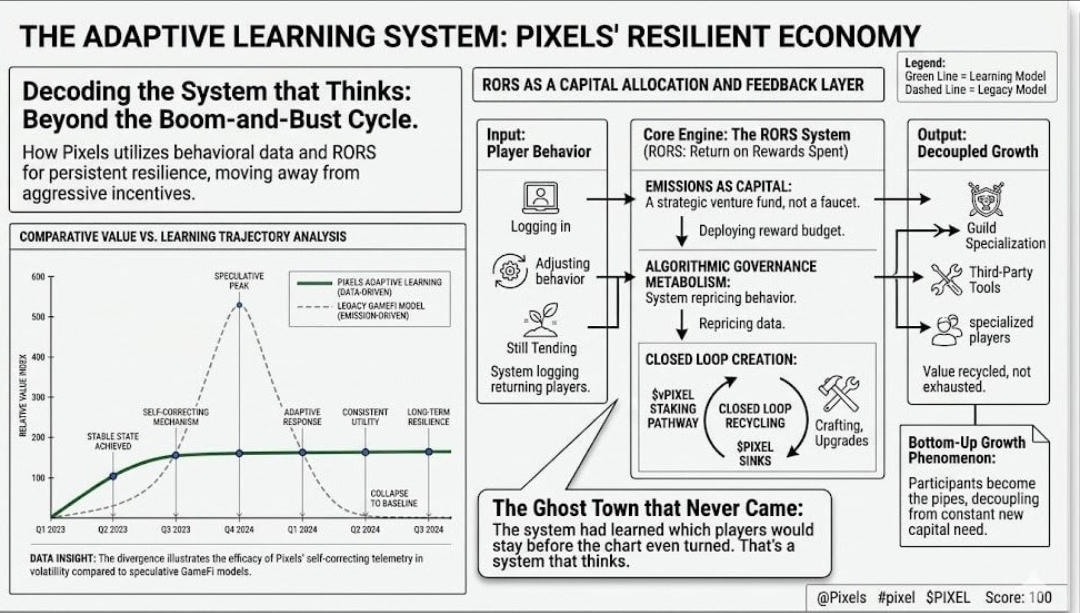
That's when I realized I was watching something that didn't fit the template. The economy wasn't surviving because the incentives were aggressive. It was surviving because the system had learned to value something other than price action. And I had been too busy watching the chart to notice.
The players who stayed through the quiet weren't the ones optimizing yield. They were the ones whose behavior had already been logged, already been measured, already been recognized by a model that knew they'd return before they did. Pixels wasn't retaining them with rewards. It was retaining them with a form of attention that no other Web3 game I'd seen had the patience to build. The system wasn't just watching who stayed. It was learning what staying looked like, and adjusting its own weight distribution around that shape.
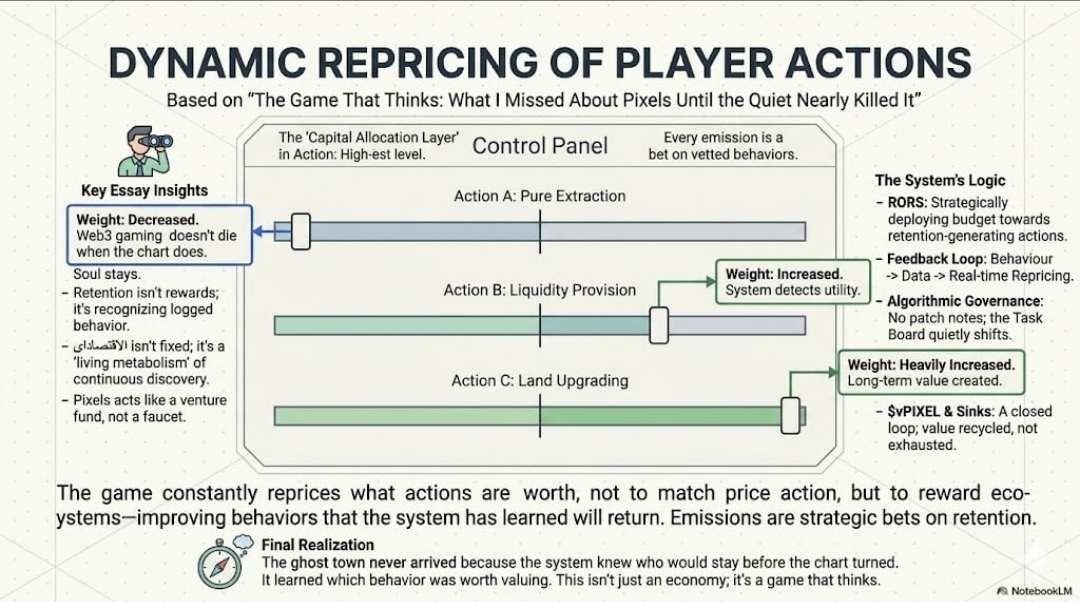
This is where the language most people use breaks. They call it "retention." They call it "community." But what's actually happening is closer to an adaptive learning system—a structure that treats economic stability not as a fixed target but as a continuous process of discovery. The game isn't balanced once and left to run. It's constantly repricing what behavior is worth, based on data generated by the behavior itself.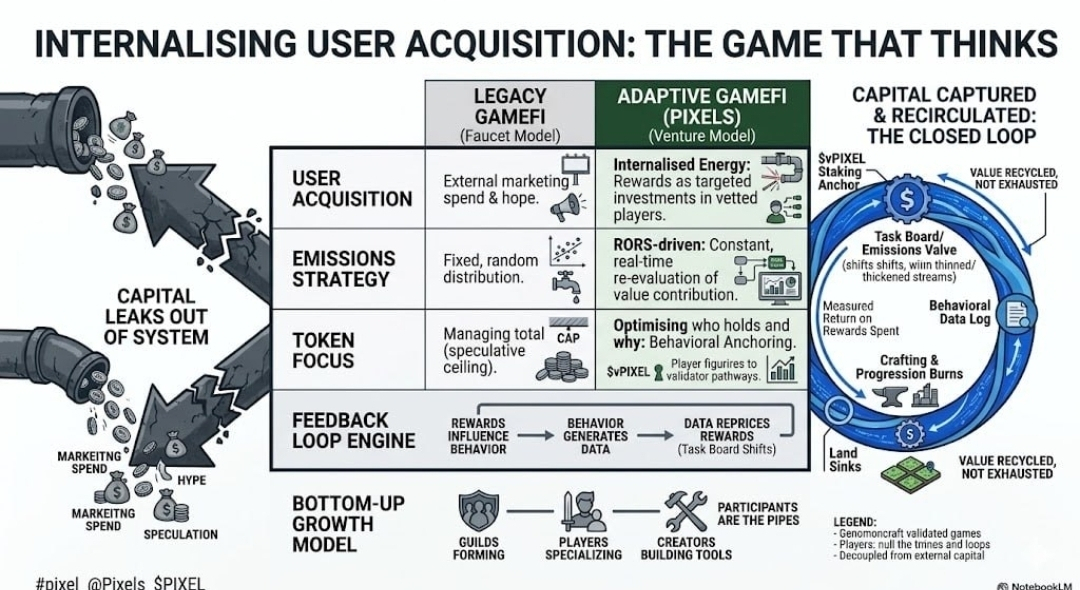
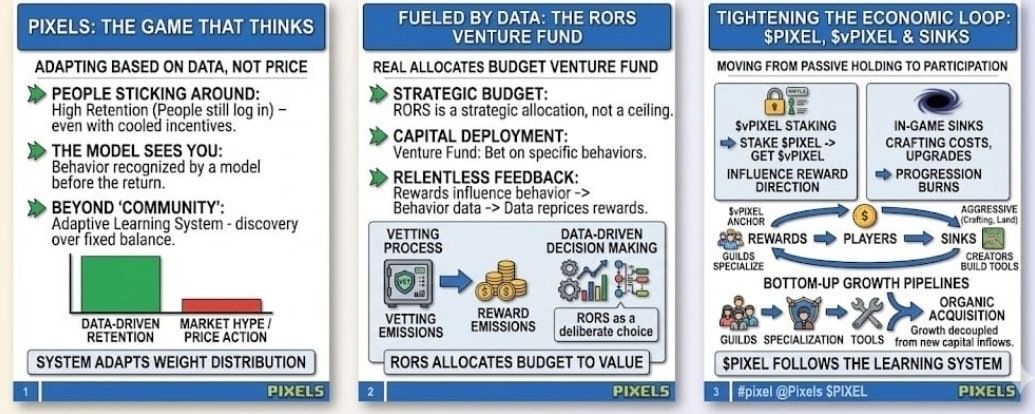
RORS is the engine behind this, but I misunderstood it for months. I thought it was a reward cap. A ceiling. A way to stop the economy from leaking. That's the surface. Underneath, RORS is a capital allocation layer. Every token emitted isn't a giveaway—it's a bet. A strategic deployment of budget toward specific behaviors that have already demonstrated a return in the form of retention, liquidity, or ecosystem contribution. Traditional GameFi treats emissions like a faucet. Pixels treats them like a venture fund. The difference is the difference between spraying capital into the wind and investing it in assets you've already vetted.
The feedback loop this creates is relentless. Rewards influence behavior. Behavior generates data. The data reprices the rewards in real time. If an activity becomes oversaturated or stops contributing to the broader economy's health, the system quietly loses weight on it. No announcement. No patch notes. The Task Board just shifts. The rewards thin. The incentives drift toward whatever is currently producing the kind of engagement the model has learned to value. It's algorithmic governance, but not in the voting sense. In the sense of a living system that adjusts its own metabolism based on what it consumes.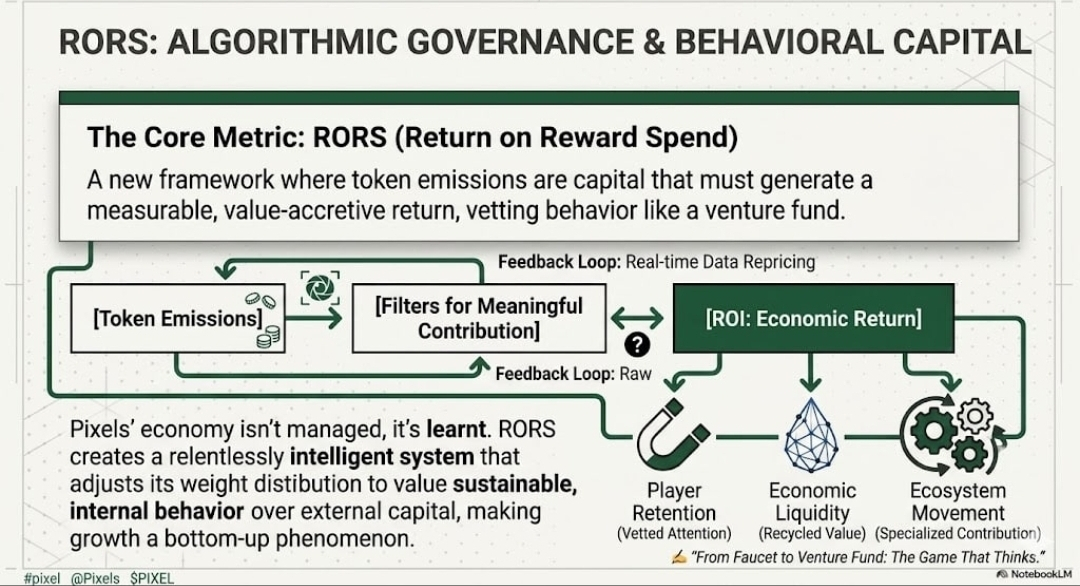
PIXEL fits into this not as a staking utility but as a behavioral anchor. The token holder stops being a spectator. Staking locks their weight into a specific validator pathway, which routes the reward budget toward the games and loops they've chosen to back. But the system only functions if the resulting economy is tight. Without aggressive sinks—crafting costs, progression burns, land upgrades—the tokens would leak faster than they could circulate. PIXEL combined with those sinks creates a closed loop. Value recycled rather than exhausted. The token stops being the lead singer and becomes the rhythm section, following the melody of the system's learning.
What emerges from all of this is a distribution model that doesn't require external marketing. Growth becomes a bottom-up phenomenon. Guilds form. Players specialize. Creators build third-party tools. The participants themselves become the pipes through which the economy expands. That decouples growth from the constant need for new capital inflows. The game begins to expand through the sheer momentum of its own internal behavior.
I don't think this is solved. The risks remain. If the system misreads what constitutes valuable behavior, or if emissions outpace its ability to adapt, the structure weakens. But the bet Pixels is making is that it can improve its understanding of player behavior faster than it distributes rewards. If that bet holds, it moves beyond the traditional boom-bust cycle entirely.
The ghost town never arrived. Not because the market cooperated. Because the system had already learned which players would stay before the chart even turned. That's not a static economy. That's a game that thinks.
And I'm still watching. Not for the token. For what the system has already decided about me.