
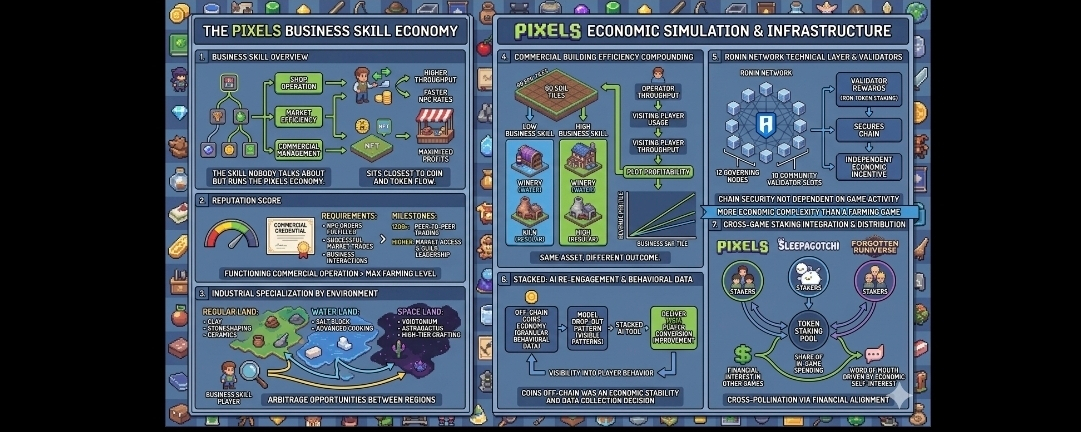
The Skill Nobody Talks About Is the One That Actually Runs the Pixels Economy
I want to talk about Business skill
Not Farming
Not Cooking
Not the skill trees that every beginner guide pushes new players toward in their first week
The Business skill is the one that separates players who participate in the Pixels economy from players who actually understand how it moves
And almost nobody writes about it seriously
The Business skill tree governs a players ability to run shops operate market stalls and manage commercial interactions within the game world at efficiency levels that raw farming output never reaches
A player with high Business skill processes marketplace transactions faster negotiates better rates with NPC vendors and operates commercial buildings on NFT land at higher throughput than a player who treated Business as an afterthought
The ten skill trees in @Pixels are not equal in how they connect to the underlying token economy and Business skill sits closest to the actual flow of Coins and tokens through the system
Most players grind Farming because they can see the crops growing
The players running the economy grind Business because they can see something less visible
The commercial building system on NFT land is where Business skill expression becomes architecturally significant
A large NFT plot supports 4 industry buildings that the landowner can configure for their own production or open to visiting players who want to use facilities they dont have on their own plots
A winery on Water environment land draws Watermint that only Water plots produce
A kiln on Regular land processes Clay that only Regular plots generate
When a landowner with high Business skill operates these facilities the throughput efficiency difference versus a low Business skill operator compounds across every player who visits that land to use those buildings
The landowner who optimized Business skill is running a more profitable commercial operation on the same 60 soil tile plot as a landowner who didnt
Same asset
Different outcome based on skill investment
The Reputation Score system connects to Business skill in a way that creates what I would describe as a commercial credentialing pathway inside the game economy
Every NPC order fulfilled every successful marketplace trade and every business interaction adds to the Reputation total that gates full economic participation
New accounts need 1200 Reputation points before peer to peer trading opens
Higher thresholds gate marketplace access and guild leadership roles
A player who combines high Business skill with high Reputation Score has built the closest thing to a business license that exists inside a browser farming game
That combination is what I think the endgame actually looks like for serious players
Not max level Farming
A functioning commercial operation inside a living economy
The industrial specialization across the three environment types creates genuine regional economic identity that Business skill players exploit more effectively than anyone else
Regular environment land exclusively produces Clay which the Stoneshaping and ceramics crafting chains require throughout the mid and late game
Water environment land generates Salt Block which the Cooking skill trees higher recipes need in quantities that free players on Speck plots cannot easily source
Space environment land yields Voidtonium and Astracactus which represent the highest tier resource inputs in the entire crafting system
A Business skill player who understands these regional dependencies positions themselves in the gaps between regions rather than competing within any single one
Arbitrage inside a farming game
That sentence sounds absurd until you watch someone actually doing it
But the thing that keeps me honest about this project even when Im impressed by these mechanical layers is the question of who the system is actually designed to reward at scale
The 5000 NFT landowners collect passive resource surpluses from players farming their plots
The players with the most tokens staked into the cross game ecosystem capture the largest share of redistribution from new participant spending
The players with the highest Business skill started building that skill when the game was less competitive and the optimal strategies were less understood
Every layer of the economy rewards the people who arrived earlier and understood it faster
Not a criticism necessarily
Just a description of how incumbent advantages work in any economy digital or otherwise
The Ronin Network technical layer underneath all of this is something I want to approach from the validator economics angle rather than just the performance metrics I have covered before
The 22 validators on Ronin earn RON token staking rewards for securing the network
The 10 community validator slots that Sky Mavis opened beyond the 12 governing nodes created a competitive validation market where community participants earn returns for providing network security
This validator reward structure means that Ronin has a distributed economic incentive layer securing the chain that is independent from any single game built on top of it
When Pixels has a slow month the validators keep validating because their rewards come from the chain not from any individual game
Chain security that doesnt depend on game activity is infrastructure design done correctly
The Stacked platform deserves analysis from an angle I havent used before which is what it reveals about the teams understanding of their own churn problem
An AI powered re-engagement tool that delivers 178 percent improvement in player conversion for lapsed accounts exists because the team has detailed data on exactly when and why players stop logging in
They built Stacked because they could see the dropout pattern clearly enough to model it
And they could see the dropout pattern clearly enough to model it because the off chain Coins economy generates granular behavioral data that a pure on chain token system would never produce
The decision to make Coins off chain was framed as an economic stability measure
It was also a data collection decision that gave the team visibility into player behavior that most Web3 gaming studios are completely blind to
I find that detail more interesting than almost anything else about this project
The cross game staking integration with Sleepagotchi and The Forgotten Runiverse is building something that I dont think the community fully appreciates yet
When players stake tokens into a specific game and earn a share of that games in game spending the stakers become financially interested in the success of games they may have never played
A Pixels farmer who staked tokens into Sleepagotchi has a reason to tell people about Sleepagotchi
A Sleepagotchi player who staked into Pixels has a reason to try farming
The staking model is creating cross pollination between player communities through financial alignment rather than through marketing campaigns
Word of mouth driven by economic self interest is the most effective distribution channel that exists
The team stumbled into building it through a staking feature
My overall read on $PIXEL in April 2026 is that the project has more economic complexity running underneath its pixel art exterior than almost anyone covering it has taken the time to map seriously
The Business skill tree and the regional resource specialization and the commercial building system and the Stacked behavioral data layer and the cross game staking distribution model are all pieces of something that reads more like an economic simulation than a farming game
Whether the token price ever reflects that complexity is a different question entirely
Monthly vesting pressure and an undelivered mobile client are still the loudest voices in the room for anyone holding tokens rather than just playing the game
But the complexity is real
And complexity that serves players rather than just extracting from them is worth acknowledging honestly even when the chart makes it hard to say
