
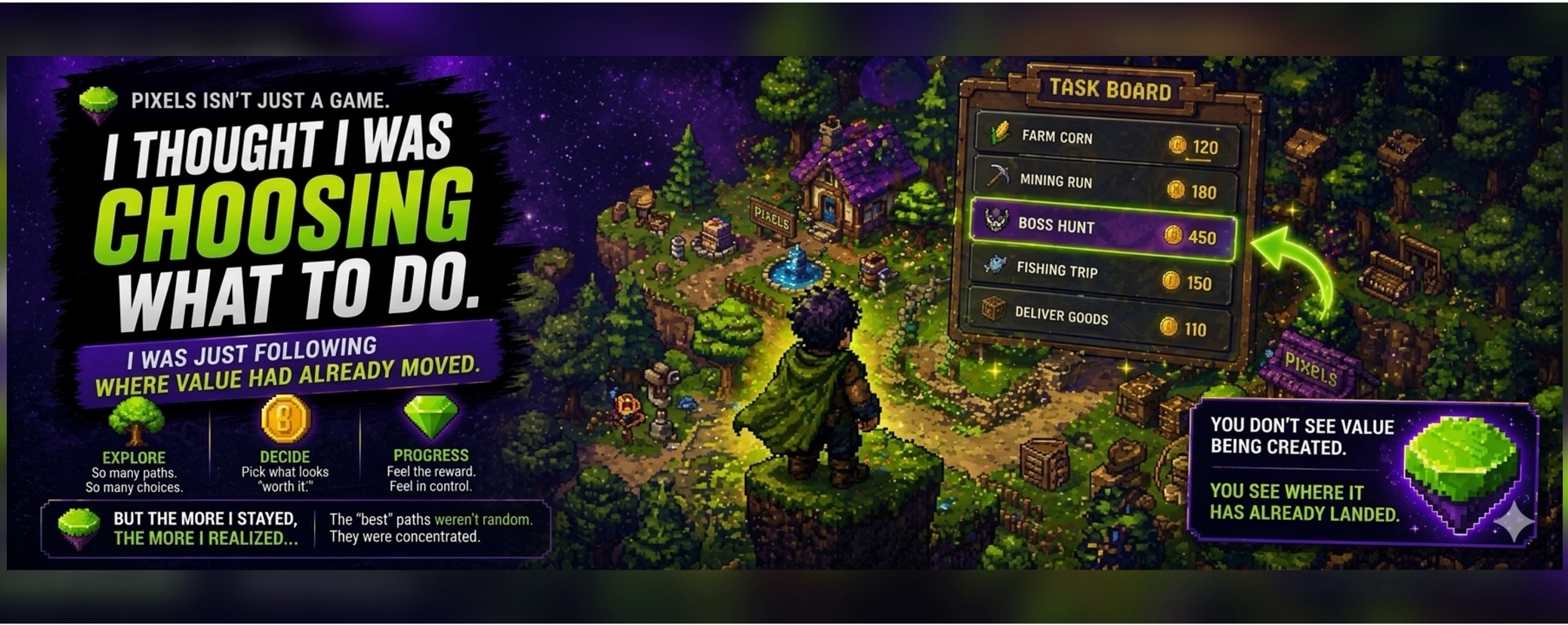


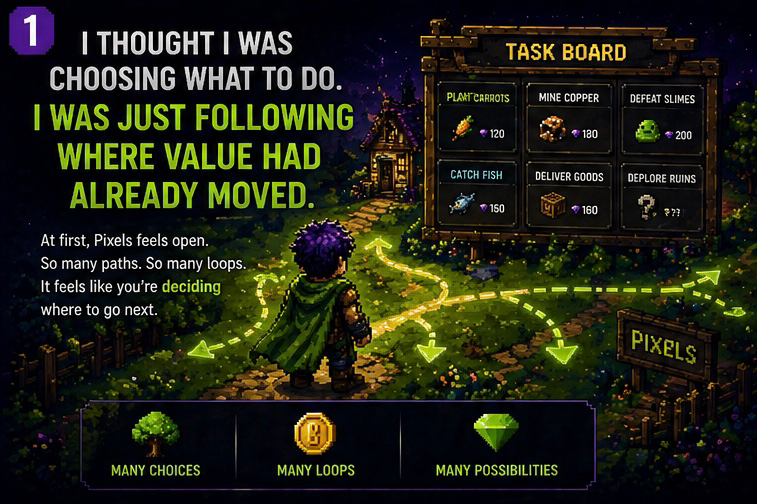
 At first, Pixels feels open.
You log in, look at the Task Board, and it seems like you have options. Different paths, different loops, different ways to move through the day. It gives you the impression that you’re deciding where to go next. That the game is reacting to you, unfolding based on what you choose to do.
And for a while, I believed that.
I would scan the board, pick what looked “worth it,” and move. Some routes felt better than others. Some days felt heavier, more rewarding, more alive. It all felt like a result of timing, or maybe just better decisions.
But the longer I stayed, the less that explanation held.
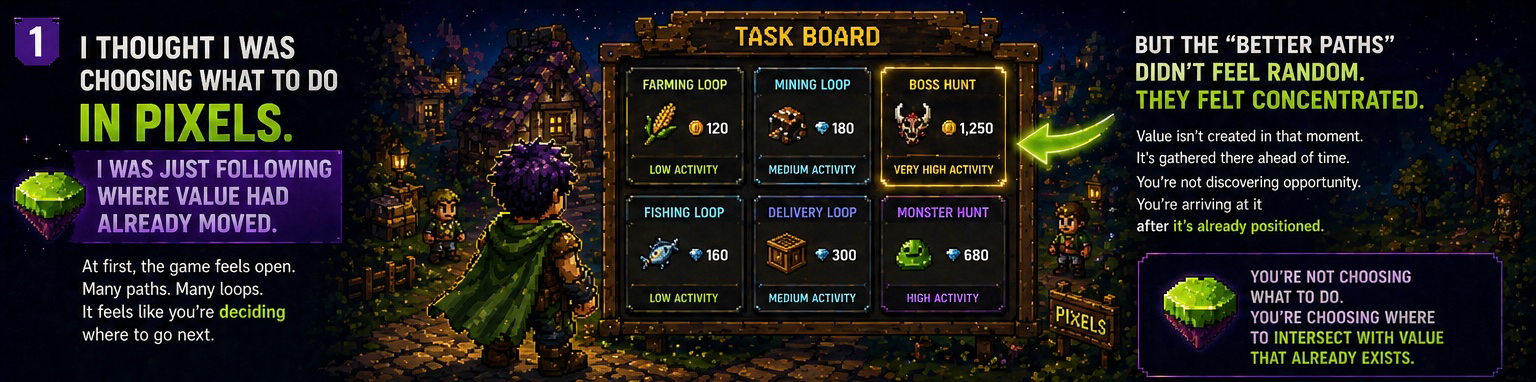
Because the “better paths” didn’t feel random.
They felt… concentrated.
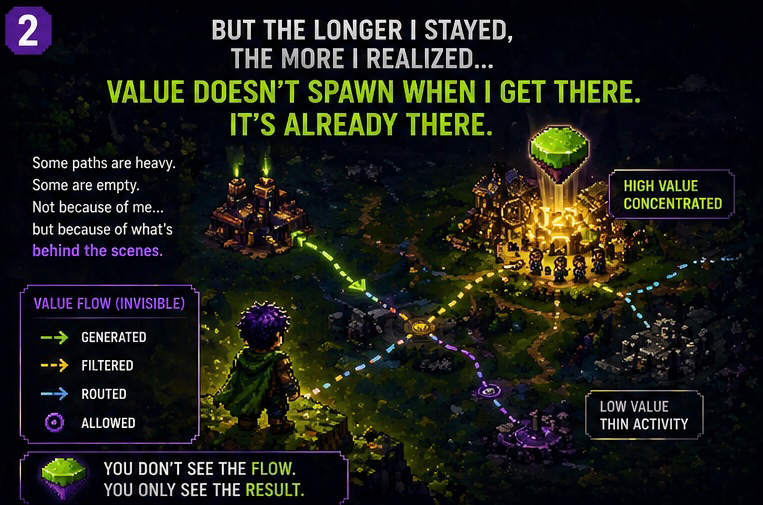
Like value wasn’t being created in those moments, but gathered there ahead of time. Like I wasn’t discovering opportunity, I was arriving at it after it had already been positioned.
That’s a subtle difference, but once you notice it, it changes everything.
Because if value is already sitting somewhere before you get there, then what you’re really doing isn’t choosing what to do.
You’re choosing where to intersect with something that already exists.
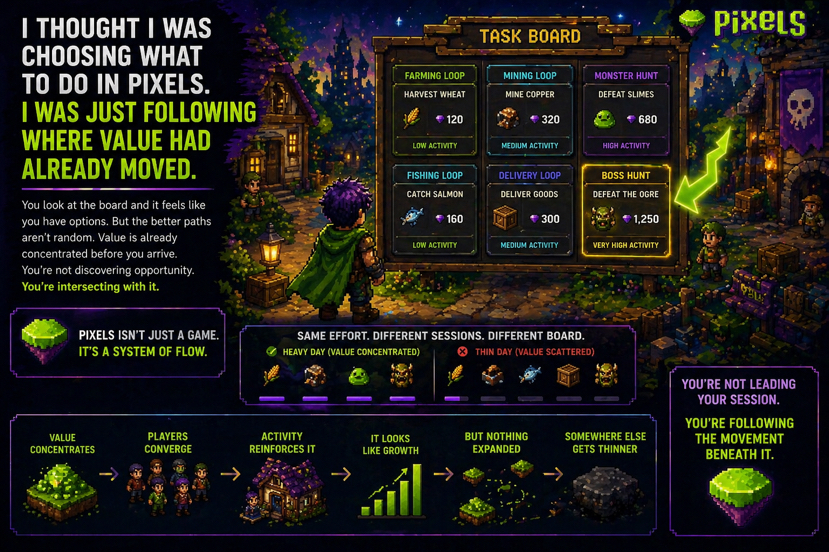
And that starts to explain why some sessions feel completely different even when nothing about you changes.
Same farm. Same routes. Same effort.
But the board feels heavier one day, thinner the next.
At first, I tried to explain that through gameplay.
Maybe I optimized better. Maybe I moved faster. Maybe I understood the system more clearly.
But eventually, that story stopped making sense.
Because nothing I did could consistently reproduce those “good” sessions.
They didn’t feel earned in a mechanical way.
They felt… aligned.
Aligned with something outside of me.
That’s when the idea started to shift.
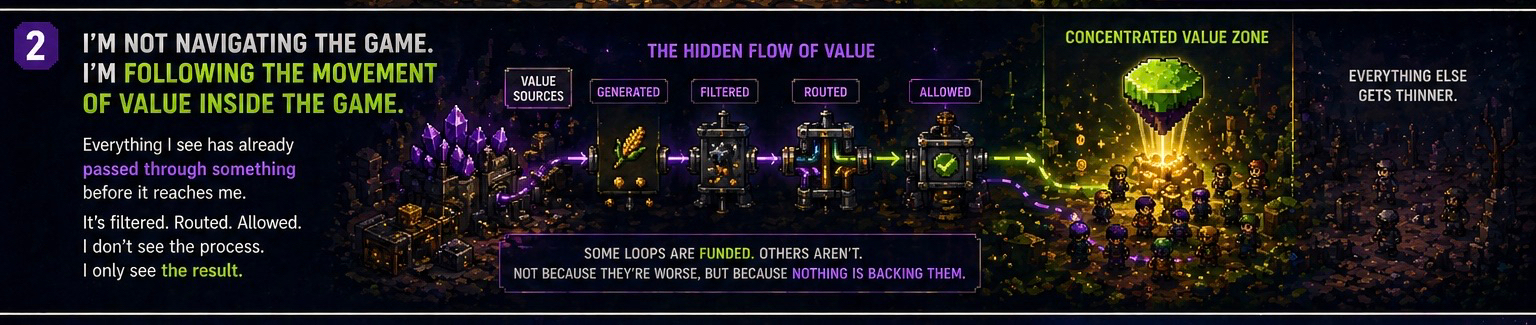
What if I’m not actually navigating the game?
What if I’m navigating the movement of value inside the game?
Because the more I pay attention, the more it feels like everything I see has already passed through something before it reaches me.
Not just generated, but filtered. Routed. Allowed.
Some loops carry weight because something behind them is funding them. Others don’t, not because they’re worse, but because nothing is backing them in that moment.
And I don’t see that process happening.
I only see the result.
So when I land on a “good” board, it feels like I made the right choice.
But what if I just arrived where value had already been pushed?
That would mean I’m not leading my session.
I’m following it.
Following where reward has already been concentrated, where the system has already decided it can afford to let value pass through.
And once you look at it that way, behavior starts to look different.
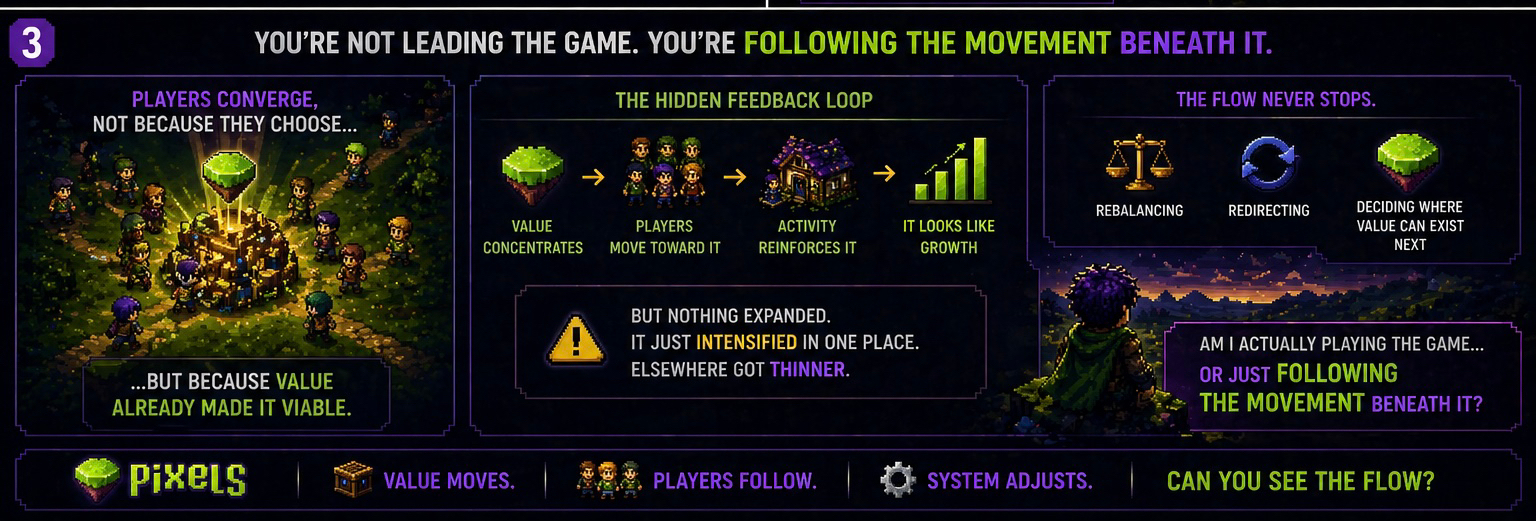
Players don’t spread out randomly.
They converge.
They move toward the same pockets of activity, the same loops that feel alive, the same places where things seem to “work.”
But maybe those places don’t work because players chose them.
Maybe players chose them because they were already working.
Because something beneath the surface had already made them viable.
That creates a feedback loop that’s hard to see from the inside.
Value concentrates → players move toward it → activity reinforces it → it looks like growth.
But nothing actually expanded.
It just intensified in one place.
And something else, somewhere else, got thinner at the same time.
That part is invisible.
You don’t see the loops that didn’t receive anything.
You don’t feel the paths that never had weight to begin with.
You only see where things landed.
Which makes it very easy to believe you’re making good decisions.
When in reality, you might just be following where decisions were already made.
And that changes how I think about effort.
Because if value is already moving underneath the system, then grinding more doesn’t necessarily create more opportunity.
It just increases the chance that you intersect with where that value currently is.
Not “do more, get more.”
More like “be present where something is already happening.”
That’s a very different kind of dynamic.
And it’s also why nothing feels fully stable.
Even the best sessions don’t feel permanent.
They feel temporary, like moments where everything aligned just enough for value to pass through.
And then it shifts again.
Quietly.
Without announcement.
Without explanation.
And you’re left trying to figure out what changed.
Was it you?
Or did the flow move somewhere else?
That question doesn’t have a clean answer.
Because from the inside, everything still looks the same.
Same board. Same loops. Same actions.
But underneath, something is constantly adjusting.
Rebalancing.
Redirecting.
Deciding where value can exist next without breaking the system that holds it all together.
And if that’s true, then the game isn’t something you control.
It’s something you track.
Not directly, not consciously, but through feel.
Through where things seem to “work.”
Through where effort turns into something real.
And maybe that’s the part that’s hardest to accept.
Because it means you’re not really choosing where to go.
You’re responding to where value has already gone.
And every time you think you found a good path, there’s a chance you’re just arriving after the system already decided it was one.
Which leaves one question sitting there longer than it should.
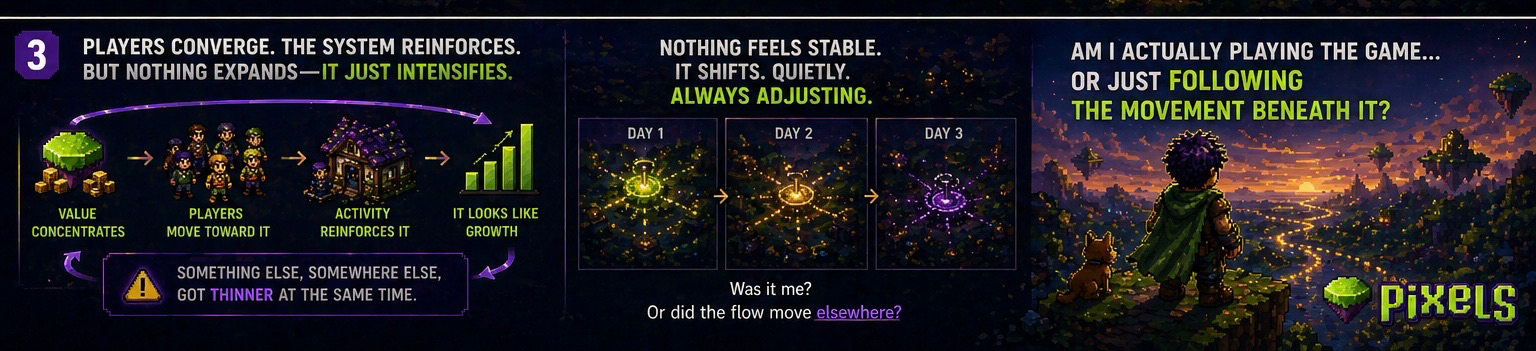
Am I actually playing the game…
or just following the movement beneath it?