

The world of prediction markets has always sold itself on one core promise: truth through incentives. Instead of relying on opinions, headlines, or emotional narratives, these platforms allow users to place money behind what they believe will happen. In theory, people with better information win, and markets become highly efficient tools for forecasting real-world outcomes.
But what happens when that “better information” isn’t research, insight, or analysis — but allegedly classified government intelligence?
That question exploded into public debate after reports surfaced that a military service member was charged in connection with alleged insider trading tied to activity on Polymarket, one of the world’s most recognizable crypto-based prediction platforms. Prosecutors claim the accused used sensitive nonpublic information to place bets ahead of major geopolitical developments, generating roughly $400,000 in profits.
If true, the case could become one of the most important legal moments in the history of decentralized prediction markets.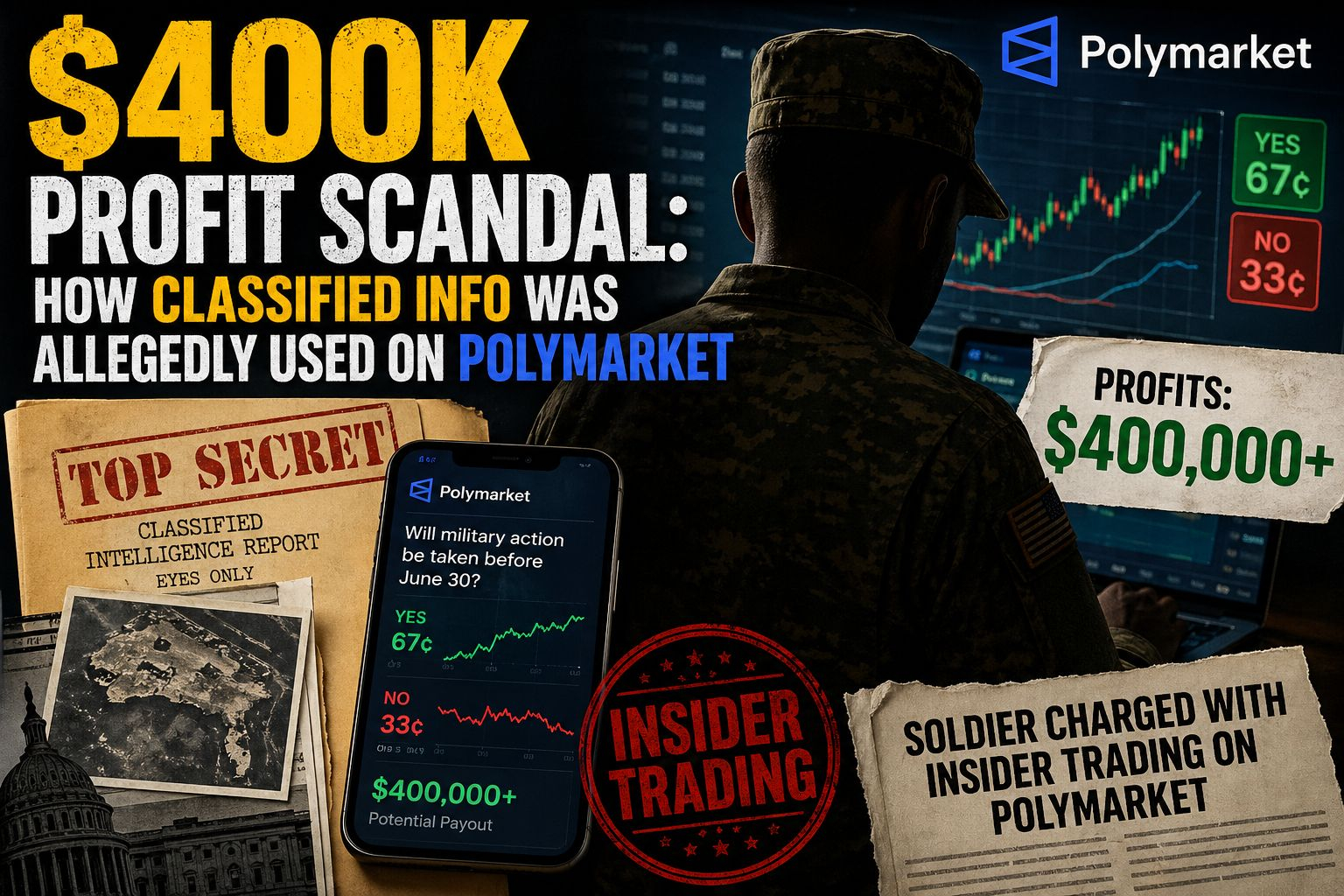
What Is Polymarket and Why Does It Matter?
Polymarket has grown rapidly by allowing users to trade on real-world outcomes. Markets range from elections and interest rates to wars, sports, regulation, and breaking global events.
Users buy shares in “Yes” or “No” outcomes, with prices reflecting perceived probability. If an event happens, winning shares pay out at full value.
This model has made prediction markets increasingly popular because they often react faster than traditional media or analysts. Traders constantly price in new data, rumors, sentiment, and trends.
That speed is exactly what makes this scandal so serious.
Because if someone with access to classified information enters the market, they can potentially exploit global events before the public even knows something is happening.
---
The Allegations: Using Secrets for Profit
According to accusations tied to the case, the service member allegedly used access to restricted intelligence related to international developments and military planning.
Instead of simply holding that information, prosecutors claim they used it to trade on Polymarket contracts connected to those outcomes.
Examples of the kind of markets involved could include:
Whether a military strike would occur
Whether sanctions would be announced
Whether a government leader would resign
Whether a conflict would escalate
Whether diplomatic talks would collapse
By entering positions before public confirmation, the accused allegedly gained a massive edge over ordinary traders relying only on news reports and public signals.
Authorities say the strategy resulted in approximately $400,000 in profits.
That number is more than just a headline figure — it represents how valuable early information can be when markets move instantly.
LWhy This Case Is Different From Normal Trading
Many people hear “insider trading” and think of stocks.
For example:
A CEO knows earnings will beat expectations
An employee leaks merger news
A banker tips a friend before a deal closes
But this case expands the concept into a newer arena: event-based markets.
Prediction markets don’t trade companies. They trade probabilities tied to future outcomes.
That means insider information could involve:
National security events
Election data
Regulatory decisions
Court rulings
Economic policy moves
If courts and regulators pursue this aggressively, it may redefine how insider trading laws apply beyond Wall Street.
That’s a huge development.
---
Why Traders Are Paying Attention
Anyone active in crypto or speculative markets understands one truth:
Speed wins.
Markets move hardest when information first becomes known. Once headlines hit social media, much of the opportunity is already gone.
So when a trader allegedly possesses secret intelligence, they aren’t just slightly advantaged — they may be operating with near-perfect timing.
That damages confidence in the fairness of the platform.
Retail users begin asking:
Was price action natural?
Were certain moves manipulated?
Are some markets dominated by insiders?
Can ordinary traders ever compete?
Those questions matter because trust is everything in prediction markets.
The Bigger Risk for Polymarket
Even if a platform had no involvement in wrongdoing, major scandals create pressure from regulators, media, and users.
Polymarket now faces broader questions such as:
1. Surveillance and Monitoring
How should suspicious trading activity be flagged?
If a user consistently profits before geopolitical shocks, should accounts be reviewed?
2. KYC and Identity Controls
Should prediction markets require stronger identity verification for sensitive markets?
3. Market Limits
Should users be restricted from betting on certain national security events?
4. Regulatory Classification
Are these markets entertainment products, financial instruments, or something new entirely?
Those debates were already happening. This case may accelerate them dramatically.
My Honest Take
I’ve watched markets long enough to know this pattern repeats everywhere.
Whenever there is money tied to information, someone will try to monetize an unfair edge.
Stocks saw it. Sports betting saw it. Crypto saw it.
Prediction markets were never going to be immune.
The real test isn’t whether abuse can happen — it’s whether platforms can detect it, deter it, and preserve fairness after it happens.
That’s where serious infrastructure matters.
---
What This Means for the Future of Prediction Markets
This scandal may actually strengthen the industry in the long run if it forces better standards.
Possible next steps across the sector:
Stronger compliance systems
Real-time anomaly detection
Cooperation with law enforcement
Better market design for sensitive events
Clearer legal frameworks globally
If that happens, prediction markets could emerge more credible than before.
But if platforms ignore trust issues, growth could slow fast.
---
A Lesson for Retail Traders
There’s another angle here many people overlook.
Retail traders often assume markets are pure charts and sentiment. But in many markets, information asymmetry still dominates.
That means risk management matters more than ego.
Sometimes the move against you isn’t “manipulation” in a cartoon sense — it may simply be that someone knows more than the crowd.
That’s uncomfortable, but real.
---
Final Thoughts
The alleged $400K Polymarket insider trading case is bigger than one person or one platform.
It’s a warning shot for the entire future of event trading.
Prediction markets promise efficiency, transparency, and crowd intelligence. But those promises only hold if participants believe the game is fair.
If classified information was truly used for profit, regulators will respond, platforms will adapt, and users will demand stronger protections.
Because no matter how innovative the market structure is, one rule never changes:
When trust disappears, liquidity follows.#SoldierChargedWithInsiderTradingonPolymarket