

I started noticing something before I could clearly explain it
Everything seemed to work on the surface in a way that felt intentional and stable, yet underneath that smoothness there was a subtle imbalance that was difficult to name but hard to ignore once it settled in
The loops were smooth, the actions made sense, and the world responded in ways that felt consistent with its design, yet there was a quiet sense that not all movement inside it carried the same kind of weight or consequence over time
At first it is easy to remain at the surface level of experience without questioning much
You move through land, you plant, you harvest, and you complete small cycles that feel contained, predictable, and almost self-sufficient in the way they reward your presence
Coins accumulate in a way that feels immediate and reassuring, almost as if every action is being acknowledged and returned without delay or resistance
Nothing feels broken, nothing feels misleading, and nothing pushes back hard enough to create doubt in the early stages
In fact, it feels carefully designed to remove friction and maintain a sense of continuity that keeps you moving forward without interruption
And maybe that is where the first layer of discomfort begins to emerge quietly
Because when everything flows too easily, it becomes harder to notice what is not flowing at all beneath that surface
Over time, I began to see that activity inside Pixels does not translate evenly into retained value, even when the effort appears identical
Two players can move through nearly identical loops, spend the same number of hours, and repeat the same patterns, yet still arrive at outcomes that begin to diverge in subtle but important ways
Not in obvious or immediate terms, but gradually, where one path starts to accumulate something more persistent while the other seems to dissolve quietly back into the system without leaving much behind
Effort remains visible everywhere in the system and is constantly reinforced through feedback loops
But value, especially the kind that persists, is far less visible and far more selective in how it is distributed
That gap is subtle enough to ignore at first, but consistent enough to shape behavior over time in ways that are not immediately obvious
It creates a quiet separation between those who are simply engaging with the game as it presents itself and those who begin to interpret the system beneath it
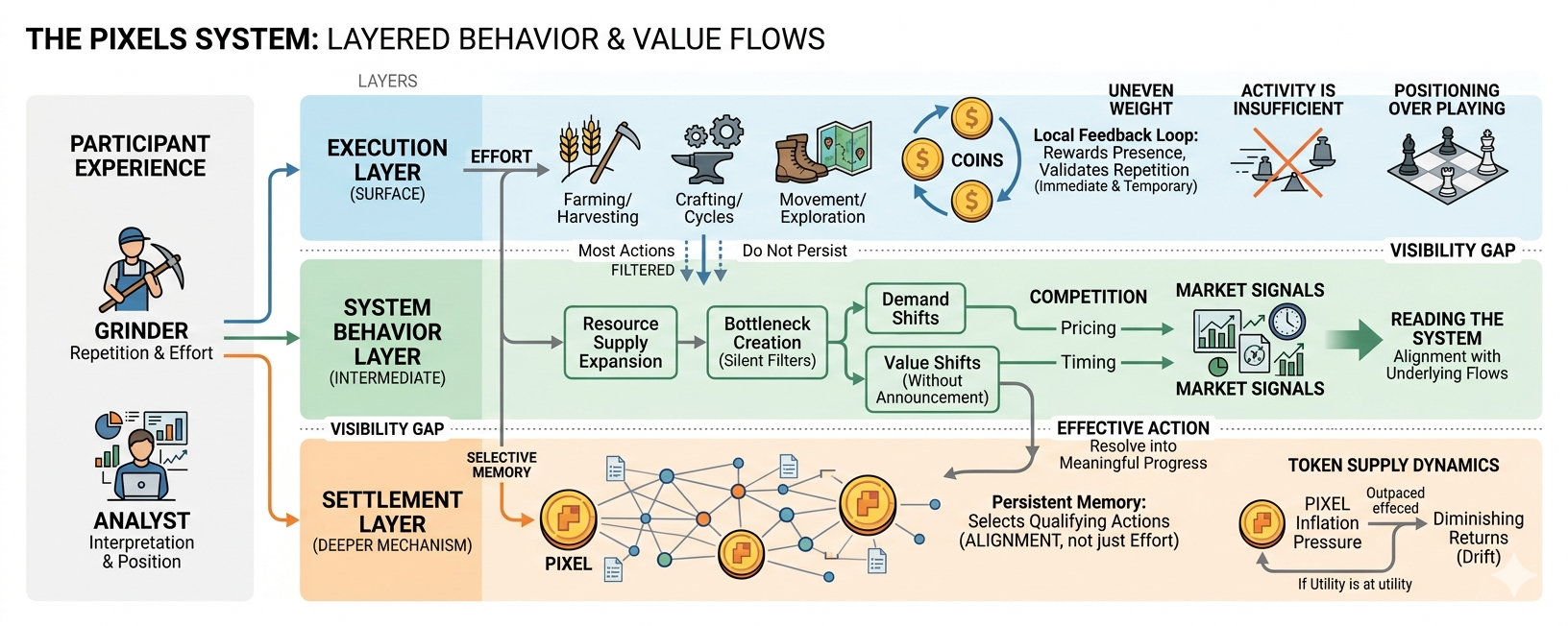
The visible layer remains grounded in familiar mechanics like farming, exploration, and small acts of progression that reinforce a sense of continuity and control
Coins function as a local feedback loop that rewards presence, validates repetition, and encourages continued interaction within a contained environment
But Coins do not travel very far beyond that immediate loop
They circulate within a limited layer, a kind of execution space where actions are processed and acknowledged, but not necessarily finalized into something lasting
Somewhere beyond that layer sits something else, less visible but more consequential
A deeper mechanism tied to PIXEL that does not respond to every action in the same way or with the same weight
This is where the system begins to feel less like a neutral game and more like an environment with selective memory
Not everything that happens is recorded equally, and not every action qualifies for persistence in the same way
And the criteria for what qualifies is not always explicit or easy to trace from the surface
It becomes less about what you do in isolation and more about how your actions align with underlying flows that are not immediately visible
In that sense, gameplay begins to resemble an execution layer where activity is generated, processed, and cycled continuously
While PIXEL begins to resemble a settlement layer where only certain actions resolve into something that carries forward and accumulates over time
The distinction is not enforced through direct restriction or limitation
It is enforced through quiet filtering that does not interrupt you but also does not reward everything equally
Most actions do not fail in a traditional sense
They simply never reach the layer where they begin to matter
This creates an environment where activity alone is not enough to ensure progress in any meaningful sense
You can remain active, consistent, and engaged without ever becoming truly effective in how the system responds to you
And that is where another division begins to take shape
There are players who continue to grind loops, trusting that consistency and repetition will eventually convert into value if sustained long enough
And there are players who begin to step back and observe rather than just act
They start to notice supply patterns, track demand shifts, understand timing windows, and adjust their positioning based on conditions rather than habits
The difference between them is not effort or dedication
It is interpretation and awareness of the system’s deeper behavior
One group interacts with the system as it is presented on the surface
The other interacts with the system as it actually behaves beneath that surface
Over time, the second approach compounds in ways that are difficult to detect from within the first perspective
Because the system does not openly reward understanding or announce it
It quietly amplifies it without making that amplification obvious
What makes this more complex is that the economy inside Pixels does not behave like a simplified or controlled game mechanic
It behaves more like a living market that responds to collective behavior in real time
Supply expands, often faster than demand can absorb, creating subtle pressure on value without any explicit signal
Certain resources become abundant not because they are inherently easy to produce, but because too many players are producing them simultaneously
Bottlenecks appear not as obstacles placed by design, but as emergent filters that shape outcomes indirectly
Value shifts without announcement, without warning, and without explanation from the system itself
And competition rarely feels direct or confrontational
It is dispersed across thousands of small decisions made independently by participants who are all responding to the same underlying conditions
Undercutting pricing, adjusting timing, choosing when not to act, and repositioning based on incomplete information
The result is a form of participation that feels less like playing and more like constant recalibration within an evolving environment
You begin to realize that progression is not strictly tied to accumulation of resources or time spent
It is tied to alignment with systems that are not immediately visible but consistently influential
And alignment requires awareness that goes beyond interaction
This is where the layered structure becomes more apparent over time
Coins operate within a local loop where they are responsive, immediate, and temporary in their impact
PIXEL connects across loops and carries weight beyond individual actions, acting as a bridge between activity and persistence
It is not a barrier in the traditional sense that blocks progress outright
Instead, it functions more like a filter that determines which progress becomes meaningful over time
That distinction matters more than it initially appears
Because it allows the system to feel open and accessible while still directing outcomes in a structured way
It creates the impression of neutrality while quietly favoring certain behaviors over others
Some patterns are amplified and carried forward
Others are absorbed without resistance and without consequence
And the difference between the two is not always clear while you are actively participating
This begins to shift the role of the player in ways that are gradual but significant
At first, it feels like you are simply playing a game and progressing through its mechanics
Then gradually, it feels like you are participating in an economy where your actions have varying levels of impact
And eventually, it starts to resemble participation in a system that is observing, filtering, and redistributing value continuously
The transition is not abrupt or clearly defined
It happens through repetition, through small inconsistencies, and through patterns that only become visible over time
Through moments where expected outcomes do not fully align with actual results
And through the realization that time alone does not guarantee meaningful progress
This raises a quieter question about why people remain engaged within the system
Some arrive with the intention of extracting value and approach it as an opportunity shaped by timing and positioning
They measure inputs and outputs, adjust strategies, and remain flexible in response to changing conditions
Others stay for different reasons that are less directly tied to outcomes
Not because the returns are optimal, but because the loops themselves become familiar and embedded into routine
Simple actions begin to form habits, and the system becomes part of a daily rhythm that does not rely entirely on efficiency
In that sense, Pixels begins to function less like a purely speculative environment and more like a habit-forming space
The tension between those two modes remains unresolved
If the system leans too heavily toward extraction, it risks instability and short-term behavior dominating participation
If it leans too heavily toward routine, it risks losing the incentive structures that initially attracted users
Somewhere between those extremes lies a balance that is not guaranteed and not clearly defined
Particularly when considering the broader dynamics around token supply and expansion
As more PIXEL enters circulation, the system begins to experience a subtle form of pressure that is not immediately visible
Utility needs to expand at a pace that can absorb that supply in a meaningful way
If it does not, the weight of accumulation begins to shift and disperse across a wider base of activity
Value becomes thinner, less concentrated, and more difficult to capture through routine participation
And the gap between effort and outcome becomes more pronounced over time
This is not a failure in a traditional sense
The system continues to operate, and the loops continue to function as designed
But the internal alignment begins to drift in ways that are not immediately obvious
And that drift reveals itself gradually through diminishing returns and shifting incentives
What makes this particularly complex is that the system does not signal these changes explicitly
There are no clear markers that indicate when a behavior has transitioned from effective to obsolete
The transition happens quietly, reinforcing the importance of interpretation over activity
You begin to understand that participation alone is not the variable being optimized
It is the relationship between participation and system state that determines outcomes
And that relationship is constantly changing in ways that are difficult to track from within the system itself
At a certain point, it becomes difficult to describe Pixels purely as a game
Not because it lacks game elements, but because those elements exist within a broader structure that behaves differently from traditional expectations
It processes behavior, filters outcomes, and redistributes value in ways that are not always proportional to input
And yet, it remains accessible and familiar on the surface
It continues to offer the same loops, the same actions, and the same sense of continuity that makes it easy to stay engaged
Which makes the underlying complexity easier to overlook
Maybe that is the most interesting part of it all
It does not need to hide anything completely
It only needs to remain just transparent enough to feel fair
And just opaque enough to reward those who choose to look deeper
I am still not entirely sure where that leaves the participant within this system
Somewhere between a player and an observer
Between an actor and an analyst
Between routine and strategy
And maybe that ambiguity is not accidental
Maybe it is part of the design itself
Or maybe it is simply what emerges when behavior and value are intertwined within the same environment
Either way, it creates a kind of quiet tension that never fully resolves
A sense that what you see is not the whole system
And what you do is not the only thing that matters
Maybe the real question is not how to play better but what the system is actually rewarding
At some point, it stops being about what you do and starts being about what the system allows to matter