
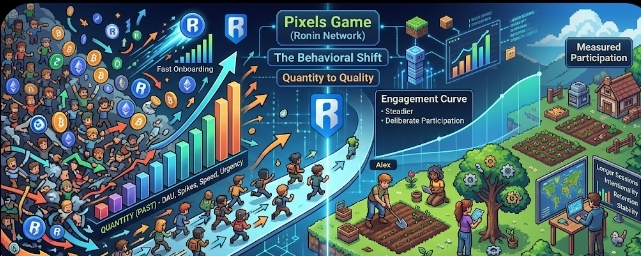
I’ve been trying to approach this slowly, without forcing a conclusion too early, because the current shift doesn’t feel like something that can be summarized in a single direction. It’s more layered than that—part behavioral, part structural, and partly something harder to measure.
When I look at platforms like Pixels, built on Ronin Network, I don’t just see a Web3 game or a technical ecosystem. I see a small, contained environment where larger market behaviors quietly surface. It becomes less about the product itself and more about how people interact with it over time.
What stands out first is the gradual shift from quantity-driven engagement to quality-driven participation.
There was a time—not too long ago—when success in digital ecosystems was often measured by visible scale. Daily active users, transaction counts, rapid onboarding spikes. Growth was expected to be fast, almost immediate. In many Web3 projects, including early blockchain games, high activity levels were interpreted as validation. More users meant more trust, more transactions meant more value.
But recently, the pattern feels different.
Instead of rapid spikes, there are steadier, flatter curves. Instead of constant activity, there are periods of pause. This doesn’t necessarily indicate decline—it may suggest recalibration.
In environments like Pixels, this becomes observable in subtle ways. Player sessions may be less frequent, but longer in duration. Engagement is less impulsive and more intentional. Rather than maximizing short-term output—harvesting, trading, optimizing—players appear to be pacing themselves, exploring systems more carefully.
From a quantitative perspective, this shift can be framed through a few observable patterns:
Engagement frequency vs. session depth: Fewer logins, but increased average session time
Transaction volume vs. transaction intent: Lower raw transaction counts, but higher-value or more purposeful interactions
User growth vs. user retention: Slower onboarding, but potentially stronger retention among existing participants
These metrics, while subtle, indicate a movement away from surface-level expansion toward more stable, experience-driven participation.
At the same time, there is a qualitative layer that numbers alone don’t fully capture.
There’s a noticeable change in tone—both in user behavior and broader conversation. Earlier, discussions around Web3 ecosystems carried a sense of urgency and optimism. Decisions were faster, often driven by momentum rather than reflection. Now, the tone feels more measured. Participants ask more questions. They wait longer before committing. There is less emphasis on immediate returns and more focus on sustainability.
The infrastructure behind it, particularly networks like Ronin Network, continues to operate as expected—providing scalability, lower transaction costs, and asset ownership. Technically, the foundation remains strong. But the perception of that foundation has evolved.
The question is no longer whether the system works.
The question is how people choose to interact with a system that works, but exists within uncertain external conditions.
This distinction matters.
Because markets are not shaped by technology alone—they are shaped by collective behavior. And behavior, especially in uncertain environments, tends to slow down before it changes direction.
I’ve noticed this not just within digital platforms, but across broader decision-making contexts. Individuals are taking more time before allocating resources. There is a visible delay between intention and action. Even when opportunities are present, the response is not immediate. Instead, there is a period of observation—sometimes brief, sometimes extended.
This delay introduces friction, but it also introduces discipline.
In a way, it filters out reactive participation and replaces it with deliberate engagement. And while this may reduce overall activity in the short term, it may also strengthen the system over a longer horizon.
Returning to Pixels, the design itself seems to align with this slower rhythm. Farming, resource management, and gradual progression naturally encourage patience. Outcomes are not instantaneous. Effort accumulates over time. This creates an environment where users are less likely to engage purely for immediate extraction and more likely to stay for sustained interaction.
And perhaps that is where the connection between structure and behavior becomes most visible.
The platform doesn’t force urgency, and in the current market context, that absence of pressure feels increasingly relevant.
Still, there is no clear conclusion to draw from this.
The shift from quantity to quality does not guarantee stability, just as high activity never guaranteed sustainability. Both are signals, not outcomes. And signals, especially in transitional periods, can be interpreted in multiple ways.
It’s possible that what we are seeing is a maturation phase—where participants become more informed, more selective, and less reactive.
It’s also possible that this is a temporary pause—an adjustment before another cycle of acceleration.
Or perhaps it is something more subtle: a long-term behavioral recalibration that doesn’t announce itself clearly, but gradually reshapes how systems are used.
For now, what remains observable is the pace.
Slower decisions. Quieter engagement. deliberate participation.
And within that slower pace, a different kind of value begins to emerge—less visible, harder to measure, but potentially more enduring.
The question that lingers, though, is not whether this shift is happening.
It’s whether this movement toward quality over quantity reflects growing clarity… or a deeper uncertainty about what, in the long run, actually holds value.
