
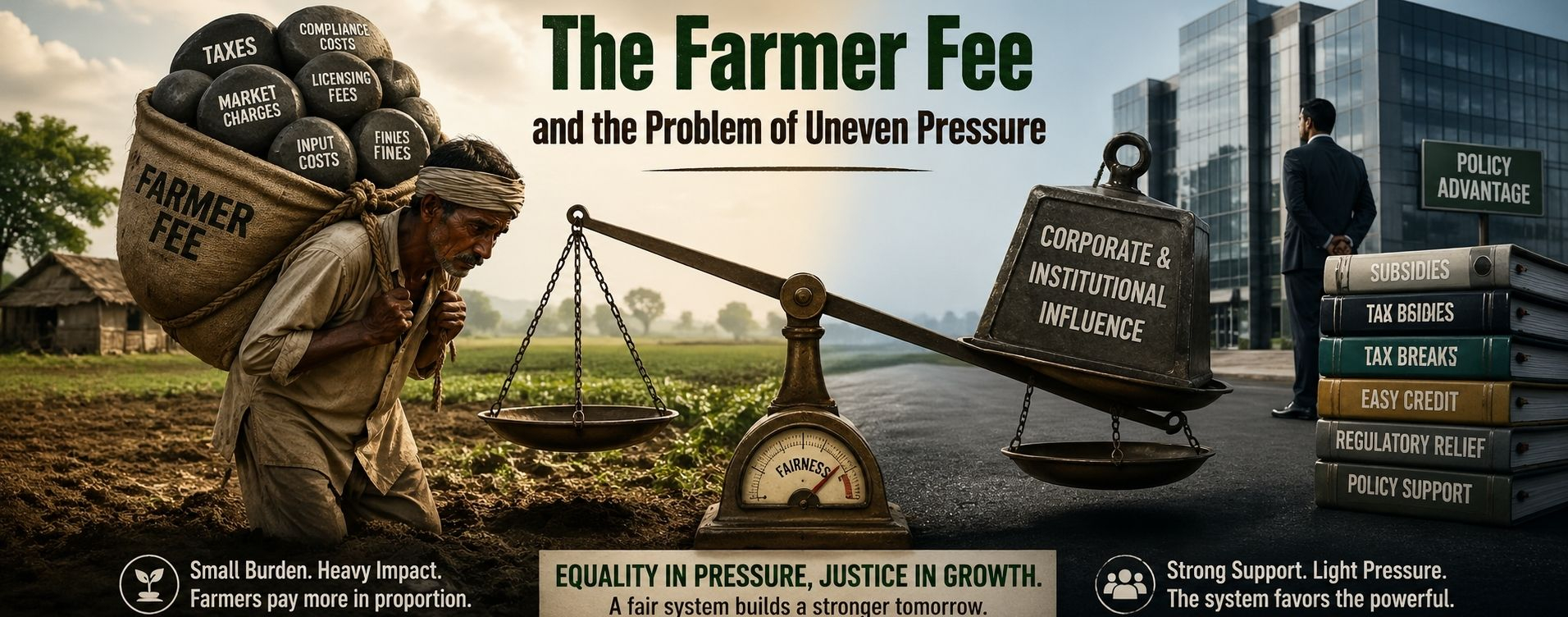

Pixels presents the farmer fee as a system built to keep the ecosystem healthy. At first, that explanation does make sense. If players can earn, withdraw, sell, and leave without any friction, the game economy can slowly turn into something that only loses value. In that situation, a withdrawal fee can look like a reasonable way to slow things down and keep some value moving back through the system.
But when I look at this fee more carefully, it does not feel like the whole story.
It is not just a tool for protecting the economy.
It is also a quiet form of pressure on how players behave.
And that pressure does not fall on every player in the same way.
The basic idea is simple. When a player withdraws $PIXEL from the game to on-chain, they have to pay a fee. That fee changes based on reputation. A player with higher reputation pays less. A player with lower reputation pays more. After that, the fees collected are sent back to stakers, so the cost paid by one player becomes a reward for another.
On paper, this looks like a clean value loop. Players who stay active, build reputation, and remain involved with the game receive better treatment. Players who appear less committed face more friction. In theory, this helps stop people who only want to farm rewards, cash out quickly, and leave the system behind.
But there is one major assumption sitting underneath this whole design.
It assumes that low reputation means low commitment.
And that is where the system starts to feel less fair.
A low-reputation player could be someone who only wants to extract value. That is possible. But a low-reputation player could also be someone who is new. They may still be learning how the game works. They may be casual. They may not have much time, much capital, or much experience inside the system yet. The fee does not always see those differences. It simply looks at reputation and charges accordingly.
That is where the real issue begins.
For older and more established players, the farmer fee may feel like a normal part of the game. They already understand the rules. They know how reputation works. They can look at the fee as motivation to stay active, improve their standing, and reduce their cost over time.
But for newer or smaller players, the same fee can feel very different.
It can feel like a wall.
Before they can properly access what they have earned, they first have to prove themselves to the system. They need time, activity, knowledge, and consistency. From the system’s side, that may sound reasonable. From the player’s side, it can feel heavy.
This is why reputation becomes more than a simple trust signal.
It becomes a kind of protection.
A high-reputation player gets more freedom. A low-reputation player has to pay more for the same action. The hardest part is that the biggest cost often lands on the players who are least ready to absorb it.
Yes, this can protect the economy.
But it can also make the game feel less welcoming.
That does not mean the farmer fee is a bad idea by itself. A serious game economy does need ways to protect itself from pure extraction. If there is no barrier at all, short-term farming can damage the value that long-term players are trying to build.
But protection should not quietly turn into punishment for genuine players who are still at the beginning of their journey.
That is the balance that matters.
The farmer fee works like a filter. It tries to separate loyal players from fast extractors. But no filter is perfect. Some players caught by it are not trying to exploit anything. They are simply new, small, or not yet trusted by the system.
That is why the farmer fee is more complicated than it first appears.
Pixels is trying to stop its economy from being drained too easily. That goal is understandable. But the result is a system where reputation does more than measure behavior. It also decides how expensive it is for a player to reach liquidity.
The higher your reputation is, the cheaper it becomes to exit.
The lower your reputation is, the more expensive it becomes to move your own earnings.
That point deserves more attention.
The farmer fee is not only a value loop. It is not only a reward system for stakers. It is also a test of where a player stands inside the game economy.
It tests patience.
It tests access.
It tests how much friction a player can handle before they begin to feel pushed away.
So yes, the alignment logic is there. The ecosystem argument is there. The reason for discouraging extraction is also understandable.
But the burden is there too.
And from my point of view, that burden does not fall evenly across the player base.
