
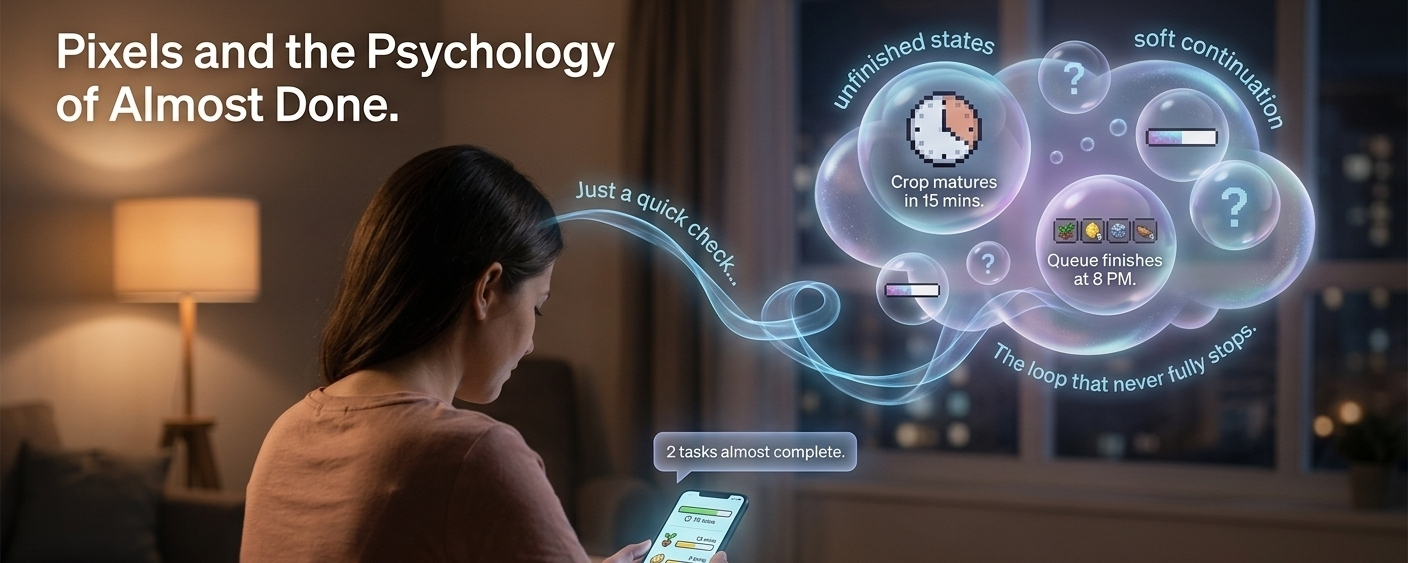
It usually starts with something small.
You open Pixels thinking it’ll be a quick check — maybe one action, maybe just a glance. Nothing serious. But then you notice something quietly sitting in progress, and suddenly “just checking” doesn’t feel as final as you thought.
That’s where it begins to stick.
What stood out to me over time is how often I caught myself returning “just to check.”
Not because I was missing out on something huge. There’s no dramatic urgency baked into it. But because something always felt halfway done.
A crop that would finish soon.
A queue that would resolve later.
A small task I set in motion and then left behind.
Nothing important enough to stress over.
But not meaningless enough to forget.
That space in between is where the design quietly sits.
Most games rely on completion loops. You do something, you finish it, you get a reward, and the cycle resets. Pixels blurs that ending a bit.
Instead of clean closure, you get soft continuation.
Things don’t always end when you log out. They just keep evolving without you.
And that changes how your brain frames the experience.
You stop thinking in terms of:
“I played for 20 minutes”
And start thinking in:
“Something is probably done now… I should check.”
That shift is subtle, but it matters.
Because it moves the motivation away from effort and into curiosity.
There’s no pressure telling you to return. No punishment for absence. But your mind fills in the gap anyway. It starts tracking unfinished states in the background, almost automatically.
That’s what makes it different from most “grind-based” systems.
It doesn’t push you forward.
It leaves things slightly unresolved behind you.
What surprised me personally is how low-friction it feels to stay engaged.
There’s no emotional spike when you log in. No overwhelming backlog. Just a calm continuation of what was already happening.
And that creates a strange pacing effect:
You don’t feel like you’re entering a game.
You feel like you’re checking on something that never fully stopped.
I think that’s the real design idea underneath everything.
Not retention through intensity.
Not engagement through pressure.
But something closer to mental continuity.
A light thread that stays active in your head even when the app is closed.
And over time, that thread becomes the reason you return.
Not because you need to.
But because it’s easier to check than to wonder.
