
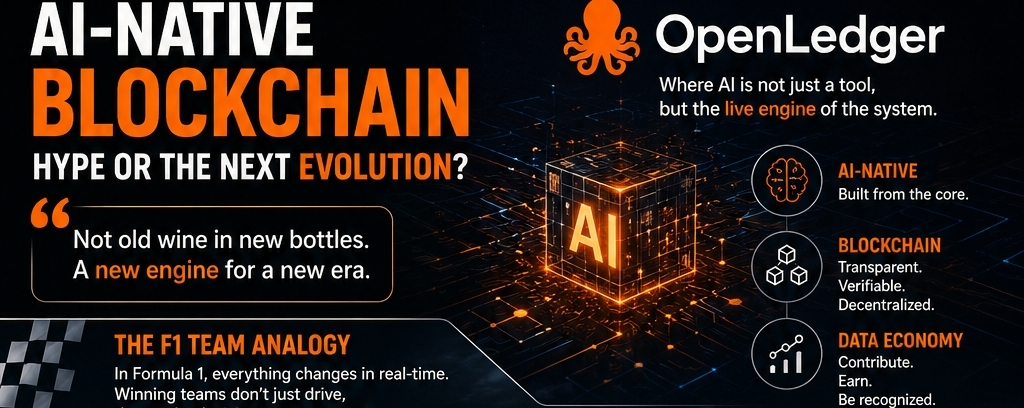
Most people in crypto focus only on charts, candles, and short-term volatility. Green days create excitement, red days create panic, and the market moves in endless cycles of emotion. But the truth is, the biggest shifts in this industry rarely begin with price. They begin quietly at the infrastructure level.
That’s exactly why OpenLedger’s latest move deserves attention.
The launch of an EVM bridge may sound technical on the surface, but underneath it represents something much bigger: the transition toward a truly connected blockchain ecosystem where AI systems, liquidity, applications, and users can move without barriers.
And honestly, this matters far more than most people realize.
For years, crypto has been expanding into a multi-chain world. Ethereum remained the center of innovation, but networks like Arbitrum, Optimism, Base, BNB Chain, Avalanche, and others created their own ecosystems with different strengths. Lower fees, faster execution, better scalability — every chain offered something unique.
But there was a hidden problem.
The more chains appeared, the more fragmented the ecosystem became.
Liquidity scattered across networks.
Users had to constantly bridge assets manually.
Developers were forced to build separate integrations for different chains.
Strategies became slower and less efficient simply because systems could not communicate smoothly.
Crypto became powerful, but disconnected.
That disconnect created friction everywhere.
And in markets driven by speed, friction quietly kills efficiency.
This is where OpenLedger’s EVM bridge becomes important.
At its core, an EVM bridge allows Ethereum-compatible environments to interact more naturally. Assets, smart contracts, and applications can move across ecosystems without being trapped inside one network.
But OpenLedger’s approach feels different because this isn’t just about token transfers.
It’s about preparing infrastructure for the next phase of blockchain itself — AI-powered execution.
That’s the key most people are missing.
AI in crypto has mostly lived in the analysis layer until now. Prediction models, market signals, sentiment tracking, automated insights — all useful, but still limited. The real challenge has never been intelligence alone.
The real challenge has been execution.
For AI to function effectively on-chain, it needs freedom of movement.
It needs access to liquidity.
It needs compatibility across protocols.
It needs the ability to react instantly across multiple environments.
Without interoperability, AI systems remain restricted and inefficient.
Every chain becomes another isolated environment requiring separate handling, separate logic, and additional risk. That creates delays, complexity, and operational weakness.
An EVM bridge changes that equation.
It creates a unified structure where systems can operate across ecosystems with far less friction. Capital can move faster. Strategies become more adaptive. AI agents gain the ability to function in real time across multiple chains instead of being locked inside one environment.
That’s why OpenLedger’s direction feels increasingly strategic rather than experimental.
It’s not simply building AI products.
It’s building the infrastructure layer required for AI-native blockchain systems to actually work at scale.
And timing matters here.
By 2026, the market is no longer satisfied with fragmented experiences. Users expect seamless interaction between ecosystems. Developers want flexible infrastructure. Traders want speed. Institutions want efficiency and reliability.
The “one-chain-wins-everything” narrative is slowly fading.
What’s emerging instead is a connected network of ecosystems where interoperability becomes the foundation of growth.
In that environment, bridges stop being optional features.
They become core infrastructure.
Of course, none of this removes the risks.
Cross-chain systems have historically been one of the weakest points in crypto security. The industry has already witnessed major bridge exploits, liquidity attacks, and infrastructure failures over the years. Billions were lost because systems moved faster than security standards.
So caution still matters.
A bridge is only as valuable as the reliability behind it.
Adoption will also take time. Infrastructure upgrades rarely create immediate explosions overnight. Trust is earned through performance, integrations, stability, and real-world usage.
But history shows something important:
When infrastructure becomes smoother, adoption accelerates naturally afterward.
That’s how major technological shifts usually happen.
Quietly first.
Then suddenly.
From an investor’s perspective, developments like this are less about immediate hype and more about long-term positioning. Projects improving interoperability are effectively building highways for future liquidity, applications, and intelligent systems.
And over time, infrastructure tends to outlast narratives.
For traders, this shift matters too.
Because market opportunities are no longer defined only by direction.
They’re defined by access, speed, execution quality, and the ability to move capital efficiently across ecosystems.
Infrastructure changes performance more than most people realize.
That’s why OpenLedger’s EVM bridge should not be viewed as just another technical update.
It represents a deeper evolution happening across crypto:
A shift away from isolated blockchains…
toward an interconnected environment where AI, liquidity, applications, and users can operate together without constant friction.
And if that future continues developing the way it appears to be, then interoperability may become one of the most important foundations of the next crypto cycle.
Not because it creates noise.
But because it quietly changes how the entire system works.
