
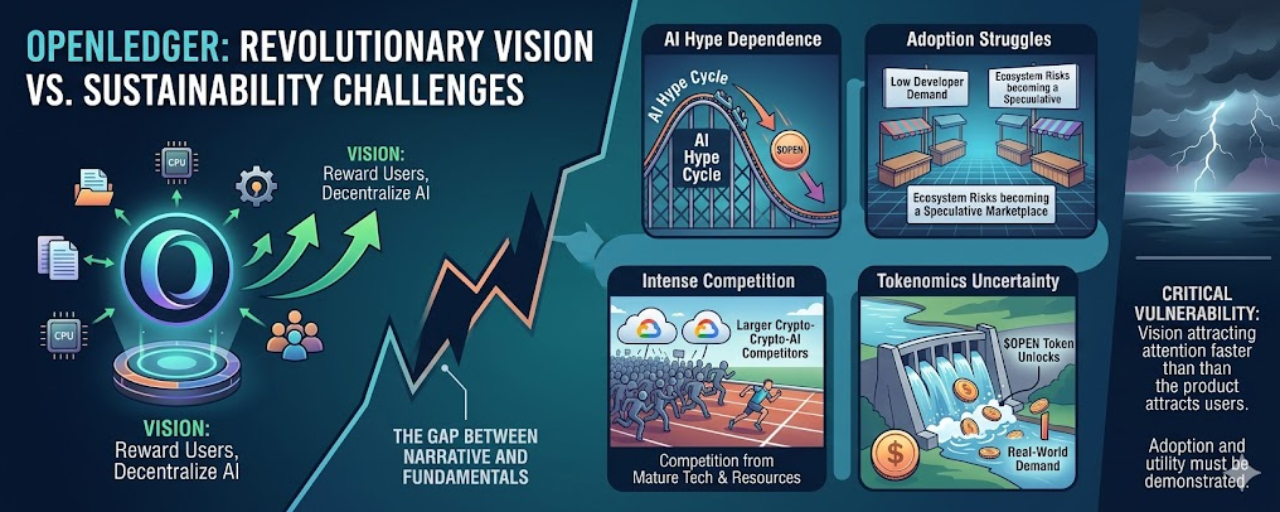

OpenLedger presents itself as a revolutionary decentralized AI infrastructure project, but skeptics could argue that beneath the ambitious vision lies a platform still struggling to prove real-world necessity. The concept sounds attractive: reward users for contributing data and power decentralized AI. Yet the gap between a compelling narrative and a sustainable ecosystem remains enormous.
The biggest criticism is that OpenLedger appears heavily dependent on the AI hype cycle. Many investors are attracted by buzzwords such as "decentralized AI," "data networks," and "AI agents," but excitement alone does not create long-term value. If market sentiment shifts away from AI-related tokens, OPEN could quickly lose the narrative premium supporting its valuation.
Another concern is adoption. For a network centered on AI data and models, actual demand from developers, enterprises, and end users must eventually justify the token's existence. Without meaningful usage, the ecosystem risks becoming a speculative marketplace where token trading generates more activity than the underlying product itself.
Competition is equally brutal. OpenLedger is not building in a vacuum. It faces challenges from established AI companies, major cloud providers, and numerous crypto-AI projects pursuing similar goals. Many possess larger resources, stronger partnerships, and more mature technology.
Tokenomics also create uncertainty. Future unlocks, incentive emissions, and reward distributions can place pressure on price if ecosystem growth fails to keep pace. In a bearish scenario, early enthusiasm fades, liquidity weakens, and new supply overwhelms demand.
The harshest critics would argue that OpenLedger risks becoming another crypto project where the vision attracts attention far faster than the product attracts users. Until adoption, utility, and sustained demand are clearly demonstrated, OPEN remains vulnerable to the possibility that its narrative is far stronger than its fundamentals.
