
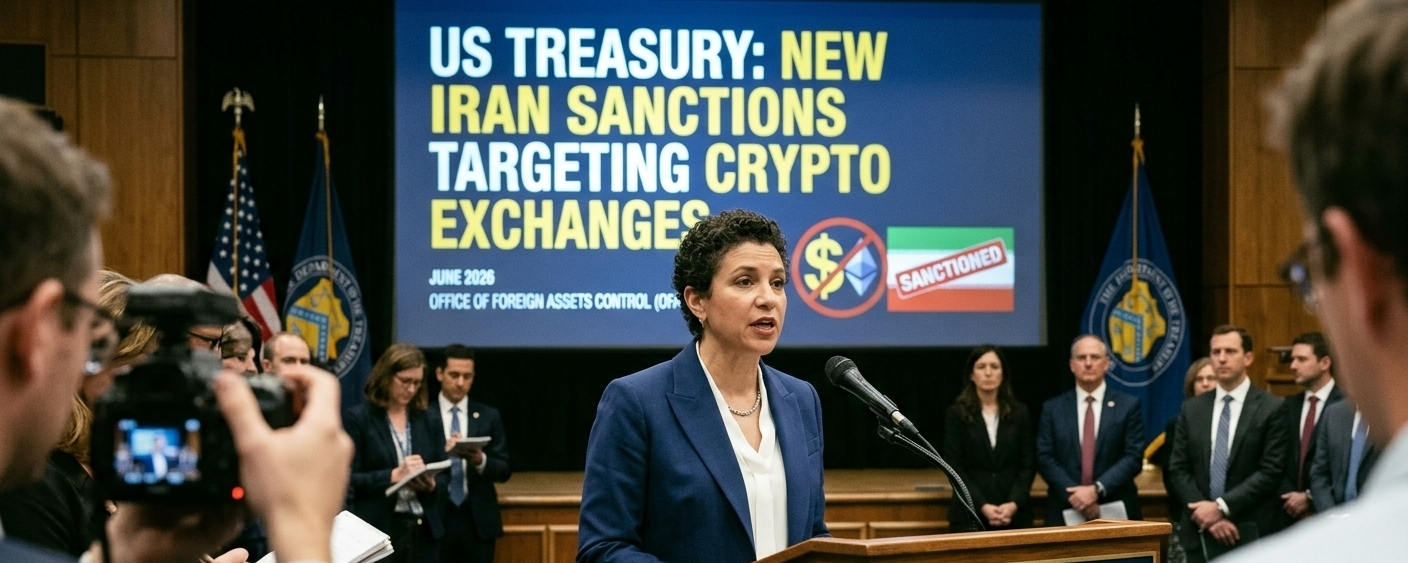
In a major expansion of its "Economic Fury" campaign, the U.S. Department of the Treasury’s Office of Foreign Assets Control (OFAC) announced sweeping sanctions on June 2, 2026, targeting four of Iran's most prominent cryptocurrency exchanges: Nobitex, Wallex, Bitpin, and Ramzinex.
This enforcement action marks the Treasury Department's largest strike against Iran's digital asset economy to date, aimed at dismantling the infrastructure that the Iranian regime and its proxy networks—including the Islamic Revolutionary Guard Corps (IRGC)—have used to circumvent international sanctions.
Targeting the "Digital Dollar Pipeline"
The U.S. government identified these exchanges as critical nodes in a parallel financial system. According to OFAC, these platforms have facilitated massive flows of capital, helping the regime and its affiliates move wealth internationally despite being cut off from traditional global banking networks like SWIFT.
* Nobitex: As Iran’s largest exchange, accounting for roughly 50% of the nation's digital asset volumes in 2025, Nobitex was a primary target. Officials allege it processed hundreds of millions of dollars in stablecoin transfers to support the Central Bank of Iran and assist regime insiders in moving assets out of the country, even during periods of government-imposed internet blackouts.
* Leadership Designations: Alongside the exchanges, the Treasury sanctioned several key figures, including Nobitex’s chairman Amir Hossein Rad, its current CEO Seyed Ali Khoee, and co-founders Seyed Mohammad Ali Aghamir and Seyed Mohammad Aghamir.
A Warning to Global Financial Institutions
The designations carry significant secondary sanctions risks. This means that any international financial institution, global virtual asset service provider (VASP), or stablecoin issuer that continues to facilitate transactions for these Iranian entities risks being cut off from the U.S. financial system.
Treasury Secretary Scott Bessent stated that the action is intended to sever the "digital on-ramps and off-ramps" that allow Iranian entities to interact with the global economy.
While Iran's economy is in free fall, the regime has chosen to co-opt digital asset technologies for its own corrupt agenda, including evading sanctions and transferring wealth out of the country," Secretary Bessent said.
Compliance Requirements
The Treasury has urged international compliance teams to immediately update their sanctions screening and transaction monitoring protocols. For global VASPs, this involves:
* Blocking: Immediate restriction of any accounts or transactions linked to the four designated exchanges and their identified leadership.
* Enhanced Monitoring: Increased vigilance to identify and block attempts by these entities to utilize front companies or indirect channels to maintain access to global liquidity.
This action is part of the broader "Economic Fury" campaign, which aims to leverage both traditional and digital financial tools to limit the regime's ability to generate revenue and support regional proxies.
Are you interested in learning more about how these sanctions might impact specific international crypto compliance protocols, or perhaps the broader context of the current U.S.-Iran economic situation?
Key reasons behind the selloff
📉 1. Risk-Off Market Sentiment When geopolitical tensions increase, investors often move away from high-risk assets such as cryptocurrencies and toward cash, government bonds, or gold. Bitcoin is still treated as a risk asset during sudden crises
CryptoSlate +1
🛢️ 2. Rising Oil Prices Escalation around the Strait of Hormuz has pushed oil prices higher. Higher energy costs can increase inflation concerns and reduce expectations for interest-rate cuts, which is generally negative for crypto and tech-related assets.
Reuters +1
⚡ 3. Massive Liquidations Reports indicate that hundreds of millions to over $1 billion in leveraged long positions were liquidated as prices fell. Forced liquidations accelerate downward momentum and create panic selling
The Economic Times +1
🏛️ 4. New U.S. Sanctions on Iranian Crypto Firms The U.S. Treasury announced sanctions against several Iran-linked crypto exchanges, adding regulatory pressure and increasing uncertainty in the digital asset market.
Are you buying the dip, holding, or selling as the US-Iran conflict impacts crypto markets? 🤔