
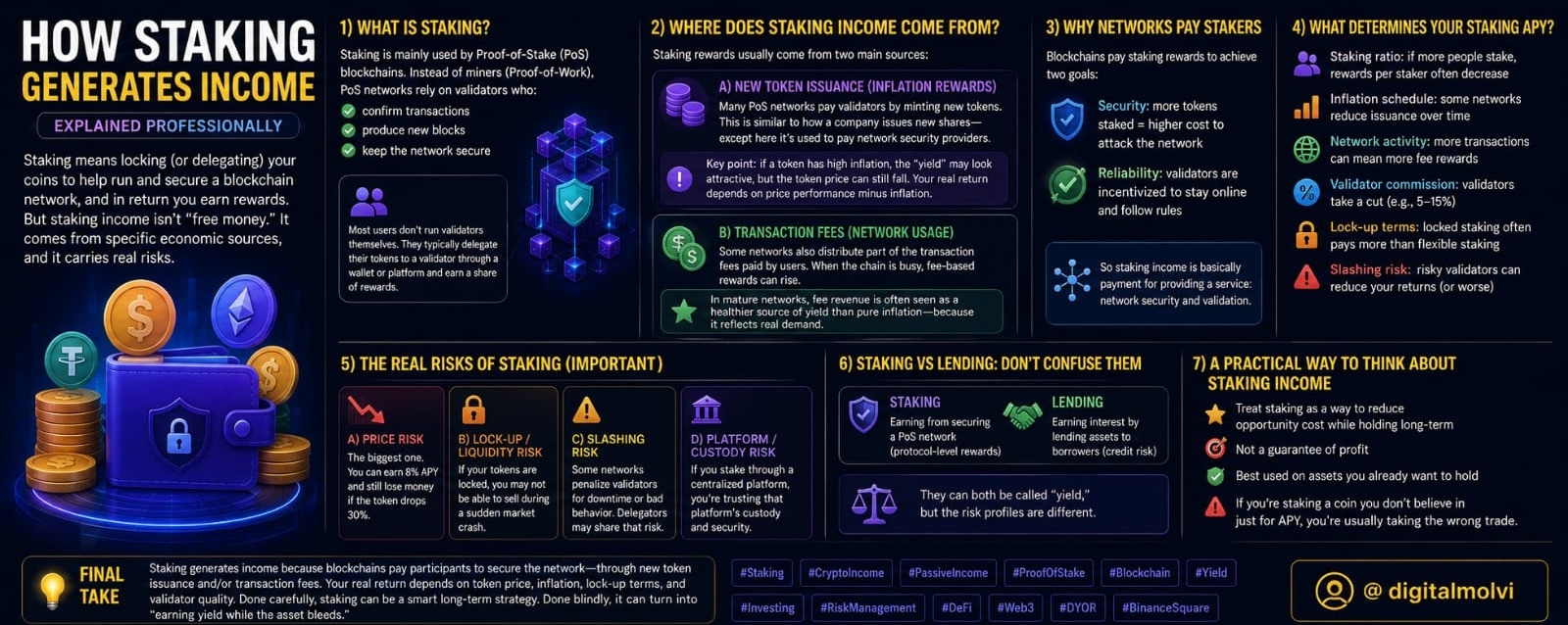
Staking is one of the most common ways crypto holders try to earn passive income. In simple terms, staking means locking (or delegating) your coins to help run and secure a blockchain network, and in return you earn rewards.
But staking income isn’t “free money.” It comes from specific economic sources, and it carries real risks. Here’s a clear, professional breakdown.
1) What Is Staking?
Staking is mainly used by Proof-of-Stake (PoS) blockchains. Instead of miners (Proof-of-Work), PoS networks rely on validators who:
confirm transactions
produce new blocks
keep the network secure
To become a validator (or to support one), you stake tokens. This stake acts like a security bond—if validators behave maliciously, they can be penalized.
Most users don’t run validators themselves. They typically delegate their tokens to a validator through a wallet or platform and earn a share of rewards.
2) Where Does Staking Income Come From?
Staking rewards usually come from two main sources:
A) New token issuance (inflation rewards)
Many PoS networks pay validators by minting new tokens.
This is similar to how a company issues new shares—except here it’s used to pay network security providers.
Key point: if a token has high inflation, the “yield” may look attractive, but the token price can still fall. Your real return depends on price performance minus inflation.
B) Transaction fees (network usage)
Some networks also distribute part of the transaction fees paid by users.
When the chain is busy, fee-based rewards can rise.
In mature networks, fee revenue is often seen as a healthier source of yield than pure inflation—because it reflects real demand.
3) Why Networks Pay Stakers
Blockchains pay staking rewards to achieve two goals:
Security: more tokens staked = higher cost to attack the network
Reliability: validators are incentivized to stay online and follow rules
So staking income is basically payment for providing a service: network security and validation.
4) What Determines Your Staking APY?
Staking returns vary widely. The main drivers are:
Staking ratio: if more people stake, rewards per staker often decrease
Inflation schedule: some networks reduce issuance over time
Network activity: more transactions can mean more fee rewards
Validator commission: validators take a cut (e.g., 5–15%)
Lock-up terms: locked staking often pays more than flexible staking
Slashing risk: risky validators can reduce your returns (or worse)
5) The Real Risks of Staking (Important)
A) Price risk (the biggest one)
You can earn 8% APY and still lose money if the token drops 30%.
B) Lock-up / liquidity risk
If your tokens are locked, you may not be able to sell during a sudden market crash.
C) Slashing risk
Some networks penalize validators for downtime or bad behavior. Depending on the chain and setup, delegators may share that risk.
D) Platform/custody risk (if staking via an exchange)
If you stake through a centralized platform, you’re trusting that platform’s custody and operational security.
6) Staking vs Lending: Don’t Confuse Them
Staking: earning from securing a PoS network (protocol-level rewards)
Lending: earning interest by lending assets to borrowers (credit risk)
They can both be called “yield,” but the risk profiles are different.
7) A Practical Way to Think About Staking Income
A professional mindset is to treat staking as:
a way to reduce opportunity cost while holding long-term
not a guarantee of profit
best used on assets you already want to hold
If you’re staking a coin you don’t believe in just for APY, you’re usually taking the wrong trade.
Final Take
Staking generates income because blockchains pay participants to secure the network—through new token issuance and/or transaction fees. Your real return depends on token price, inflation, lock-up terms, and validator quality. Done carefully, staking can be a smart long-term strategy. Done blindly, it can turn into “earning yield while the asset bleeds.”
#digitalmolvi #staking #CryptoIncome #blockchain #BinanceSquare


