

A Market That Is Growing Faster Than Many Expected
the real-world asset sector for a while, and one trend is becoming impossible to ignore. Tokenized stocks are no longer a small experiment sitting on the edge of the blockchain industry. They are rapidly becoming one of the most discussed segments of the entire tokenization movement.
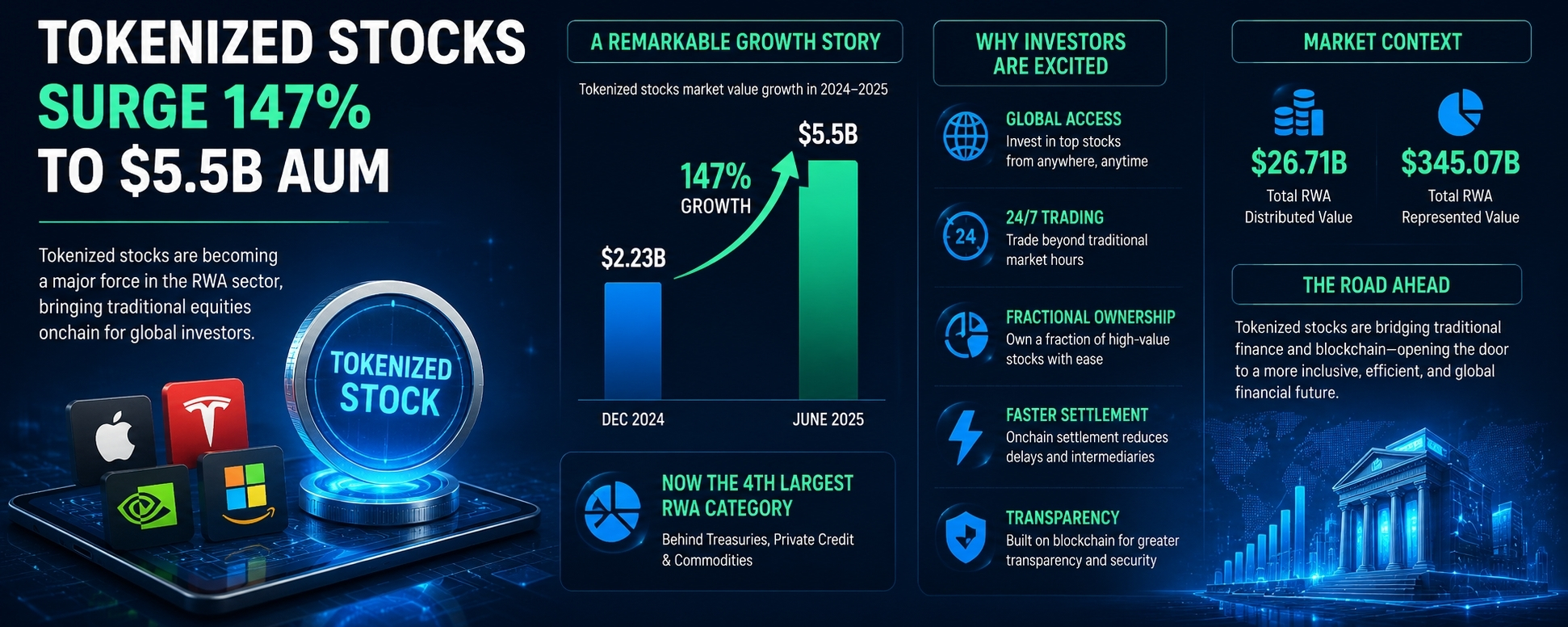
Recent data shows tokenized stocks have surged roughly 147% in value, reaching around $5.5 billion in assets under management. On the surface, that sounds like another impressive growth statistic. But underneath the headline, something more important is happening. Investors are beginning to treat blockchain networks as a place where traditional financial assets can exist alongside digital assets rather than apart from them.
For years, the conversation around crypto focused on cryptocurrencies, decentralized finance, and stablecoins. Stocks remained largely tied to traditional brokerage systems. Today, that separation is starting to fade.
Why Investors Are Paying Attention
The appeal of tokenized stocks is relatively easy to understand.
Traditional equity investing still comes with limitations. Market hours are fixed. Settlement can take time. Cross-border investing often involves multiple intermediaries, paperwork, and restrictions. Blockchain infrastructure offers a different vision—one where assets move faster, ownership can be divided into smaller fractions, and access becomes more flexible.
For many investors, this is less about replacing traditional markets and more about improving how they interact with them.
Someone who already holds digital assets may want exposure to major public companies without constantly moving funds between different financial systems. Tokenized stocks create the possibility of keeping capital inside a blockchain-based environment while still participating in equity markets.
That convenience is becoming a powerful driver of adoption.
The Bigger Story Behind the Growth
The rise to $5.5 billion is significant not simply because of the number itself. Compared to the size of global equity markets, it is still relatively small. What makes it noteworthy is the speed at which the sector is expanding.
Markets rarely grow this quickly without underlying demand.
Investors are showing increasing interest in bringing familiar financial products onchain. They already understand stocks. They follow earnings reports, product launches, market trends, and company performance. Unlike many emerging blockchain products, equities require little explanation.
People know what they are buying.
This familiarity gives tokenized stocks an advantage that many crypto-native products never had. Instead of introducing an entirely new concept, tokenization is applying new technology to an asset class that investors already recognize.
The Push Toward Onchain Finance
The growth of tokenized stocks is also part of a larger trend.
Real-world asset tokenization has expanded significantly over the past few years. Government bonds, private credit, commodities, and investment funds have all found their way onto blockchain networks. Each category addresses a different investor need, but together they point toward the same destination.
Financial markets are gradually becoming more digital, more programmable, and more interconnected.
The idea is simple. If money can move onchain, why shouldn't stocks?
That question is driving investment, development, and experimentation across the industry. Every new tokenized product moves the market one step closer to a future where traditional assets and blockchain infrastructure operate together rather than separately.
Access Is Becoming a Competitive Advantage
One reason tokenized stocks have gained momentum is accessibility.
Historically, access to certain investment opportunities has often been concentrated among institutions and wealthy investors. Retail participants typically receive fewer opportunities and face more restrictions.
Tokenization promises a more open model.
Fractional ownership allows investors to gain exposure without purchasing a full share. Digital infrastructure can potentially reduce barriers that have existed for decades. International investors may gain easier access to assets that were previously difficult to reach through traditional channels.
This doesn't automatically solve every problem, but it does expand the conversation around who gets access to financial markets and how that access is delivered.
Not Every Tokenized Stock Is the Same
Despite the excitement, investors need to understand an important reality.
The phrase "tokenized stock" can describe several very different products.
Some tokenized stocks may be directly backed by real shares held by custodians. Others may provide exposure through more complex financial structures. Some may grant rights similar to traditional shareholders, while others may simply track the performance of the underlying asset.
From a distance, these products can appear identical.
On a trading screen, both may look like a digital version of a stock. Behind the scenes, however, the legal rights, ownership structure, custody arrangements, and investor protections can vary significantly.
As the market grows, transparency around these differences will become increasingly important.
Regulation Is Moving Into Focus
The rapid growth of tokenized equities has naturally attracted regulatory attention.
For regulators, the central question is not whether blockchain technology works. The question is whether investors receive adequate protections when traditional financial assets move onto new infrastructure.
This has shifted the discussion away from hype and toward practical issues such as custody, disclosures, compliance, shareholder rights, and market integrity.
That shift may ultimately benefit the industry.
Innovation often grows fastest when rules are unclear. Long-term adoption, however, tends to occur when investors understand exactly what they own and what protections they have.
The next stage of growth will likely depend as much on trust as it does on technology.
Liquidity Remains One of the Biggest Tests
One area that deserves close attention is liquidity.
There is a common assumption that tokenization automatically creates more liquid markets. In reality, tokenization and liquidity are not the same thing.
An asset can exist onchain and still suffer from low trading volume, wide spreads, and limited market depth.
Strong liquidity requires active participants, efficient markets, and confidence from both buyers and sellers. Those conditions take time to develop.
As tokenized stocks continue growing, liquidity will become one of the key metrics investors watch. A market's true strength is often revealed during periods of volatility rather than periods of excitement.
Why Institutions Are Watching Closely
Large financial institutions are paying attention because tokenized stocks represent more than another investment product.
They represent a potential shift in market infrastructure.
Traditional financial systems rely on layers of intermediaries, settlement networks, clearing mechanisms, and operational processes that have evolved over decades. Blockchain technology offers an alternative approach that could simplify parts of that system.
The goal is not necessarily to replace existing infrastructure overnight.
Instead, many institutions are exploring whether blockchain networks can make financial markets more efficient, transparent, and accessible without sacrificing reliability or investor protections.
That balance will be critical.
The Road Ahead
The surge to $5.5 billion demonstrates that investor interest is real.
What remains uncertain is how the market evolves from here.
The strongest projects will likely be those that focus not only on growth but also on transparency, compliance, custody, liquidity, and investor confidence. Early adoption can attract attention, but sustainable adoption requires trust.
Tokenized stocks have already proven that demand exists. Investors want greater flexibility. They want easier access to traditional assets. They want financial products that fit naturally into a digital-first world.
The next challenge is proving that tokenized equity markets can deliver those benefits consistently and responsibly.
Final Thoughts
The 147% jump in tokenized stock assets is more than a headline number. It reflects a broader shift in how investors view blockchain technology and its role in financial markets.
What started as an experiment is beginning to look like a serious financial trend.
Tokenized stocks are still in their early stages, and many questions remain unanswered. Regulation continues to evolve. Market structures are still developing. Investor protections are being tested and refined.
Yet the direction is becoming clearer.
Investors are no longer asking whether traditional assets can move onchain. They are increasingly asking how quickly that transition will happen and what the future financial system will look like once it does.
The real story isn't the $5.5 billion valuation. The real story is that the gap between traditional finance and blockchain finance continues to shrink, and tokenized stocks are becoming one of the most visible signs of that transformation.