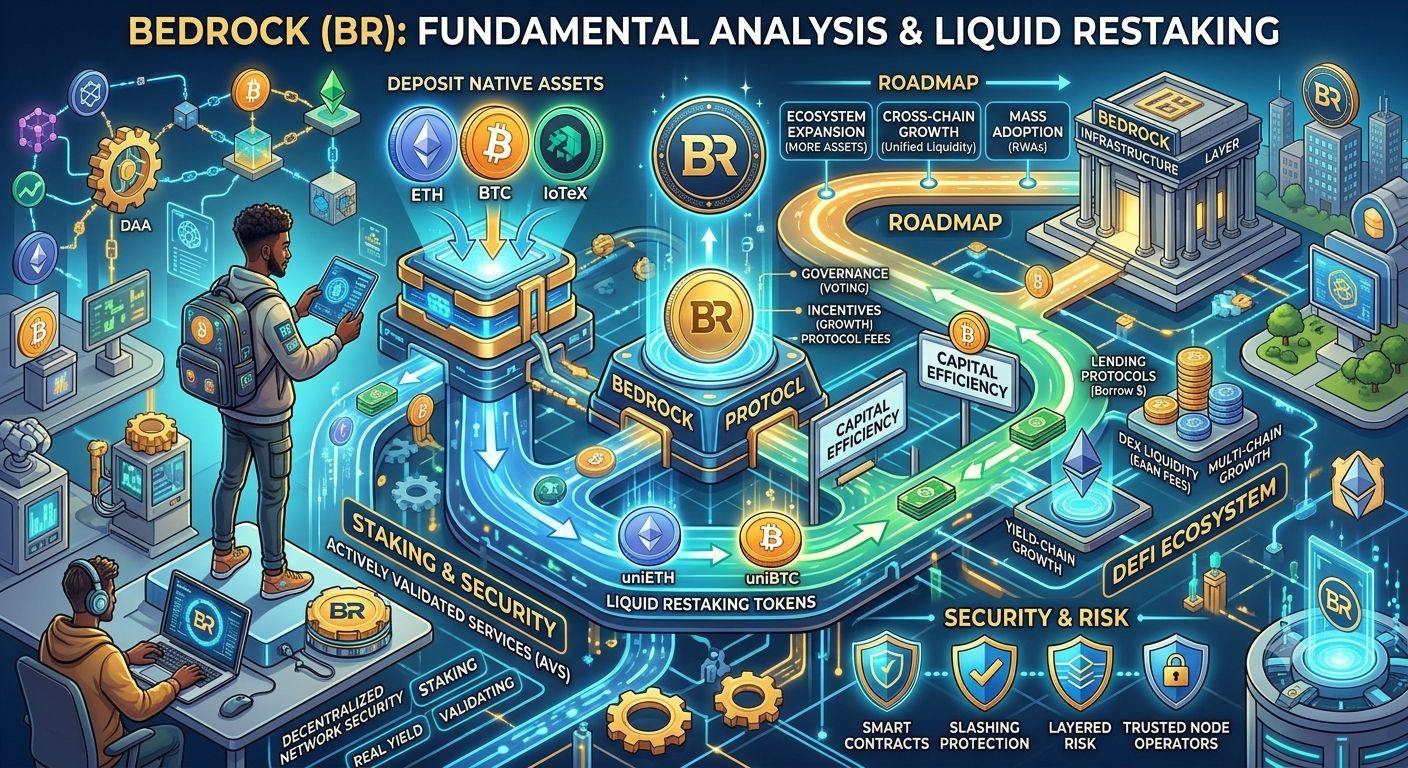
$BR @Bedrock (BR) is an emerging project in the decentralized finance (DeFi) space that focuses on a concept called liquid restaking.
At its core, Bedrock is trying to solve one of the biggest inefficiencies in crypto:
the problem of idle capital locked in staking systems.
In traditional staking, users lock their assets to earn rewards.
However, once locked, those assets cannot be used elsewhere.
This creates an opportunity cost, especially in a fast-moving DeFi environment.
Bedrock addresses this issue by allowing users to restake their assets while still keeping them liquid.
This means users can earn yield from staking and still use their assets in other DeFi applications.
This idea significantly improves capital efficiency,
which is one of the most important metrics in modern DeFi protocols.
The protocol introduces a liquid restaking token,
which represents the user’s staked position.
This token can be used across different platforms,
allowing users to stack multiple yield opportunities.
One of Bedrock’s key strengths is its multi-asset support.
Unlike some projects that focus only on Ethereum,
Bedrock supports assets like ETH, BTC derivatives, and other staking tokens.
This multi-asset approach helps Bedrock attract a wider user base.
It also increases the total value that can flow into the protocol.
Another important development is the mainnet launch.
Bedrock is not just a concept—it is already live and operational.
Users can restake assets, mint tokens, and participate in the ecosystem.
This reduces early-stage risk compared to projects that are still in development.
Bedrock is also actively building ecosystem integrations.
It is connecting with DeFi platforms such as exchanges, lending protocols, and bridges.
These integrations increase liquidity and usability of its token.
A unique part of Bedrock’s model is its connection to Actively Validated Services (AVSs).
These services use restaked assets to provide security, data validation, and other functions.
This creates real yield,
rather than relying only on token emissions or inflationary rewards.
From a security perspective, Bedrock emphasizes decentralization.
It supports multiple node operators
and includes mechanisms like slashing to maintain trust.
Security is especially important in restaking,
because the same asset is exposed to multiple layers of risk.
Looking at the token itself, BR has several utilities.
It is used for governance,
allowing holders to vote on protocol decisions.
It also plays a role in incentives,
helping to grow the ecosystem and reward participants.
In the future, it may capture value through protocol fees,
which could make it more fundamentally valuable.
Now looking at the roadmap,
Bedrock has a clear and structured growth plan.
The first phase focused on launching the core protocol.
This included enabling restaking and token minting.
The next phase is ecosystem expansion.
This involves adding more integrations
and supporting more assets across the platform.
After that, Bedrock plans to focus on cross-chain growth.
This means expanding beyond a single blockchain
and connecting multiple ecosystems together.
Cross-chain capability is important
because liquidity in crypto is fragmented across many networks.
By connecting these networks,
Bedrock can position itself as a unified liquidity layer.
Another major step in the roadmap is decentralization.
The protocol aims to reduce central control over time
and increase community participation.
This includes governance improvements
and more distributed infrastructure.
In the long term, Bedrock is aiming for mass adoption.
This includes integrating real-world assets (RWAs)
and building more advanced financial products.
If successful, this could move Bedrock beyond DeFi
into broader financial use cases.
From an investment perspective,
Bedrock benefits from being in the restaking narrative,
which is currently one of the fastest-growing sectors in crypto.
However, there are also risks to consider.
Restaking is still a relatively new concept,
and the technology is complex.
There is also strong competition from other protocols
trying to capture the same market.
Security risks are another concern,
especially with smart contracts and layered staking systems.
Despite these risks, Bedrock shows strong potential.
It has a clear use case,
a working product,
and a structured roadmap.
Its focus on capital efficiency,
multi-chain growth,
and real yield generation
makes it an interesting project to watch.
In simple terms,
Bedrock is trying to make crypto assets work harder
without locking them away.
If the team continues to execute well,
it could become an important infrastructure layer in DeFi.
But like all early-stage crypto projects,
it should be approached with both optimism and caution.
#BR #CPIWatch #UKFCAProposesRetailFunds10PctCryptoETNs #UKFCAProposesRetailFundsCryptoETNAllocation #TONCommunityApprovesRenameToGRAM