It started as a dream that sounded completely impossible.
Years ago, Elon Musk was betting everything on ideas that critics openly laughed at—electric cars, reusable rockets, planetary colonization, and brain-machine interfaces. While the broader market focused heavily on the downside risks, he kept building.
Today, the line between science fiction and global finance has officially dissolved. With SpaceX’s historic debut on the Nasdaq, the absolute limits of human wealth and corporate valuation have been completely rewritten.
Inside the Largest IPO in Human History
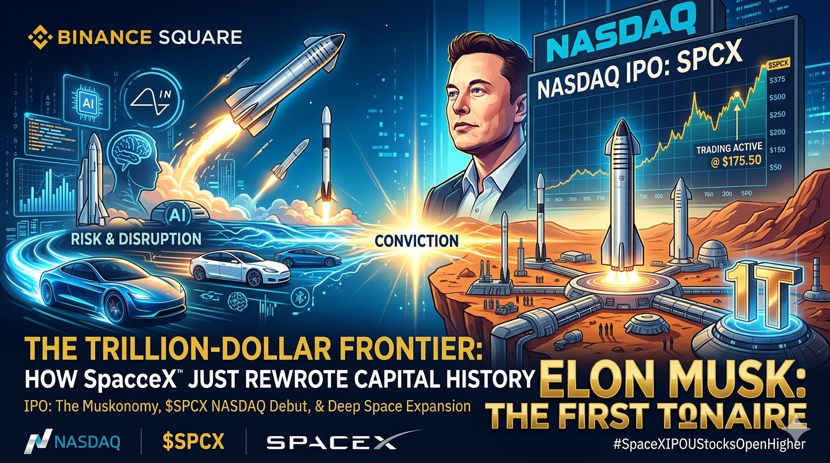
The public markets have never seen an event of this magnitude. Trading under the ticker $SPCX, SpaceX completed a record-breaking $75 billion initial public offering—comfortably leapfrogging Saudi Aramco's 2019 record to become the largest IPO in global history.
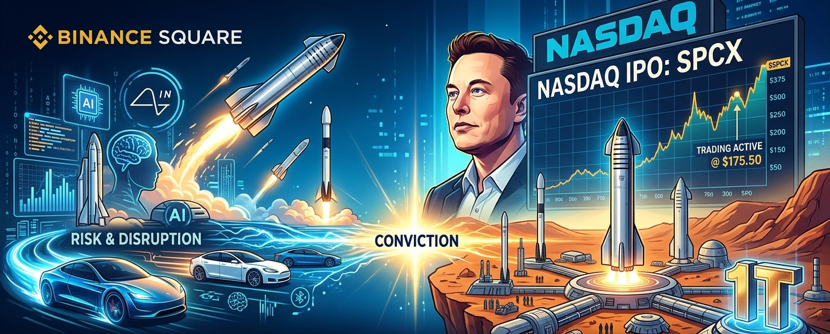
The market response was immediate and overwhelming. After pricing at a fixed baseline of $135 per share, the stock order book drew in massive institutional demand and over $100 billion in retail interest. When the first trade finally crossed the tape at 11:46 AM EST, $SPCX surged upward to open at $150 per share (an immediate 11% premium) before climbing as high as $175.50 during early afternoon trading.
This opening explosion instantly pushed SpaceX's market capitalization past the $2.2 trillion mark, positioning the aerospace and satellite intelligence giant ahead of tech staples like Meta and Musk's own Tesla.
The Muskonomy: Redefining the Ceiling of Wealth
The broader macroeconomic headline, however, belongs to the man behind the machine. Driven by his 42% equity stake and massive block of Class B voting shares, the listing pushed Elon Musk's personal net worth well past the $1.1 trillion mark.
Elon Musk officially becomes the first trillionaire in human history.
For context, a $1 trillion fortune is a number so vast it challenges standard financial comprehension. It is a milestone that doesn’t just break existing records; it fundamentally shifts what the global market believes is commercially achievable by a single individual.
Wall Street analysts are already calling the massive valuation gap between SpaceX and traditional aerospace entities the "Elon Premium"—a structural market acknowledgment that his disruptive multi-planetary vision defies conventional lagging revenue metrics.
Beyond Earth: What Comes Next?
The $75 billion in fresh capital isn't destined to sit idle on a corporate balance sheet. In a pre-debut briefing, management made it clear that public funding will be directed toward scaling infrastructure that was unthinkable a decade ago:
Deep Space Infrastructure: Accelerating the production of the Starship architecture to establish permanent lunar and Martian outposts.
Orbital Data Networks: Expanding the profitable Starlink satellite framework to support upwards of 100,000 active satellites in orbit.
Extraterrestrial AI Centers: Deploying specialized, solar-powered artificial intelligence data centers operating entirely beyond Earth's atmosphere.
If a trillion-dollar individual valuation and a multi-trillion-dollar aerospace empire are now tangible realities, the old rules of growth no longer apply. We are no longer just investing in companies; we are investing in the infrastructure of a multi-planetary economy.
below.
#SpaceXIPOUSStocksOpenHigher #SPCX #SpaceX #ElonMusk #IPO $SPCX $TSLAB