
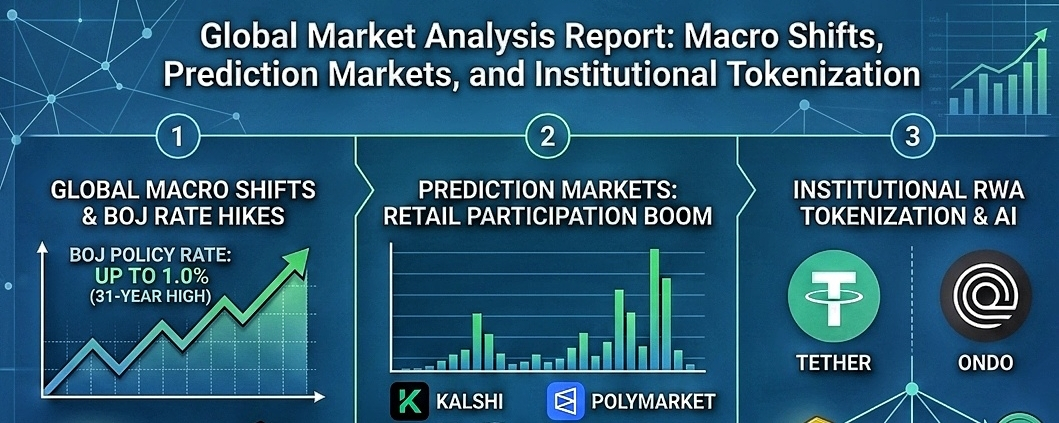
1. Monetary Policy: Bank of Japan’s Historic Rate Hike and Global Liquidity Implications
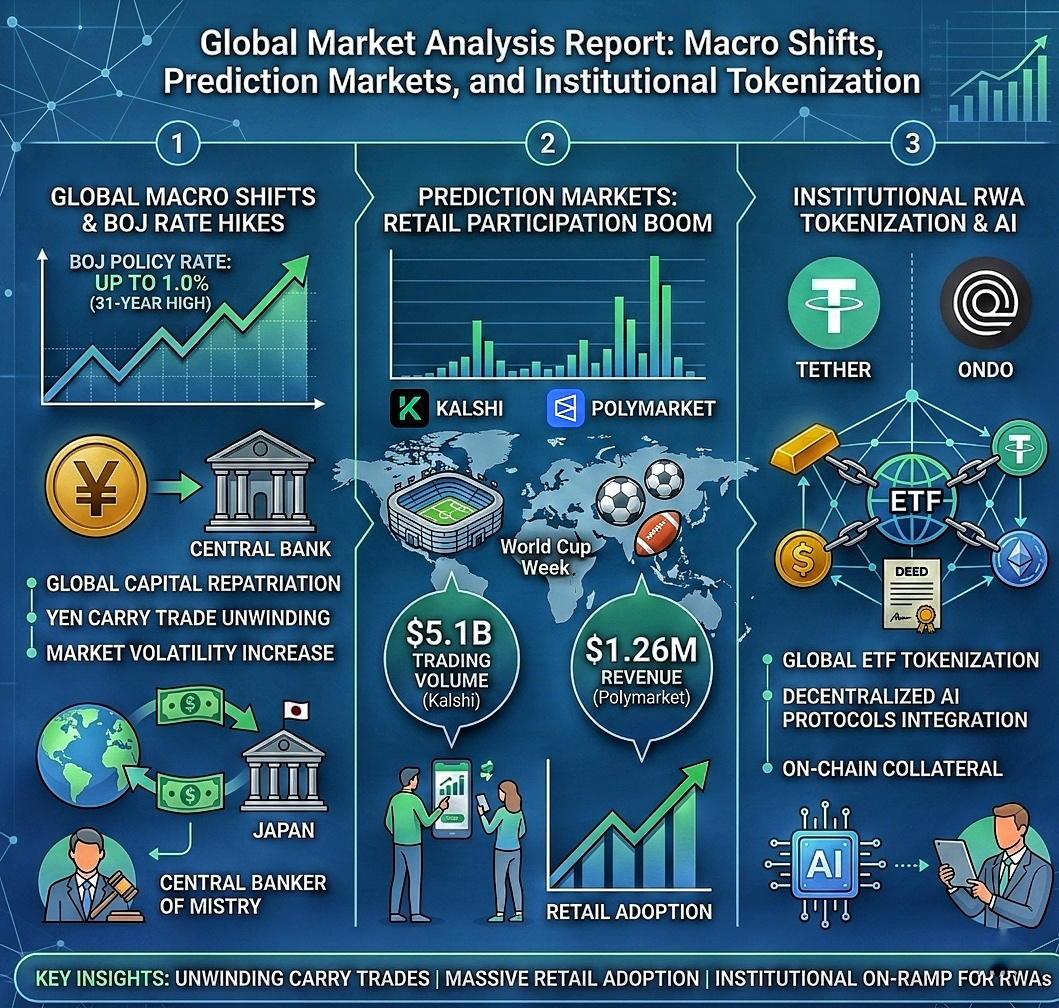
The Bank of Japan (BoJ) has raised its benchmark policy rate to 1.0%, marking the highest borrowing costs seen in the nation in 31 years. This aggressive hawkish pivot represents a definitive end to decades of ultra-loose monetary policy and negative interest rate regimes aimed at combating deflation.
Market Implications & Structural Shifts
The Unwinding of the Yen Carry Trade: For decades, global investors utilized the "carry trade"—borrowing capital in cheap Japanese Yen to invest in higher-yielding assets abroad, such as US equities, tech stocks, and emerging market debt. A 1.0% policy rate significantly narrows the interest rate differential, forcing institutional players to rapidly unwind these positions. This repatriation of capital back into Japan triggers localized volatility across global equity and bond markets.
Global Liquidity Squeeze: As the BoJ pulls back on its massive liquidity injections, the cost of global capital rises. This tightening mechanism pressures high-risk financial sectors, forcing a re-evaluation of asset valuations worldwide.
Strength of the Yen: The domestic tightening cycle bolsters the Japanese Yen against major currency pairs, modifying import-export dynamics and altering international corporate earnings structures for multinational conglomerates.
2. FinTech Innovation: The Exponential Rise of Decentralized Prediction Markets
The financial landscape is witnessing an unprecedented surge in retail participation within decentralized prediction platforms, exemplified by Kalshi recording $5.1B in trading volume during World Cup week and Polymarket’s revenue hitting $1.26M.
Strategic Analysis of Retail Inflows
Alternative Asset Class Validation: Event-based trading and prediction markets have transitioned from niche cryptographic applications to mainstream financial instruments. The multi-billion dollar volume underscores a growing retail appetite for wagering on real-world events (sports, politics, economics) as a legitimate hedging or speculative mechanism.
Liquidity and Depth: High volume metrics during major events like the World Cup indicate deep liquidity pools. This prevents heavy slippage, attracting larger quantitative trading desks alongside retail participants.
Regulatory Divergence: While platforms like Polymarket operate primarily on-chain in decentralized ecosystems, Kalshi operates as a regulated CFTC entity. The simultaneous growth of both highlights that user demand transcends traditional compliance frameworks, showing a universal pull toward prediction-based trading.
3. Digital Assets: Decentralized AI and Real-World Asset (RWA) Tokenization
The intersection of blockchain technology and legacy finance is accelerating, driven by Decentralized AI protocols and Real-World Asset (RWA) initiatives from industry leaders like Tether and Ondo Finance. These sectors are gaining substantial traction due to strategic institutional partnerships aimed at tokenizing global ETF lineups.
Institutional Integration & Future Outlook
The RWA Paradigm Shift: Tokenizing Exchange-Traded Funds (ETFs) and traditional financial securities converts legacy assets into highly divisible, 24/7 liquid digital tokens. Ondo Finance and Tether are building the infrastructure necessary to bring multi-trillion dollar traditional finance (TradFi) products onto public blockchains.
Operational Efficiency: By moving global ETF lineups onto distributed ledgers, institutional partnerships eliminate intermediary settlement costs, optimize cross-border transactions, and enable instantaneous collateral management.
Synergy with Decentralized AI: As AI protocols scale, they require decentralized, transparent financial layers to process automated, machine-to-machine microtransactions. Tokenized RWAs supply the stable, yield-bearing on-chain collateral needed to power these decentralized computing and AI ecosystems safely.
Executive Summary & Market Outlook
The convergence of these three narratives marks a major transition phase in global finance. While the Bank of Japan's rate hike signals a contraction in cheap fiat liquidity, capital is actively migrating toward highly efficient, technologically advanced vehicles. The massive retail volume flowing into prediction markets coupled with institutional deployment of tokenized ETFs and RWA frameworks demonstrates that the future of capital markets is shifting rapidly toward digital, decentralized, and highly automated architectures.
__________________________________
Disclaimer ⚠️
Educational Purposes Only: This report is prepared solely for informational and educational purposes based on market data. It does not constitute financial, legal, or investment advice.
__________________________________