Fogo didn’t arrive in the blockchain world quietly. It came in like a spark that instantly turned into a firestorm, a chain built with one obsession carved into its core: speed so real and so sharp that traders could feel it in their fingertips. While most blockchains talk about being fast, Fogo talks in block times measured in heartbeats. It talks in milliseconds, in raw execution, in the rhythm of high-frequency trading systems that barely blink. From the moment it hit the scene, it wasn’t a chain begging for attention; it was a chain daring the rest of crypto to keep up.
The idea behind Fogo was almost rebellious. Instead of trying to be everything for everyone, it focused on one thing—make on-chain trading feel like real-world trading. That meant no sluggish block intervals, no laggy confirmations, no waiting around as bots front-run you to death. Fogo’s designers came from backgrounds where speed wasn’t a luxury but oxygen. They knew that traders don’t care about fancy slogans or colorful dashboards; they care about how fast an order hits the chain, how quickly it confirms, and whether the system can keep up when the market is exploding with activity. So they built Fogo as a Solana Virtual Machine chain that doesn’t just mimic Solana—it tries to outrun it.
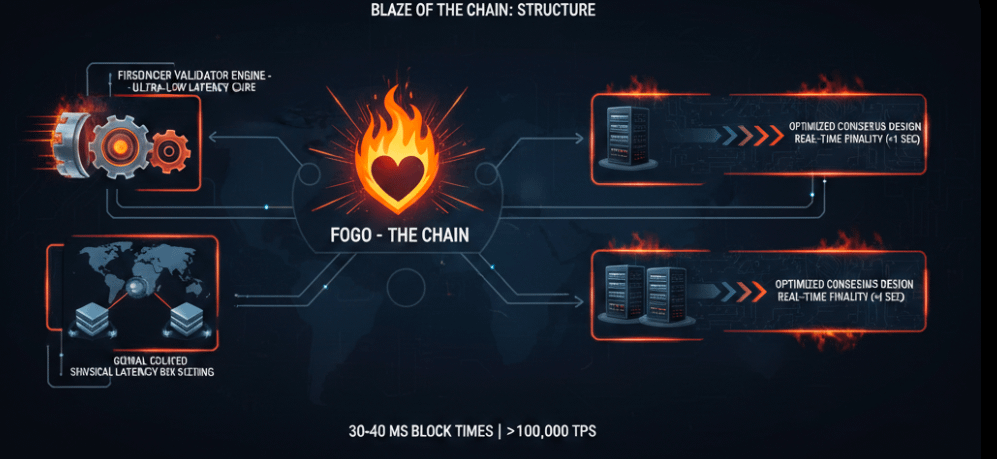
The heart of Fogo is pure Firedancer, a high-performance validator engine originally intended to push Solana to the next level. Fogo didn’t just use it; it leaned fully into it, shaping an entire network around the idea that latency should be as close to invisible as possible. When Fogo launched its mainnet in January 2026, the announcement was almost shocking. Thirty to forty millisecond block times. A claim of over one hundred thousand transactions per second. Finality near a single second. Numbers that sounded like centralised trading engine territory, but running on a public chain anyone could build on.
The magic wasn’t just in code—it was in the network design. Validators colocated in data centers across the world, strategically placed to slice physical latency. A consensus design optimized not for showy decentralization statistics but for real, functioning speed. Developers could take Solana apps and bring them over with barely any rewrites, and suddenly Fogo’s ecosystem started waking up. Small at first, but alive. Trading tools, liquidity pools, early lending platforms, swap engines, mini order books—tiny sparks building into a fire.
But the story wasn’t perfect. Fogo wasn’t trying to be perfect. It was trying to be fast. And with speed comes trade-offs. Less physical decentralization. More reliance on high-performance hardware. A smaller validator set tuned for efficiency rather than geographic sprawl. It made some purists uncomfortable. But the traders? They loved it. Because Fogo wasn’t pretending. It wasn’t claiming to be an everything chain. It was claiming to be the place where milliseconds mattered and where people who lived in the world of charts, bots, liquidity, and volatility could feel at home.
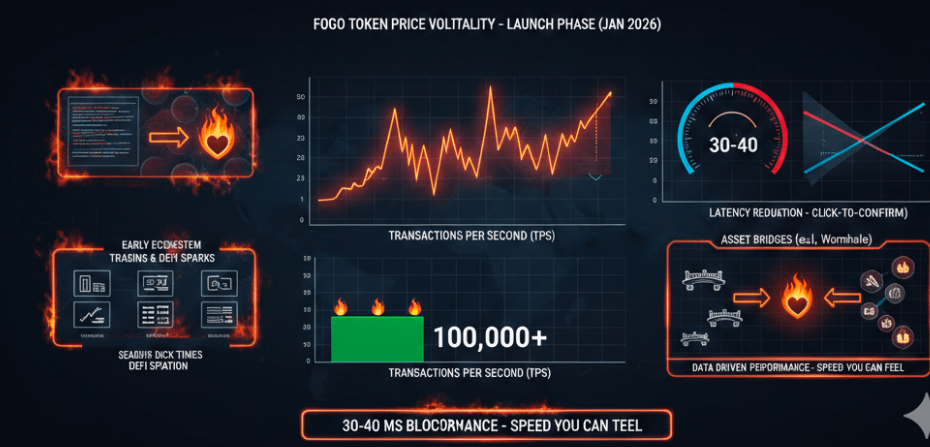
What really set the tone for the project was its approach to community. The team ended up canceling a giant presale, a rare move in a time when every early token seemed to come prepackaged with dozens of venture funds lined up. Instead, they pushed those tokens toward the public through airdrops, making the launch messy, wild, and undeniably real. When the token hit major exchanges, the volatility was instant. Prices shot up, then crashed under a wave of airdrop selling. Liquidity was thin. Traders circled. Speculators jumped in. Critics called it unstable. But Fogo wasn’t built to impress early chart watchers. It was built to grow with use, not hype.
Meanwhile, the tech kept speaking for itself. Bridges like Wormhole began connecting assets into the ecosystem. Developers tinkered and migrated. Early dApps started handling real volume. And people began to whisper the same thing again and again: this chain feels fast. Not theoretically fast. Not “marketing fast.” Actually fast. As in click-and-it’s-there fast. As in almost invisible latency fast.
Still, the big questions linger. Can Fogo sustain its speed when the market floods it with traffic? Will liquidity deepen enough for traders to stay? Can it carve out a niche in a world dominated by Solana, Sui, Aptos, and dozens of hungry Layer-1s? Those questions don’t have answers yet. They can only be answered by time, builders, users, and real market chaos hitting the chain all at once.
But Fogo doesn’t pretend to be the safe choice. It is the ambitious choice. The high-risk, high-reward chain that might one day host the kind of trading engines people never thought possible on public blockchains. The chain that might pull institutional traders into Web3 not because of ideology, but because the numbers finally make sense. The chain that might become the unofficial playground for those who live and breathe market speed.
Right now, it’s early. It’s volatile. It’s loud. It’s imperfect. But it’s undeniably one of the most thrilling stories in the Layer-1 world—a chain built for performance first, philosophy later. A chain that tries to bridge the gap between the world of crypto and the world of high-frequency finance. A chain that could burn bright or burn out, but will never be accused of being boring.
Fogo is a blaze in the darka reminder that innovation doesn’t always come from playing it safe. Sometimes it comes from pushing so hard and so fast that the rest of the world has to sprint just to keep up.