
Fogo feels like it was built by people who are tired of hearing promises and actually want things to work in real time. For years, blockchains have talked about speed, scalability, and mass adoption, yet most users still experience delays, high fees, or clunky interfaces that break the illusion of a modern financial system. Fogo enters this space with a clear mindset: on-chain activity should feel instant, predictable, and reliable, especially for trading and applications that live and die by milliseconds. Instead of reinventing everything, Fogo makes a practical decision by using the Solana Virtual Machine, allowing developers to build with familiar tools while pushing performance far beyond what most Layer 1 networks currently deliver.
What makes Fogo interesting is not just how fast it claims to be, but why that speed actually matters. In real markets, delays are costly. Slippage, failed transactions, and unpredictable execution hurt both users and builders. Fogo is designed to reduce these frictions by focusing on extremely low latency and fast block times, making on-chain execution feel closer to centralized exchanges while still preserving the transparency and composability of blockchain systems. This approach changes how developers think about what is possible on-chain, opening the door to applications that were previously impractical due to timing constraints.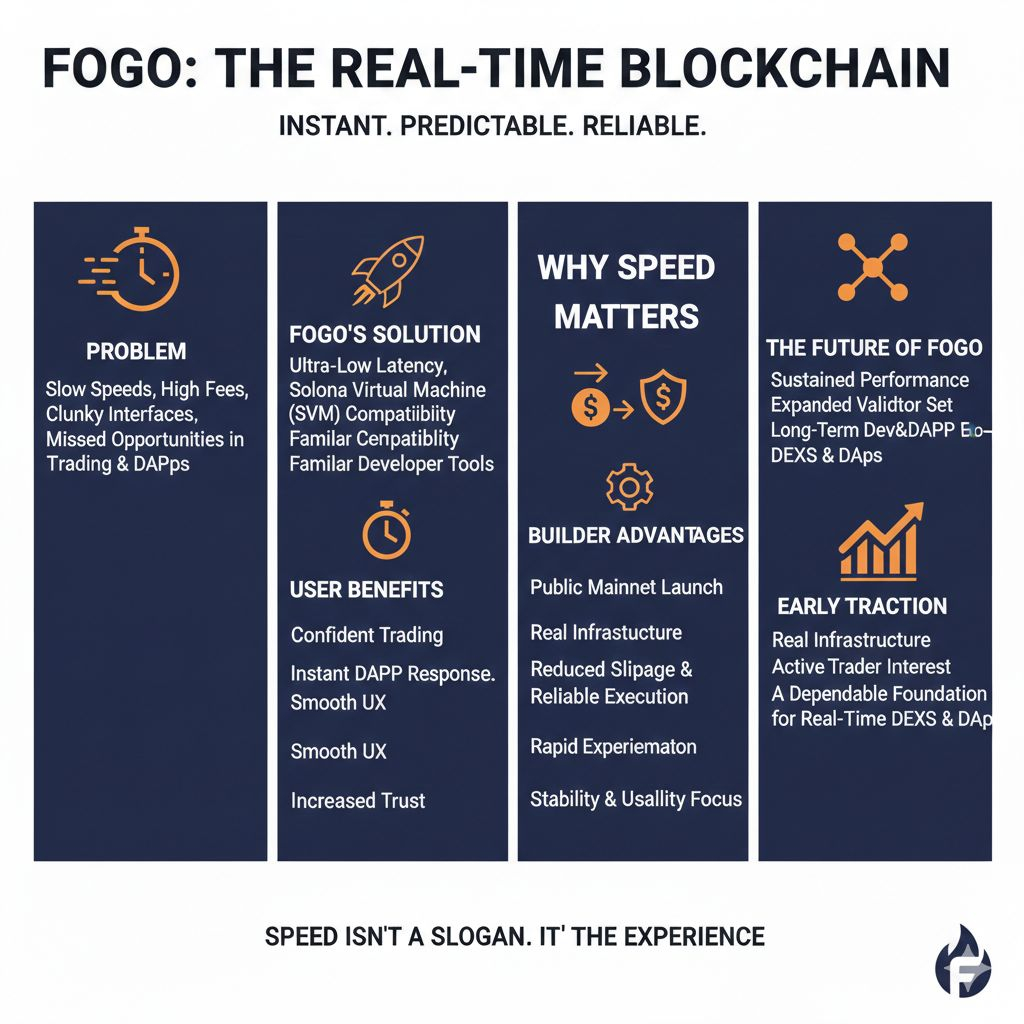
Since its public mainnet launch, Fogo has positioned itself as more than a test experiment. It arrived with real infrastructure, early applications, and active interest from traders and developers. That timing matters. Launching with momentum creates confidence, and confidence attracts builders. The network’s early phase shows a clear emphasis on stability and usability rather than hype alone. Instead of overwhelming users with complex governance or abstract narratives, Fogo focuses on proving that the chain can run smoothly under real conditions, which is ultimately what keeps ecosystems alive.
When looking at Fogo’s current position, it sits at an intersection many chains aim for but few reach. It is fast enough to attract serious trading activity, yet familiar enough for developers who already understand SVM-based systems. This balance lowers the barrier to entry and accelerates experimentation. Projects do not need to completely rethink their architecture to try Fogo; they can adapt and deploy, test performance, and decide based on real results. That flexibility is one of Fogo’s quiet strengths and could become a major driver of long-term adoption.
Comparing Fogo to other systems highlights its practical edge. Many EVM-based chains focus heavily on compatibility but struggle with throughput and latency. Others chase raw performance but sacrifice developer experience or composability. Fogo tries to avoid both extremes. By staying compatible with SVM while aggressively optimizing execution and validator performance, it carves out a space where speed does not come at the cost of usability. Against Solana itself, Fogo is not a replacement but an alternative execution environment, tuned specifically for ultra-low latency use cases and financial precision.
The benefits of this design become clearer when imagining how users actually interact with the chain. Faster confirmation means traders can act with confidence. Developers can design applications that respond instantly to user input. Games and real-time markets feel smoother and more engaging. These are not abstract improvements; they directly affect how people perceive and trust a platform. Over time, that trust becomes a competitive advantage that is difficult to copy.
Of course, no system is perfect, and Fogo faces real challenges. Maintaining decentralization while pushing high performance is not easy. Validator requirements can be demanding, and the network must work carefully to ensure participation remains broad and resilient. Speed must also be paired with fairness, otherwise efficiency simply shifts value toward those with the fastest access. How Fogo manages these trade-offs will define its long-term credibility.
From a scoring and market perspective, Fogo shows strong early potential. Technical ambition is high, developer onboarding is relatively smooth, and market interest is clearly present. The next phase will be about consistency: sustaining performance, expanding the validator set, and supporting builders beyond the launch window. If Fogo can do this, it moves from being “the fast chain” to being a dependable foundation for real-time decentralized applications.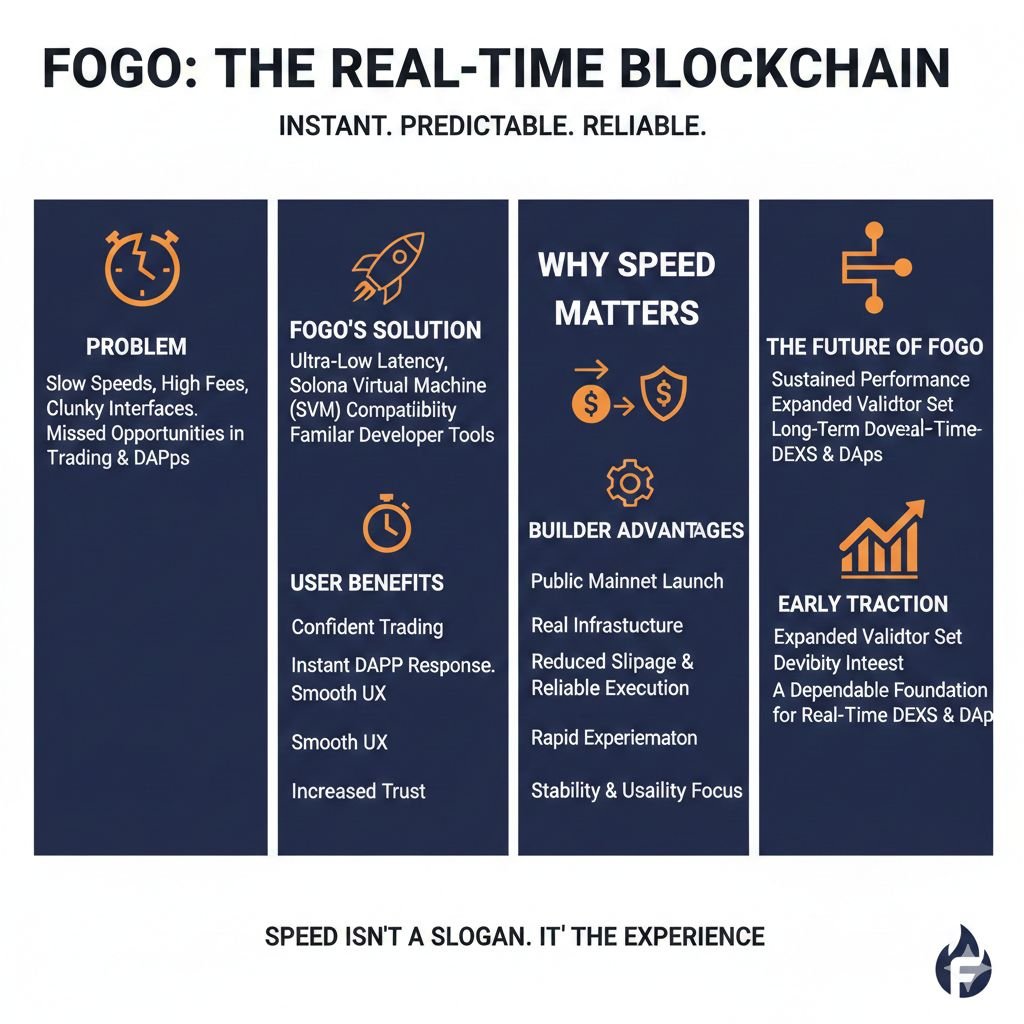
Ultimately, Fogo represents a shift in mindset. It treats speed not as a marketing slogan, but as a core user experience requirement. If the network continues to mature while staying grounded in practical execution, it has a real chance to define a new standard for what on-chain systems should feel like. The future of blockchain will not belong only to the most decentralized or the most compatible networks, but to those that users actually enjoy using. Fogo is betting on that future.
