
When I look at Fogo, I don’t see another chain competing on theoretical TPS. I see an infrastructure thesis centered on one variable most networks underestimate: time predictability.
Markets do not reward raw throughput. They reward determinism. In trading, settlement, and real-time DeFi execution, what matters is not how fast a chain can go in ideal conditions — it’s how reliably it performs under load. Fogo’s positioning reflects that distinction. The focus is operational discipline: reduce latency variance, eliminate unnecessary execution friction, and make performance measurable at the service level.
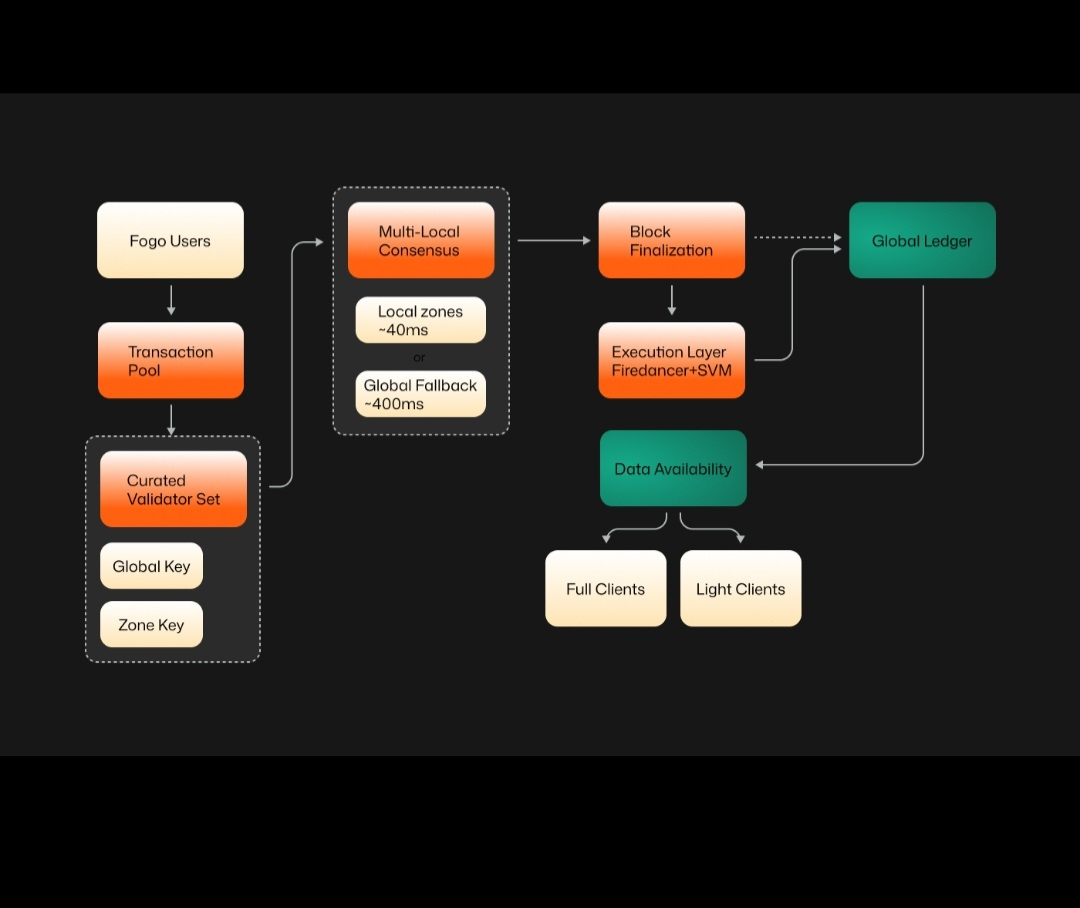
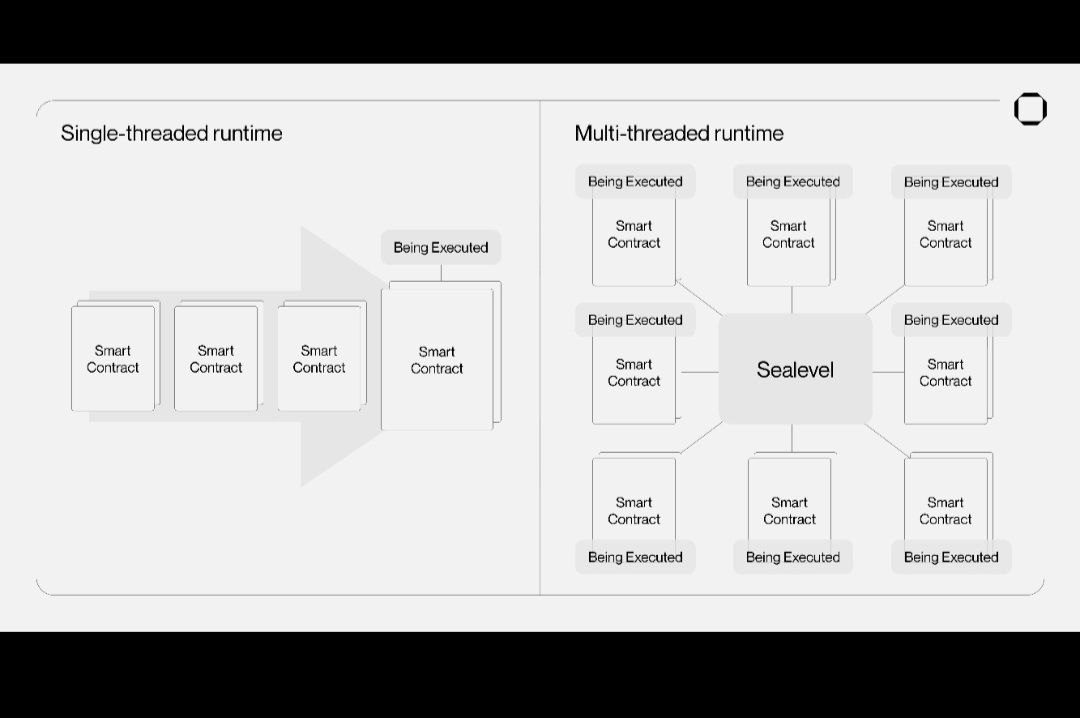
The SVM compatibility is not a marketing layer. It’s a strategic constraint. By aligning with the Solana Virtual Machine, Fogo removes developer migration cost. No code rewrites. No tooling reinvention. Existing applications can deploy without architectural surgery. That single design decision collapses onboarding friction — and friction, not ideology, is what slows ecosystem growth.
But compatibility alone is not the thesis. The core is execution architecture.
Fogo’s zone-based approach reframes how load is handled. Instead of forcing the entire network to share congestion risk, workload can be segmented. This reduces cross-domain interference and stabilizes performance characteristics. In practice, that means applications operating in one zone are less exposed to latency spikes generated elsewhere. For trading systems and liquidity venues, isolation is not a luxury — it’s risk management.
Validator mechanics reinforce this orientation. A network that prioritizes predictable performance must align economic incentives accordingly. Staking participation is not just about security weight; it is about sustaining uptime guarantees and throughput consistency. If validators are rewarded strictly on volume without regard to reliability, the system degrades under stress. Fogo’s structure implicitly treats validator behavior as part of the service layer, not merely consensus plumbing.
RPC reliability is another under-discussed axis. Most application failures in Web3 are not consensus failures; they are infrastructure failures. Endpoints stall. Requests queue unpredictably. Latency becomes asymmetric across geographies. When that happens, developers lose confidence — not in cryptography, but in deployability. Fogo’s emphasis on infrastructure quality signals an understanding that production-grade adoption depends on endpoint performance as much as block production.
From an institutional lens, this matters. Enterprises and serious trading firms do not optimize for ideology. They optimize for service-level assurances. They ask: What is the latency distribution? What is the tail risk during congestion? How isolated is my execution environment? How predictable is my settlement window?
Fogo’s narrative aligns with those questions. It positions performance not as a bragging right, but as a contractual expectation. That framing changes the audience. It moves the conversation from retail speculation to operational integration.
There is also a subtle but important implication in the low-latency focus. In high-frequency environments, small timing advantages compound. When block confirmation variance narrows, strategies that were previously too fragile become viable. Market makers can tighten spreads. Arbitrage becomes more efficient. Capital utilization improves. The ecosystem becomes mechanically more competitive.
Yet the discipline must hold under pressure. Any performance-oriented chain faces the same test: how does it behave when activity spikes? Does latency remain within defined bounds? Do zones maintain isolation? Do validators sustain throughput without centralizing power? The credibility of Fogo will be determined not by announcements, but by empirical stability during real demand.
I view Fogo less as a chain chasing headlines and more as a network attempting to professionalize blockspace. If it succeeds, the differentiation will not be aesthetic. It will be statistical. Narrower latency bands. Lower variance. Cleaner RPC performance. Predictable settlement windows.
In infrastructure markets, those metrics matter more than slogans.
The long-term opportunity is not simply attracting developers. It is attracting developers who build systems where milliseconds translate to capital efficiency. By preserving SVM compatibility, Fogo lowers switching costs. By optimizing for latency and segmentation, it raises execution standards. That combination is structurally coherent.
Performance, treated as a service layer rather than a marketing metric, is a defensible positioning strategy. It acknowledges a simple reality: Web3 will not scale because chains are marginally faster in theory. It will scale when application teams trust the underlying infrastructure enough to build systems that assume reliability.
Fogo’s bet is that predictability — not peak speed — becomes the scarce commodity.
If that thesis holds, the network will not be remembered for benchmarks. It will be measured by how quietly and consistently it performs when real capital flows through it.
And in infrastructure, consistency is power.