

The point the industry has never made is that making a validator participate in consensus when one is not in a good position to do so will not strengthen the network. It makes it weaker.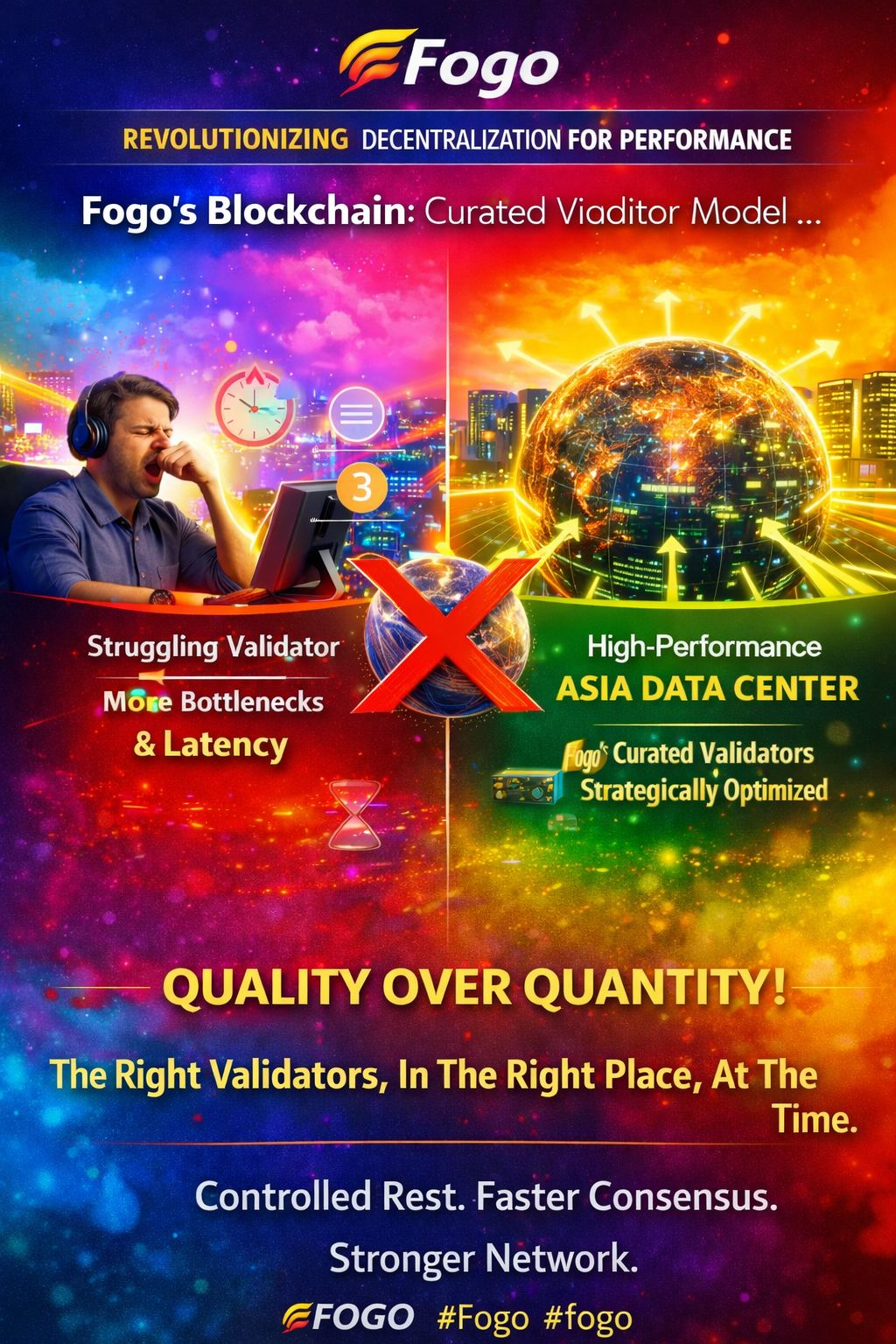
There is one issue with traditional blockchain networks. They are victims of bottlenecks of client diversity. This implies that a client limits the performance of the networks. There are some benefits of client diversity. But it does not produce performance problems either. The reason behind this is that, networks must work with the speed and optimization of clients.
A New York based validator running consensus at 3 AM Singapore time is not doing the network any favour. Its actually causing delays.
This is a residue of the belief that the more validators, the better.
Fogo does things in a different way. It has the validator set that is curated. This enables enforcement of behaviors that are beneficial to the network in layers. Such actions may be a nightmare to capture in protocol rules.
The right validators are at the right place and the right time generate a cleaner consensus faster.
This would be superior to the state of having validators distributed among conditions.
This is not a tradeoff to decentralization. It is a re-definition of what decentralization ought to accomplish. It's not about participation. Concerning the integrity of the outcome. Decentralization is concerned with good working network.
The Inner Meaning: Competitive Advantage of Controlled Rest.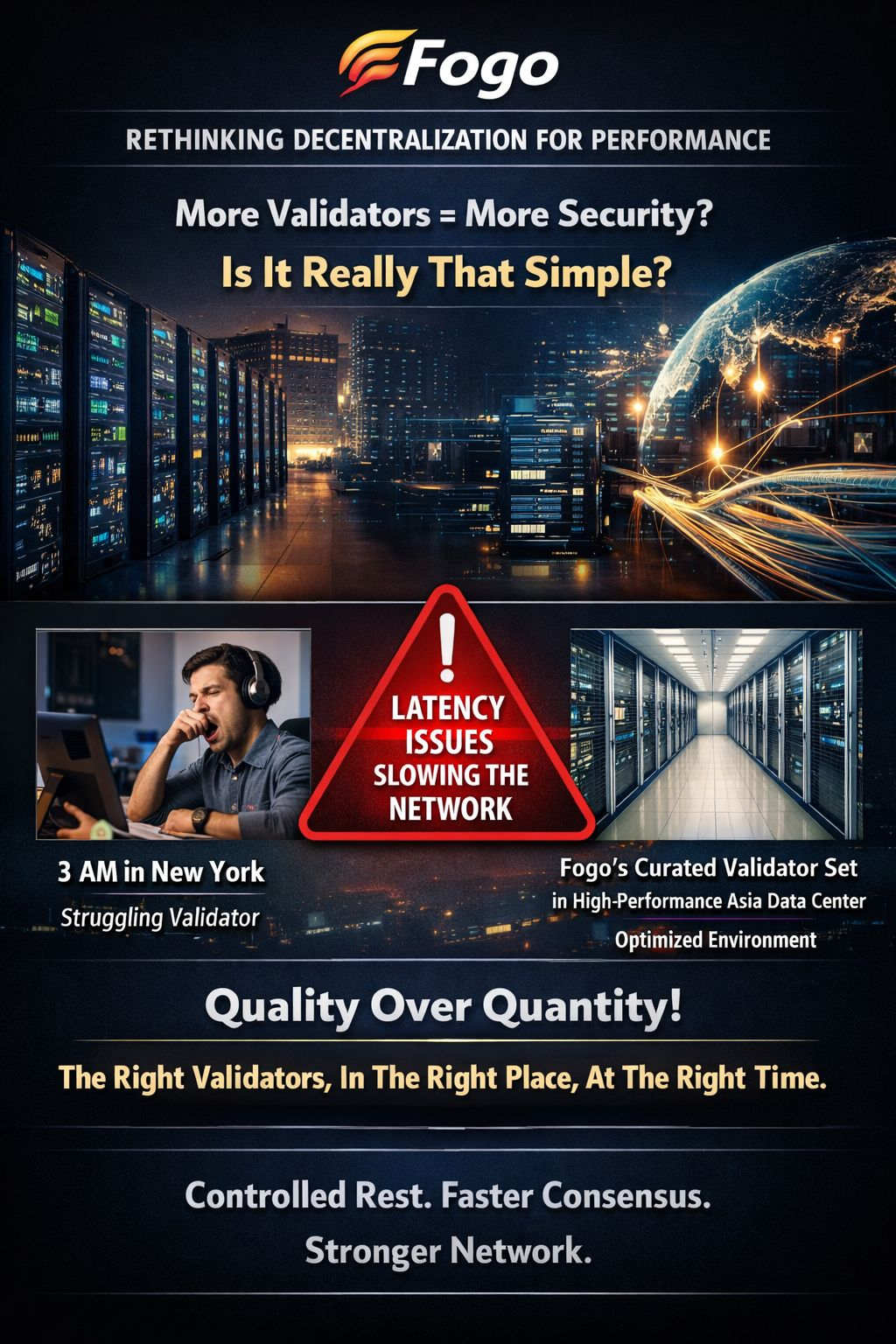
Fogos was launched using the validator model. It has all its initial active validators in a high-performance data center in Asia. This datacenter is located strategically close to crypto exchanges infrastructure. This methodology is borrowed in finance. It reduces physical distance information which has to be covered by validators.
The analogy of finance is educative.
The stock exchanges do not need market makers who have to quote at all times.
They plan sessions, maintenance schedules and levels of participation.
One of the risk management tools is the organization of participation.
This reasoning is applied to consensus architecture by Fogo.
What dawns is a network that is functioning as an educated team. Every member performs optimally on his or her window. Every change is premeditated.
The Industry Wants a Wake-Up Call It Is Not Ready to Take.
The blockchain arena had more than ten years of availability at security. These are not the thing. The network where all nodes are constantly connected irrespective of the quality of performance and geographic utility is not maximally secure. It is maximally noisy.
This questions the held notion that decentralization requires unvarying uniform involvement.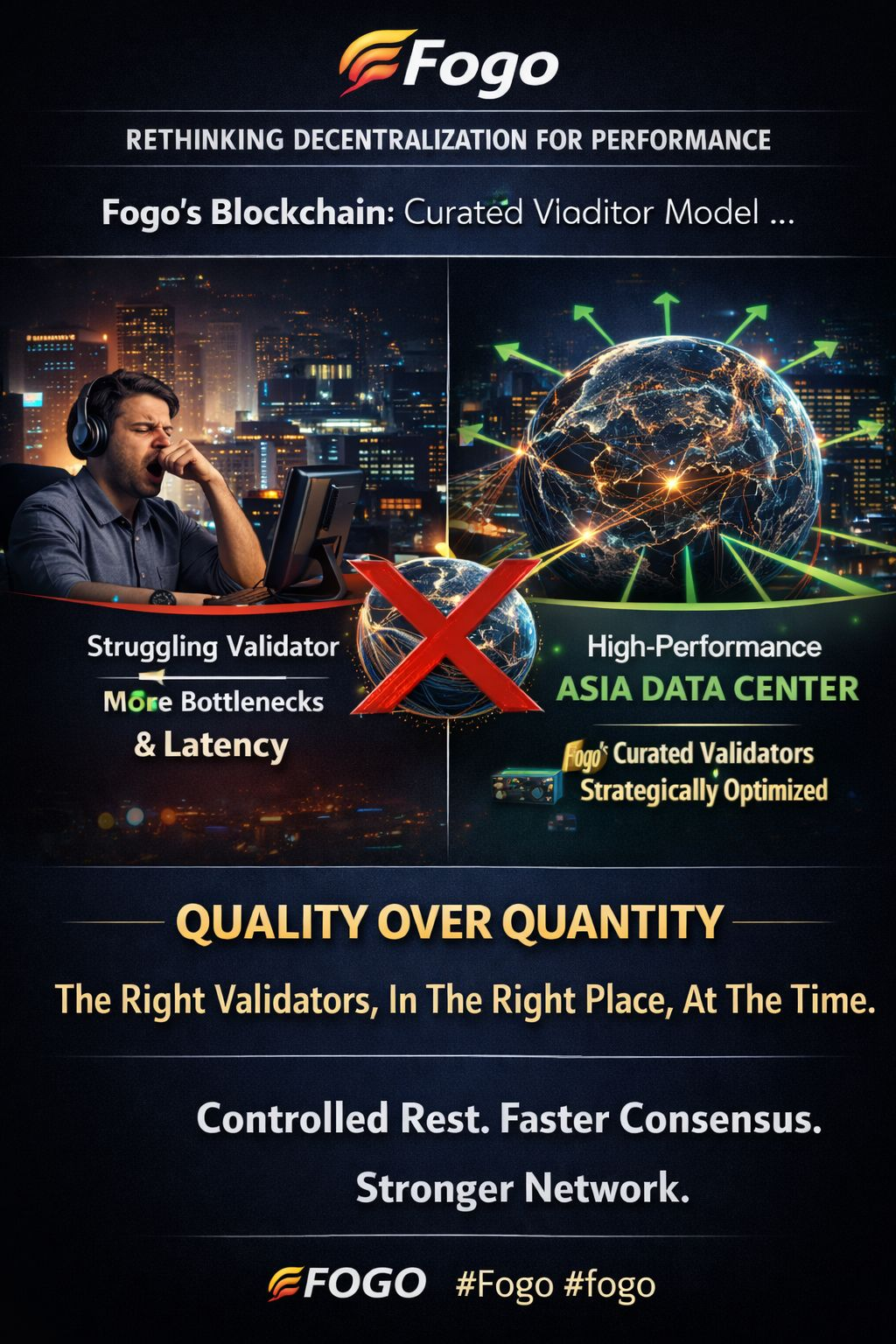
It redefines resilience as coordinated action as opposed to ongoing presence.
To say; stop forcing it, is the protocol, foge. Let the nodes rest. Let zones rotate. Meditative silence should be included in the design.
This idea is not likely to be accepted in the industry.
The mythology of on decentralization is well rooted.
It is difficult to disagree with Fogos logic.
The concept of distributed system resilience was not tied to all the components being operational at all times.
It was never, of the entire so to go on when parts are bound to fail.
This observation is not merely technically correct. The thing is that it might be the design philosophy, which makes the chain creation a fact that is independent of all that preceded it.