Speed in DeFi is not a vanity metric. It is a coordination primitive.
Fogo builds its thesis around that distinction. Not “How fast can we go?” but rather, "How predictably can we execute when markets are under stress?”
Because in decentralized finance, timing is risk.
When liquidations trigger milliseconds apart, when order books update in real time, when margin thresholds shift during volatility — fragmentation becomes systemic danger.
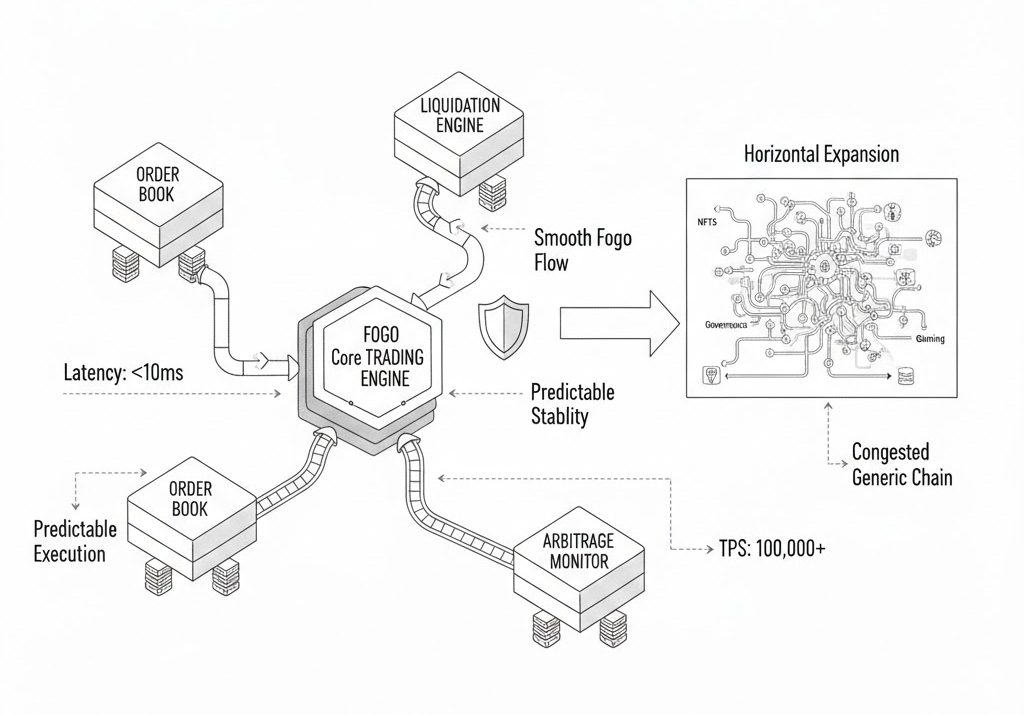
As a Layer 1 fast chain, Fogo narrows its surface area deliberately.
It does not try to optimize for every possible on-chain activity. Instead, it prioritizes the most timing-sensitive workloads:
On-chain order books
Real-time auctions
Precise liquidation engines
“Speed without synchronization is noise.”
Testnet metrics — block times near 20 milliseconds and throughput reaching tens of thousands of transactions per second — signal more than raw TPS ambition. They indicate a design tuned for sustained execution, not headline bursts.
A central architectural decision is alignment with the Solana Virtual Machine.
By maintaining compatibility with the execution layer popularized by Solana, Fogo preserves developer continuity while rethinking the performance envelope beneath it.
This separation is strategic.
Execution familiarity above.
Performance optimization below.
Developers can migrate SVM programs with minimal friction — yet operate inside a system recalibrated for lower latency and tighter finality targets.
Technically, the differentiation becomes clearer:
SVM compatibility: tooling and contract portability
Firedancer-based client architecture: latency compression
Multi-local consensus design and reduced timing variance
The objective is not simply high TPS.
It is deterministic coordination.
“Markets reward precision, not peak throughput.”
Compared with broader L1 ecosystems, the contrast sharpens.
Many blockchains pursue heterogeneity: NFTs, gaming, governance, DeFi — all sharing execution bandwidth. That diversity drives adoption, but also introduces unpredictable contention.
Even high-throughput chains can experience temporal inconsistency during network stress.
Fogo’s specialization suggests a different philosophy:
What if a chain were engineered primarily as financial infrastructure?
From my perspective, this narrowing of scope is a structural thesis, not a constraint.
Traditional financial systems rarely collapse due to lack of speed. They collapse when participants lose confidence in synchronized state transitions.
I think Fogo is implicitly addressing that subtle layer of risk within DeFi — the coordination gap that emerges during volatility spikes.
The comparison with Solana is nuanced.
Solana remains a broad, high-performance ecosystem. Fogo appears to extract the execution strengths of the SVM model while tightening the performance envelope specifically for high-frequency DeFi environments.
Less a competitor.
More a specialization.
If DeFi continues evolving toward institutional-grade trading environments, chains may increasingly be evaluated not by maximum TPS, but by execution determinism under pressure.
“Fast” will no longer mean peak speed.
It will mean synchronized, predictable settlement — even when markets are chaotic.
And in that framing, Fogo’s architecture feels less like optimization, and more like calibration for the next phase of decentralized finance.