Last week I was standing in a small electronics shop watching the owner update prices by hand. He kept glancing at the street, adjusting numbers depending on who walked in. Regular customer, slightly softer price. Stranger, firmer tone. It reminded me that markets are not just about speed. They’re about how information moves between people, and who reacts first.
That’s why order book DEXs feel different from the usual automated exchanges. An order book is simply a live list of buy and sell offers. You post the price you want. Someone else agrees. Trade done. No formula adjusting the price behind the curtain. It’s transparent, but also exposed. If the network hesitates, even briefly, the whole structure feels shaky.
Solana made on-chain order books practical because it processes a large number of transactions per second. Throughput just means how much activity the chain can handle. Latency, the delay between submitting a trade and seeing it confirmed, is low enough that market makers—firms that continuously place buy and sell orders—can operate without constant fear of being picked off. That changed behavior. Traders stopped treating on-chain order books like experiments and started using them seriously.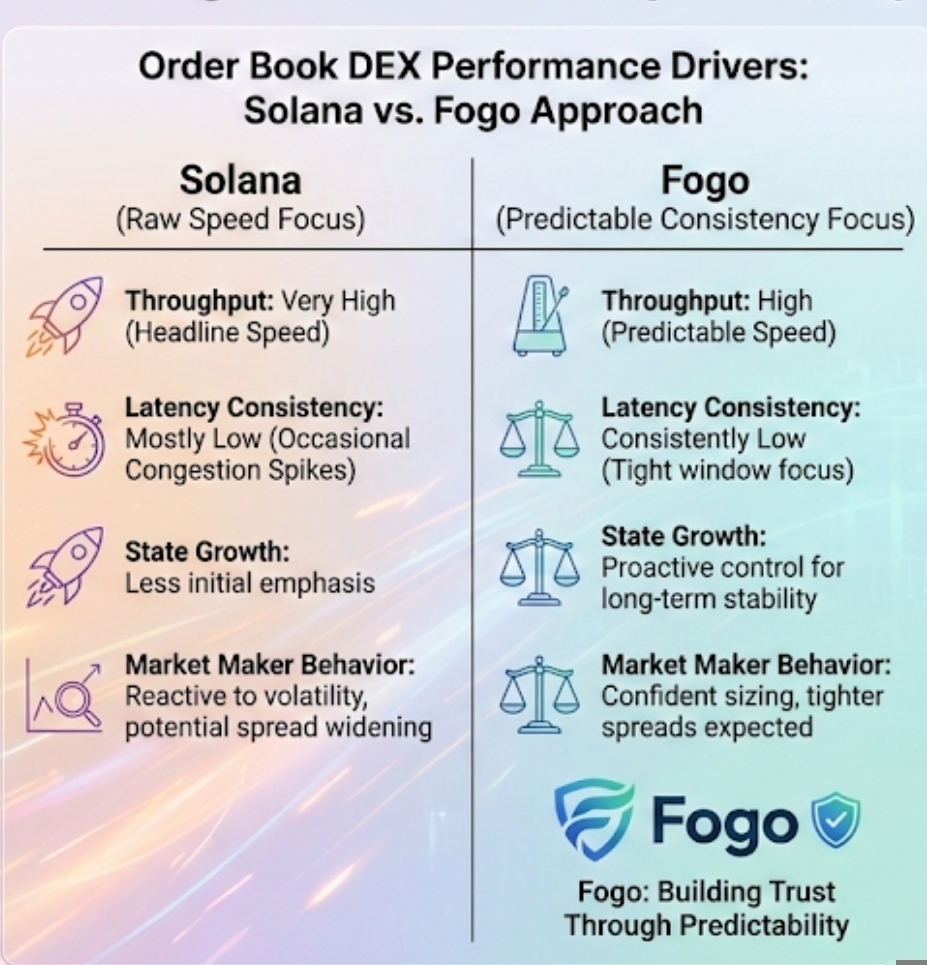
Fogo approaches the same space with a slightly different tone. It talks less about raw speed as a headline and more about making that speed predictable. That distinction sounds subtle, but it matters. In an order book, predictability can be more valuable than peak performance. If I know confirmations consistently arrive within a tight window, I can size positions more confidently. If sometimes it’s instant and sometimes it stalls, I widen my spreads. Spreads, by the way, are just the gap between the highest bid and the lowest ask. Wider spreads mean higher trading costs.
I’ve seen this play out before. During volatile periods on Solana, congestion led to failed transactions and delayed confirmations. Not constantly, but enough that traders noticed. When that happens, liquidity thins. Liquidity simply means how easily you can buy or sell without moving the price too much. Once confidence dips, market makers reduce exposure. They pull orders back. The book looks full until suddenly it doesn’t.
Fogo’s design tries to address stress before it shows up on dashboards. There’s discussion about controlling state growth, which means preventing the blockchain’s stored data from expanding in a way that slows validation over time. It sounds technical, but the practical question is simple: will performance degrade as usage grows? Many chains look impressive early on. The real test comes months later, when traffic is steady and unglamorous.
And here’s something I don’t see discussed often. Lower latency can quietly change who wins. When execution becomes extremely fast, the edge shifts toward those with better infrastructure. Colocated servers. Optimized connections. Retail traders may technically have equal access, but practically, they’re a few steps behind. We’ve seen this dynamic in traditional finance for years. Crypto likes to believe it’s different. I’m not fully convinced.
There’s also the incentive layer. Early DEX growth often depends on liquidity mining, which pays users to provide capital. That boosts volume numbers. Volume is simply the total value traded over a period of time. High volume looks impressive on analytics dashboards and on platforms like Binance Square, where visibility metrics amplify whatever is trending. But not all volume reflects conviction. Sometimes it reflects rewards. When emissions drop, activity can cool quickly. An order book DEX built on incentives alone feels fragile.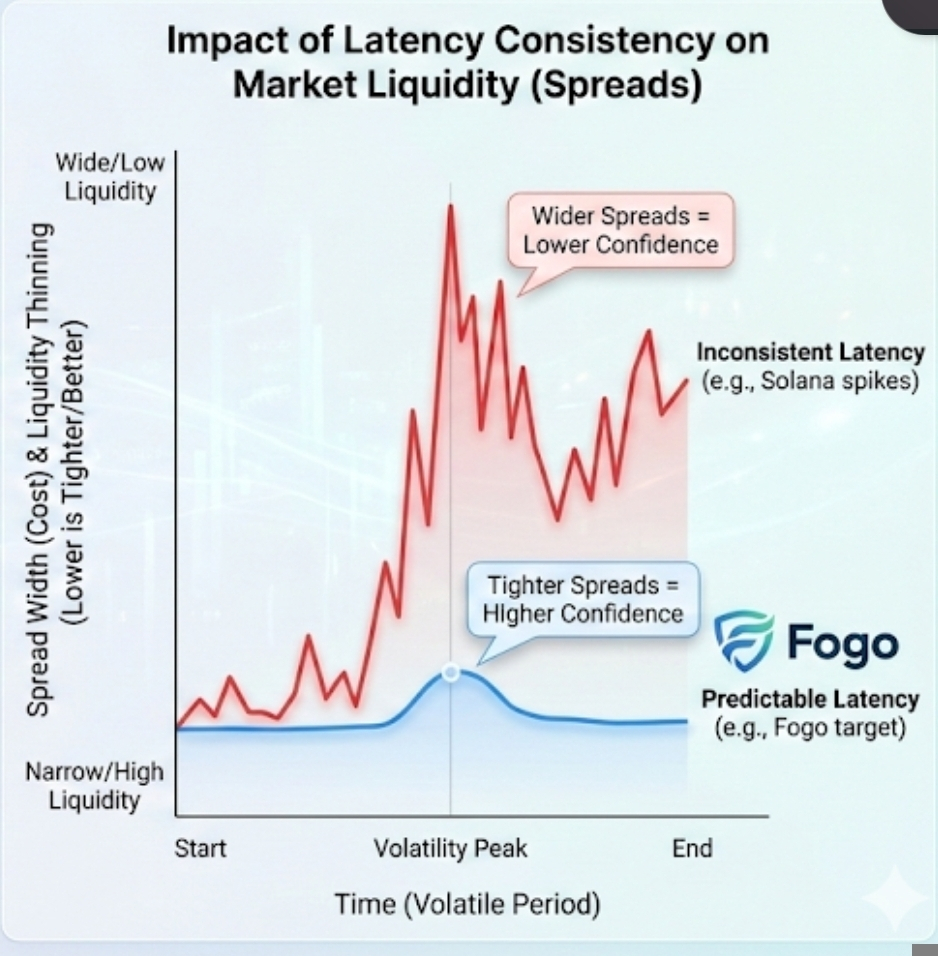
Solana already has depth with wallet integrations, analytics tools, derivatives platforms. Derivatives are contracts whose value depends on another asset, like futures tied to a token’s price. That ecosystem matters. Traders don’t just want a fast order book. They want the ability to hedge, borrow, rotate capital. Infrastructure around the exchange can matter as much as the exchange itself.
Fogo still has to prove that side. Speed claims are easy to tweet. Building trust that takes longer. Traders pay attention to transaction ordering, which is how the network decides which trade gets processed first. If ordering feels inconsistent, it creates suspicion. In an order book environment, even a small perception of unfairness spreads quickly. And once trust erodes, it doesn’t recover overnight.
I sometimes wonder whether the real difference won’t be technical at all. It might be culturals. Solana grew through experimentation and occasional chaos. That shaped its community. Fogo seems to be positioning itself as more deliberate, almost cautious. That could attract a different type of trader. Or it could feel less exciting in a market that often rewards noise.
There’s a temptation to reduce the comparison to benchmarks. Transactions per second. Milliseconds. Finality times, which simply refer to how long it takes before a transaction is considered irreversible. But trading is emotional. Predictability reduces stress. Consistency builds habits. Habits build liquidity.
If Fogo can maintain tight spreads during volatility without leaning heavily on temporary incentives, that would signal something real. If Solana continues to refine reliability while keeping its ecosystem vibrant, it remains formidable. Neither path guarantees dominance.
Order book DEXs don’t hide weaknesses. They expose them in real time. Every stalled transaction, every widened spread, every sudden drop in depth tells a story. Watching how Fogo and Solana handle those quiet, unglamorous moments will probably reveal more than any launch announcement ever could. And markets, like that shop owner with his handwritten price tags, respond not just to speed, but to who adjusts best when the crowd shifts unexpectedly.

Bài viết
Order Book DEXs on Fogo vs Solana. What Changes?
Tuyên bố miễn trừ trách nhiệm: Bao gồm cả quan điểm của bên thứ ba. Đây không phải lời khuyên tài chính. Có thể bao gồm nội dung được tài trợ. Xem Điều khoản & Điều kiện.
0
2
1.1k
Tìm hiểu tin tức mới nhất về tiền mã hóa
⚡️ Hãy tham gia những cuộc thảo luận mới nhất về tiền mã hóa
💬 Tương tác với những nhà sáng tạo mà bạn yêu thích
👍 Thưởng thức nội dung mà bạn quan tâm
Email / Số điện thoại