
Most chains are presented through average metrics: average TPS, average confirmation, average conditions.
But markets do not break during average conditions. They break when volatility spikes, liquidations chain together, and bots flood every profitable route. That is where infrastructure quality becomes visible.
What makes Fogo interesting to me is that the design appears focused on variance control and predictable execution. Official docs describe a multi-local consensus model with zone-based validator coordination, while testnet docs show a 40ms target block time and 375-block leader terms. Combined with a Firedancer-based client direction, this is a very specific thesis: prioritize deterministic low-latency behavior for latency-sensitive workloads.
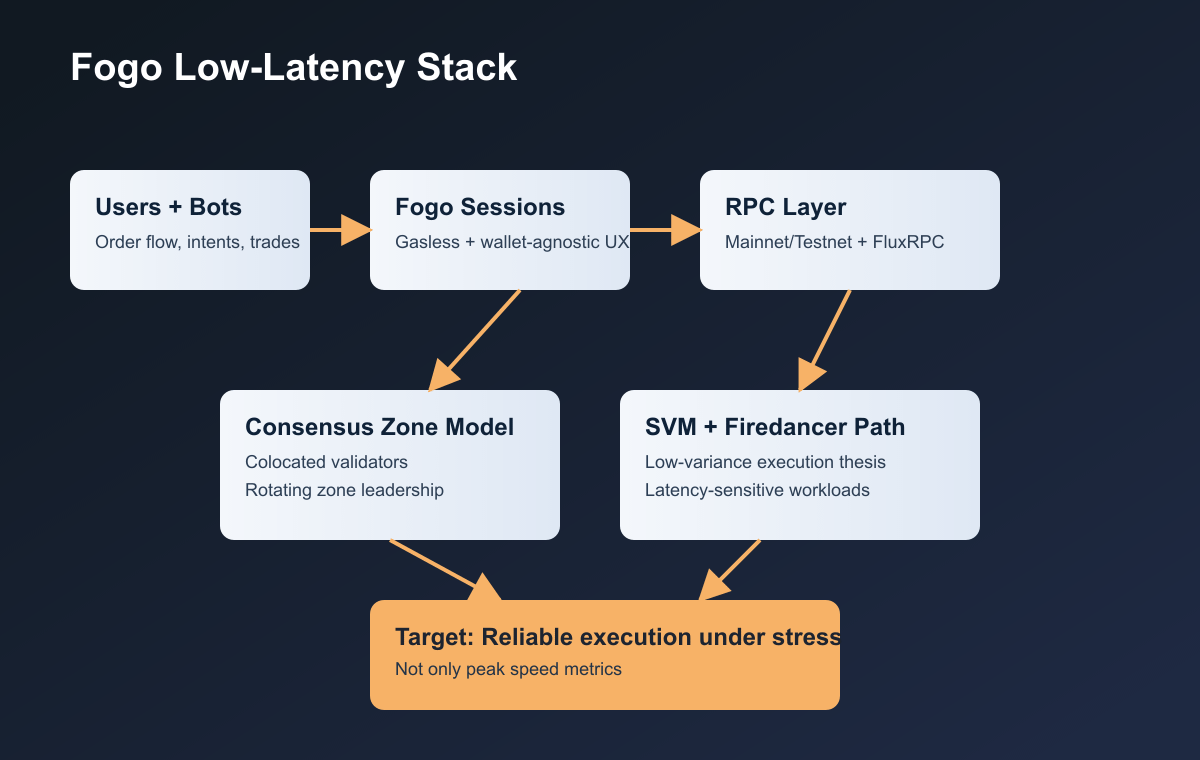
This also matches practical product direction. The docs include public mainnet/testnet RPC access, FluxRPC infrastructure, and Fogo Sessions for gasless wallet-agnostic UX through account abstraction and paymaster patterns. So this is not just "faster chain" branding; it is trying to align user flow, infra flow, and execution flow into one system.
Recent project timeline also matters. Mainnet is documented as live, tokenomics were published on January 12, 2026, the airdrop update was published on January 15, 2026, and Flames Season 1.5 was announced on February 20, 2026. That sequence looks like a project moving from architecture narrative into distribution and ecosystem activation.
I am watching one thing most: whether Fogo can preserve low-variance behavior during actual stress windows, not only during controlled benchmarks. If that holds, it can become one of the most relevant execution environments for onchain markets.