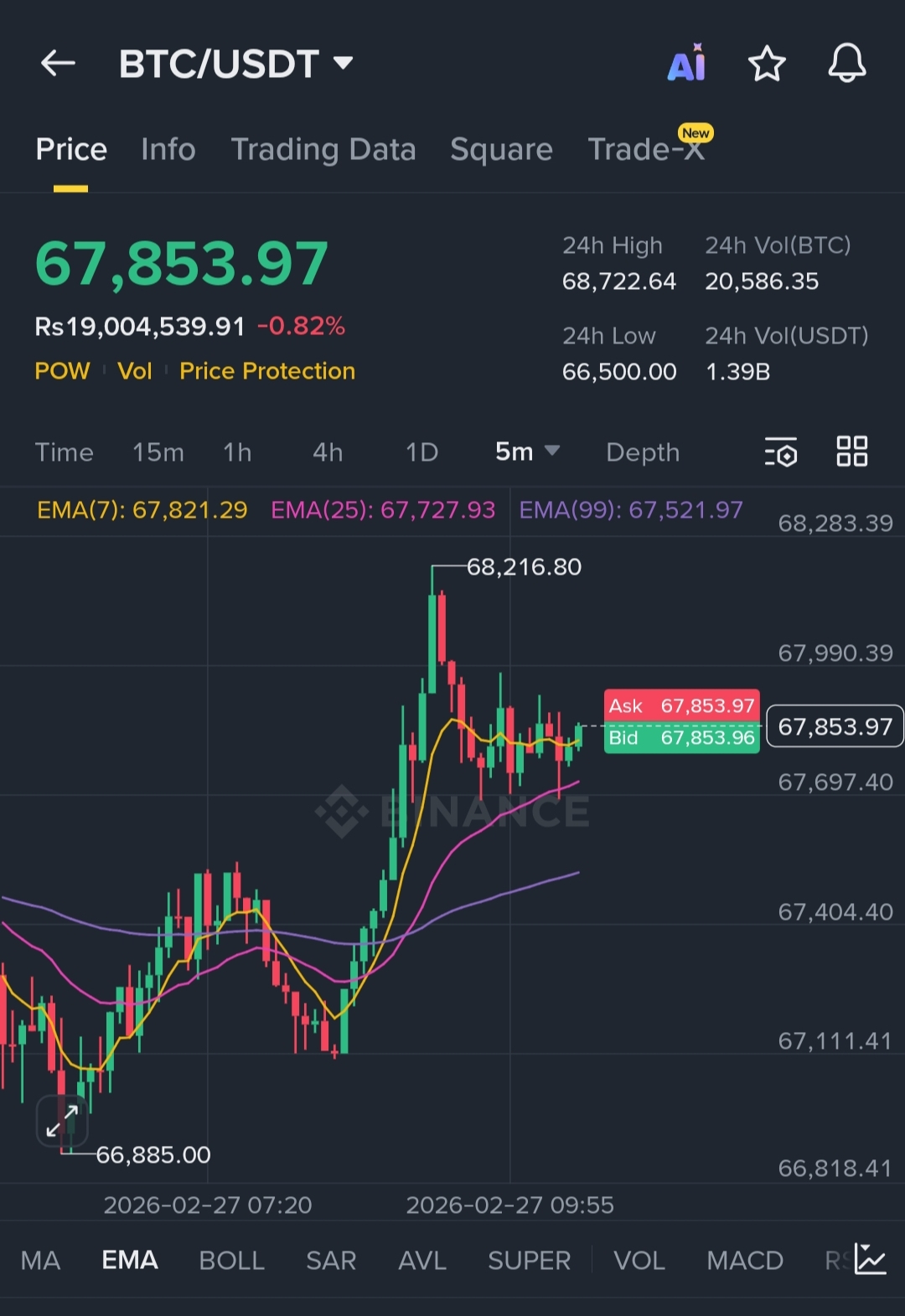
I’ve been watching Bitcoin grind its way back toward the $70K region, and honestly, this phase feels very different from the panic-driven volatility we saw during previous corrections. This isn’t chaos — it’s compression. It’s the kind of price behavior that forces everyone to question their bias while quietly building the foundation for the next major move.
For weeks, I’ve seen the market swing between fear and cautious optimism. Every dip gets labeled as the start of a deeper crash, and every rally gets dismissed as a dead cat bounce. But when I zoom out and look at the structure, what stands out isn’t weakness — it’s resilience. Bitcoin isn’t collapsing under selling pressure. It’s absorbing it.
The Psychology Behind This Range
From my perspective, the current range below $70K is doing exactly what markets are supposed to do after a strong move: shake out weak hands. I can almost feel the frustration in the market. Traders who expected instant continuation are exhausted. Late sellers are hoping for lower prices that never quite arrive. Meanwhile, long-term holders aren’t panicking — they’re waiting.
This is the phase where conviction gets tested. It’s easy to be bullish when price is trending cleanly upward. It’s much harder to stay confident when Bitcoin moves sideways for weeks, wicking both directions and invalidating overleveraged positions. But historically, these are the environments where strong bases form.
Why the $70K Region Matters
I’m paying close attention to the $70K zone because it isn’t just a number — it’s a psychological threshold. Markets remember levels where large amounts of trading occurred, and this region is loaded with trapped liquidity, previous distribution, and emotional decision-making.
If Bitcoin reclaims and holds above this level, the narrative changes quickly. What was resistance becomes support. What was doubt becomes momentum. I’ve seen this happen repeatedly: once a major level flips, sidelined capital rushes back in, afraid of missing the next leg.
But if price continues to reject here, that doesn’t automatically mean bearish continuation. It may simply mean the market needs more time to build a stronger base. Strong trends are rarely built in a straight line — they are constructed through repeated tests of conviction.
Volatility Isn’t a Threat — It’s a Signal
A lot of people fear volatility, but I see it differently. Volatility is information. It shows where liquidity sits, where stops are clustered, and where the market is searching for balance.
Right now, the spikes and pullbacks feel less like panic and more like positioning. Large players don’t accumulate in calm, predictable markets. They accumulate in uncertainty, when retail traders hesitate. The current environment — sharp wicks, quick reversals, and failed breakdowns — looks exactly like that kind of accumulation phase.
What I’m Watching Closely
Instead of obsessing over every intraday move, I’m focusing on a few key signals:
Higher lows on the macro timeframe — evidence of demand stepping in earlier.
Reduced sell volume on pullbacks — showing seller exhaustion.
Strong reactions from support zones — indicating buyers are defending structure.So far, these signals suggest the market isn’t preparing for collapse — it’s preparing for expansion. The Market’s Favorite Trick: Making Everyone Doubt
If there’s one thing I’ve learned, it’s that the market loves to create maximum doubt before major moves. When Bitcoin topped in past cycles, euphoria was obvious. But near bottoms and bases, the mood is always the same: uncertainty, skepticism, and endless debate.
That’s exactly where we are now.
Some traders are calling for a full macro reversal. Others are convinced new highs are imminent. I’m somewhere in between — not because I’m unsure, but because markets don’t move in straight lines. They build pressure first.
The Bigger Picture
When I step back and look beyond daily candles, the broader trend still shows a market that has matured. Institutional interest hasn’t disappeared. Global liquidity cycles still matter. And despite all the noise, Bitcoin continues to hold levels that would have been considered unimaginable support just a few years ago.
That perspective keeps me grounded. A volatile range near $70K isn’t weakness — it’s a sign of how far the asset has come.
Final Thoughts
Right now, I’m not chasing hype or reacting to every red candle. I’m observing. I’m watching how price behaves around key levels, how participants respond to volatility, and whether the market continues to absorb selling pressure.
Bitcoin approaching $70K doesn’t feel like the end of a move to me. It feels like the middle of a story — a chapter where doubt is loud, conviction is tested, and the foundation for the next trend is quietly being built.