

 The Spark @Mira - Trust Layer of AI
Imagine you’re strolling through a night market in Taipei, and every lantern you pass whispers a personalized recommendation for a bubble tea shop three streets over without you ever pulling out your phone. That is the kind of quiet, ambient intelligence Mira Network is building, not with magic, but with a lattice of low‑latency, privacy‑first nodes that chat among themselves like a neighbourhood of hyper‑aware squirrels.
#Mira didn’t start in a glass‑clad Silicon Valley incubator. It was born in a cramped apartment in Lisbon, where a trio of cryptographers, a data‑scientist‑turned‑painter, and an ex‑telecom engineer spent a year arguing over coffee about how to make the internet feel less like a noisy billboard and more like a thoughtful friend. Their answer: a decentralized mesh that treats data as a living organism, not a static file.
The Fabric $MIRA
At its core, Mira is a self‑healing overlay network—think of it as a digital immune system. Each node, whether it’s a modest edge server in a rural clinic or a high‑performance blade in a cloud farm, runs a lightweight protocol called Pulse. Pulse constantly measures latency, bandwidth, and trust scores, rerouting traffic the way a river finds the path of least resistance. If a node wobbles, the network simply “walks” around it, preserving the flow without missing a beat.
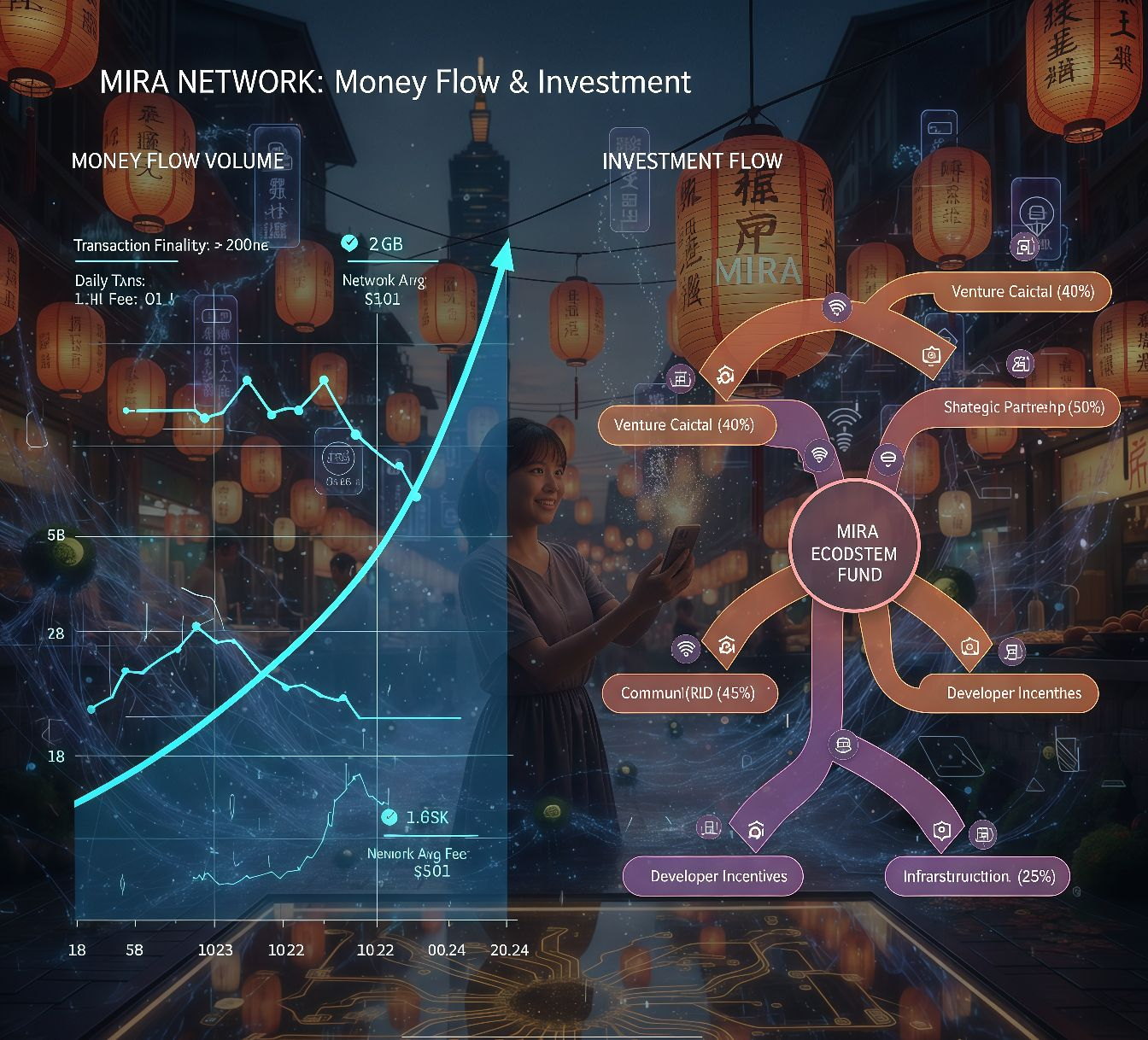
What makes Pulse feel almost alive is its adaptive consensus. Instead of the energy‑guzzling proof‑of‑work or the somewhat rigid proof‑of‑stake, Mira uses a probabilistic voting mechanism. Each node casts “micro‑votes” on the validity of transactions every few milliseconds, and the system aggregates these into a fuzzy consensus that matures in near‑real time. The result? Transaction finality in under 200 ms, even on a mesh of heterogeneous devices.
But Mira isn’t just about speed. It’s about privacy by default. Every piece of data that traverses the network is wrapped in a zero‑knowledge veil—a cryptographic envelope that lets the network verify correctness without ever peeking inside. That means a health‑monitoring wearable can share a risk score with an insurance provider, while the provider never sees the raw heart‑rate data. The envelope is opened only by the intended recipient, using a key that never leaves the user’s personal enclave.
The Pulse in Actions
Let’s drop into a concrete scenario. In a sprawling smart‑city pilot in Nairobi, traffic lights, bus sensors, and pedestrian smartphones all belong to the Mira mesh. When a sudden rainstorm hits, the traffic‑light nodes exchange real‑time precipitation data, re‑timing the signals to keep buses moving and prevent floods of standing water. No central server is bogged down; the logic lives in the collective.
On the consumer side, imagine a gamer in São Paulo joining a live‑streamed esports tournament. The Mira node on her console detects a surge of latency to the nearest server. It instantly “whispers” to a neighboring node in a nearby data centre that has spare capacity, rerouting her stream without her noticing. The transition is so smooth that the only clue something changed is a tiny flicker in the frame‑rate graph—an artifact she’ll never see.
The Community: A Loose‑Knit Tribe
Mira’s most surprising ingredient isn’t technology; it’s the culture that surrounds it. The project runs on a commit‑to‑code philosophy: anyone who contributes a bug fix, a new micro‑service, or a creative UI gets a “Pulse badge,” a non‑fungible token that grants voting rights on future protocol upgrades. The badges are intentionally scarce—only 1,000 are minted each quarter—turning contributors into a kind of digital guild.
There’s also an annual event called Mira Moon, a hybrid hackathon‑retreat held in a different city each year. The 2024 edition took place in Reykjavik, where participants built “ambient applications” that leverage Mira’s low‑latency mesh to create interactive art installations that respond to city sounds in real time. One installation, Echoes of Ice, used acoustic sensors across the harbor to modulate a giant LED screen, turning the harbor’s soundscape into a living mural.
The Horizon
Mira is still a young network—its node count just crossed the 50,000 mark, and the protocol is iterating on its third major release, codenamed Horizon. The roadmap includes cross‑chain liquidity pools that let assets flow between Mira and other decentralized finance (DeFi) ecosystems without a central bridge, and a sovereign identity layer that lets users carry a single, cryptographically signed identity across borders, while retaining full control over what data they reveal.
But the most intriguing line of research is biological plausibility—a research arm that draws inspiration from how neurons communicate. The team is experimenting with “spike‑timing” protocols that could allow nodes to fire messages only when they sense a change, drastically cutting energy consumption. If successful, Mira could become the first network that’s greener than a forest, a paradox worth watching.
In the End
Mira Network feels less like a product and more like a living rumor—something that whispers in the background, shaping experiences without demanding attention. It’s a reminder that the next leap in connectivity won’t be about faster cables or shinier screens, but about building a fabric that respects privacy, heals itself, and maybe, just maybe, makes the digital world feel a little more like a conversation and a little less like a monologue. If you listen closely, you can almost hear it humming.#MarketRebound #StrategyBTCPurchase #VitalikSells #BTC走势分析 $BTC $ETH