At 2:47 p.m., a security robot denies entry to a contractor with valid credentials. The badge scans green. The door stays locked. Later, the vendor says the AI “flagged an anomaly.” No one can explain which rule fired, which model version ran, or who approved the last update. The machine made a call. The logic vanished into a server log.
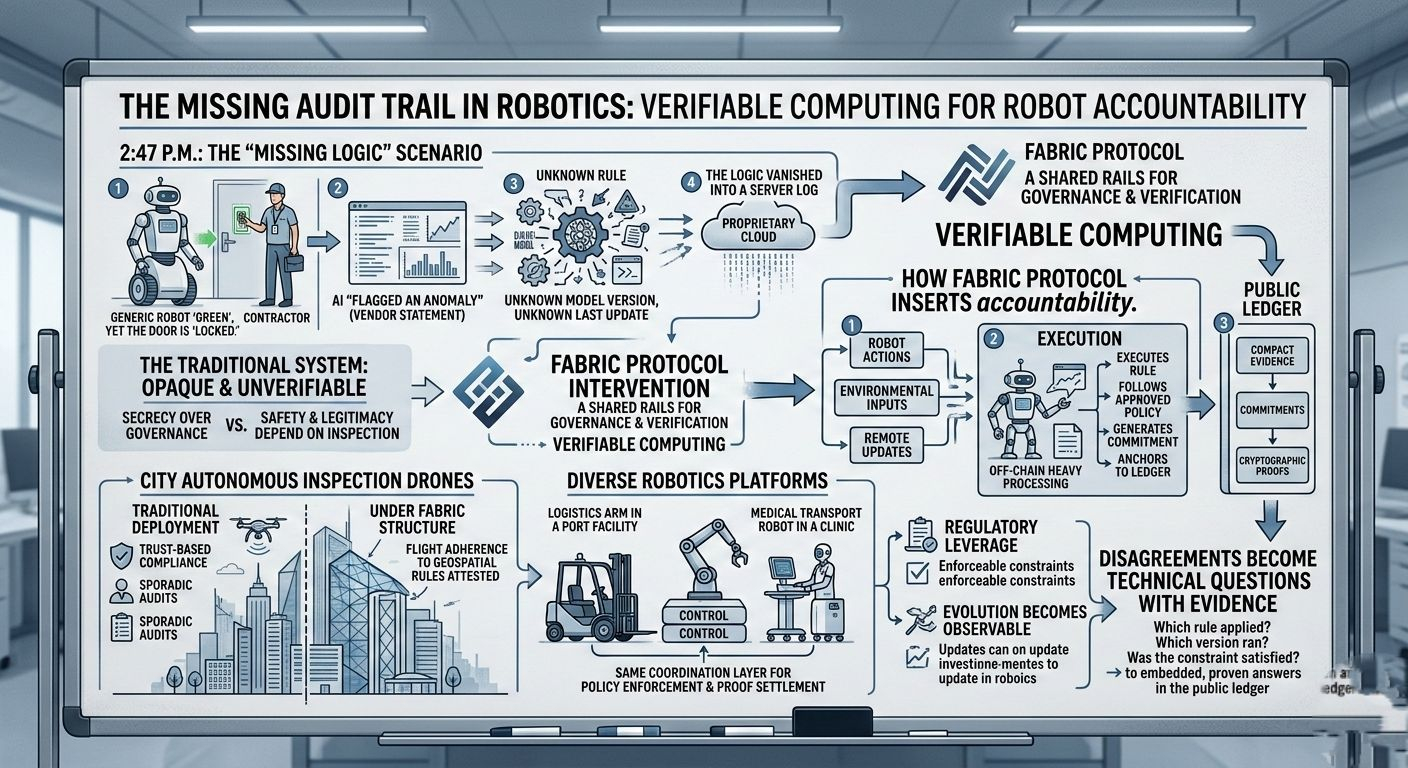
Fabric Protocol is designed to prevent that vanishing act.
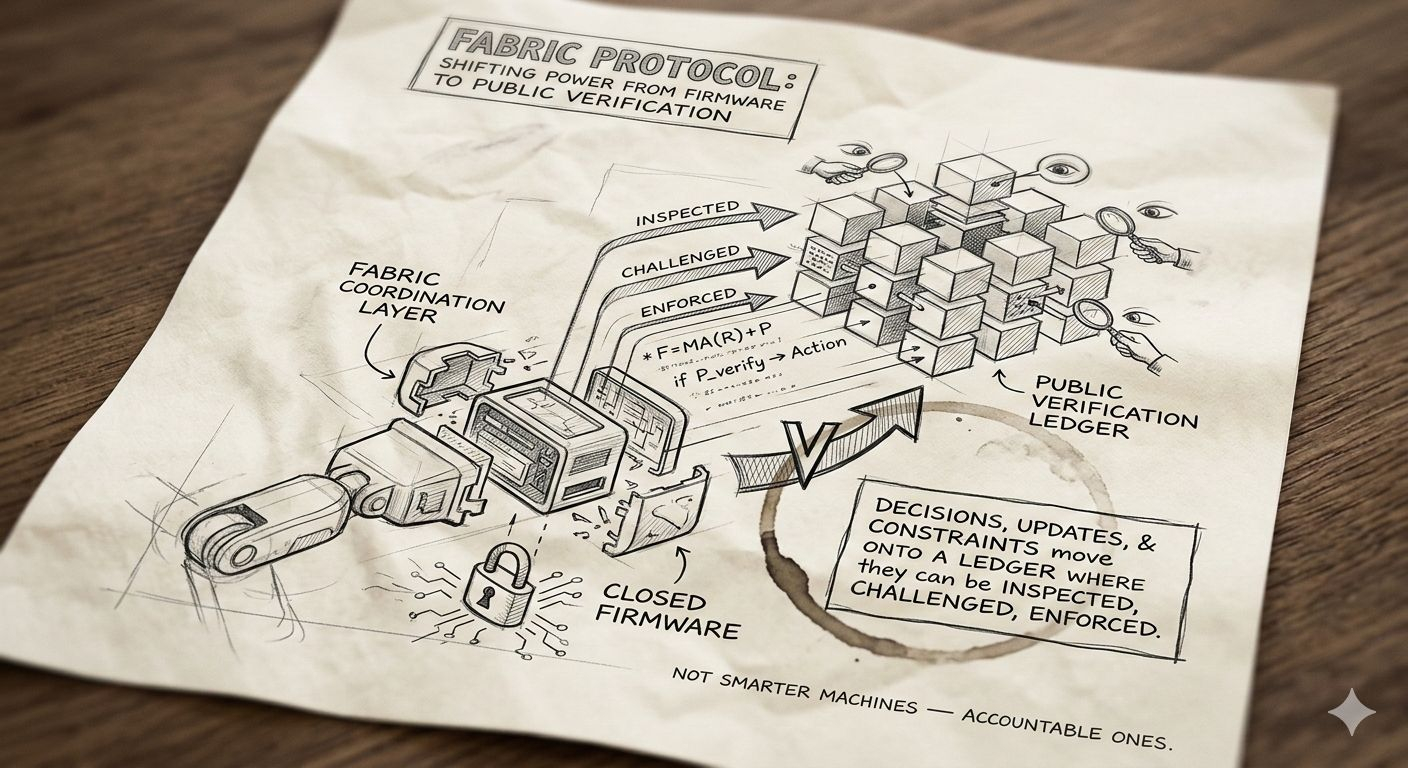
Supported by the non-profit Fabric Foundation, the network reframes robots as accountable digital actors operating on shared infrastructure. Instead of burying control logic inside proprietary clouds, Fabric coordinates data, computation, and policy through a public ledger. The aim isn’t publicity. It’s traceability.
Modern robots are no longer rigid automata. They ingest live data, adapt to new environments, and receive remote updates that alter behavior in subtle ways. A warehouse rover may change its routing logic overnight. A hospital assistant might integrate a new object-recognition model. Each change shifts how the machine behaves in the real world. Yet those shifts often remain invisible outside the vendor’s internal systems.
Fabric inserts verifiable computing into that lifecycle. When a robot executes a rule—speed limits, access permissions, safety thresholds—it can generate cryptographic proof that the computation followed an approved policy. The heavy processing still happens off-chain for responsiveness. What reaches the ledger is compact evidence: commitments that a specific version of code ran under defined constraints.
Consider a city deploying autonomous inspection drones for bridge maintenance. Regulations require strict geofencing and altitude caps near residential zones. Under traditional deployment, compliance depends on trust and sporadic audits. Under Fabric’s structure, each flight’s adherence to geospatial rules can be attested and anchored. If a resident files a complaint, investigators don’t rely on a company statement. They verify the execution record.
The architecture is modular. Fabric does not attempt to standardize every robotic brain. Instead, it provides shared rails for governance and verification. A logistics arm in a port facility and a medical transport robot in a clinic can differ entirely in hardware and control software while relying on the same coordination layer for policy enforcement and proof settlement. Interoperability emerges at the governance level, not by forcing identical stacks.
This approach also alters how updates are handled. In many systems, firmware changes are unilateral. A vendor pushes a patch; behavior changes; documentation lags behind. Fabric allows updates to be proposed, recorded, and governed within an open framework. Stakeholders—operators, regulators, partners—can see which policy version is active and when it changed. Evolution becomes observable rather than opaque.
Regulators gain practical leverage. Instead of issuing guidelines that depend on after-the-fact compliance checks, they can require enforceable constraints encoded into the protocol layer. Emergency stop responsiveness, restricted zones, data retention limits—these rules can become executable conditions. Noncompliance is detectable through missing or invalid attestations, not through speculation.
Skeptics point to performance costs. Public infrastructure introduces latency; robots require split-second reactions. Fabric’s model addresses this by separating execution from settlement. Real-time control remains local. Proofs of correct behavior are generated and later anchored to the ledger. The robot keeps moving; accountability keeps pace.
The deeper shift is cultural. Robotics has traditionally rewarded secrecy. Competitive advantage lives in hidden models and proprietary tuning. Fabric proposes that once machines operate in shared human spaces, secrecy cannot dominate governance. Safety and legitimacy depend on inspection.
Autonomy without audit trails invites disputes that cannot be resolved. Autonomy with verifiable footprints creates a different dynamic: disagreements become technical questions with evidence. Which rule applied? Which version ran? Was the constraint satisfied? The answers are embedded in the system itself.
Fabric Protocol does not promise flawless robots. It promises that when they act, their actions can be proven against declared rules. In a world where machines increasingly make decisions that shape physical reality, that distinction draws a hard line between convenience and responsibility.
@Fabric Foundation #robo $ROBO