

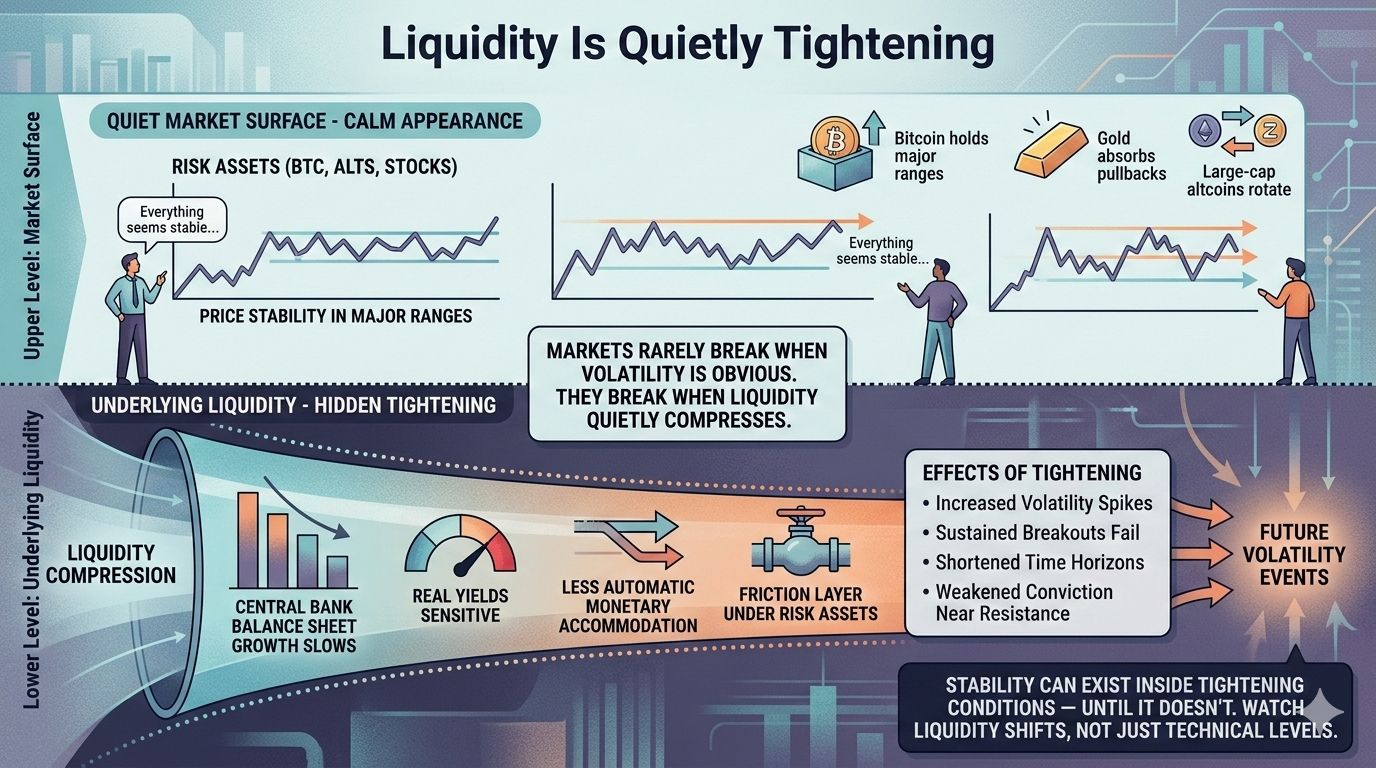
Markets rarely break when volatility is obvious. They break when liquidity quietly compresses.
Over the past sessions, risk assets have shown resilience despite rising uncertainty in macro conditions. Bitcoin holds major ranges. Gold absorbs pullbacks. Large-cap altcoins rotate without collapsing. On the surface, stability appears intact.
But stability and liquidity are not the same thing.
Liquidity is not about price direction. It is about how easily capital can move without causing distortion. When liquidity is abundant, pullbacks are shallow and recoveries are fast. When liquidity tightens, volatility clusters become sharper and recoveries take more effort.
The current environment suggests subtle tightening rather than expansion.
Central banks are no longer in aggressive easing mode. Balance sheet growth has slowed compared to prior crisis periods. Real yields remain sensitive to inflation data. Fiscal spending continues, but monetary accommodation is less automatic.
That creates a friction layer under risk assets.
In such environments, markets often enter a rotational phase instead of a trend phase. Capital moves between sectors - from Bitcoin to large-cap alts, from alts back to Bitcoin, from crypto to gold - without sustained expansion.
This is not bearish by default. It is transitional.
The key structural signal is whether breakouts sustain follow-through. If expansions fail repeatedly, it indicates capital is cautious rather than committed.
Liquidity compression also changes trader behavior. Participants reduce leverage. Time horizons shorten. Conviction weakens near resistance zones.
If liquidity expands again, momentum assets accelerate quickly. If it continues tightening, volatility spikes become more frequent and less predictable.
Right now, markets are balanced between those two outcomes.
The mistake would be assuming price stability equals structural strength. Stability can exist inside tightening conditions - until it doesn’t.
The next decisive move across major assets will likely align with a clear liquidity shift, not just technical levels.
Until then, this is a regime of caution disguised as calm.