Late on the night of March 9, Fabric left me with a serious technical question. While watching my monitor, I noticed a sudden surge in gas fees across public networks just as an update for the $ROBO token was being attempted. Within about an hour — around 21:00 UTC — transaction confirmation times spiked to unusually high levels.
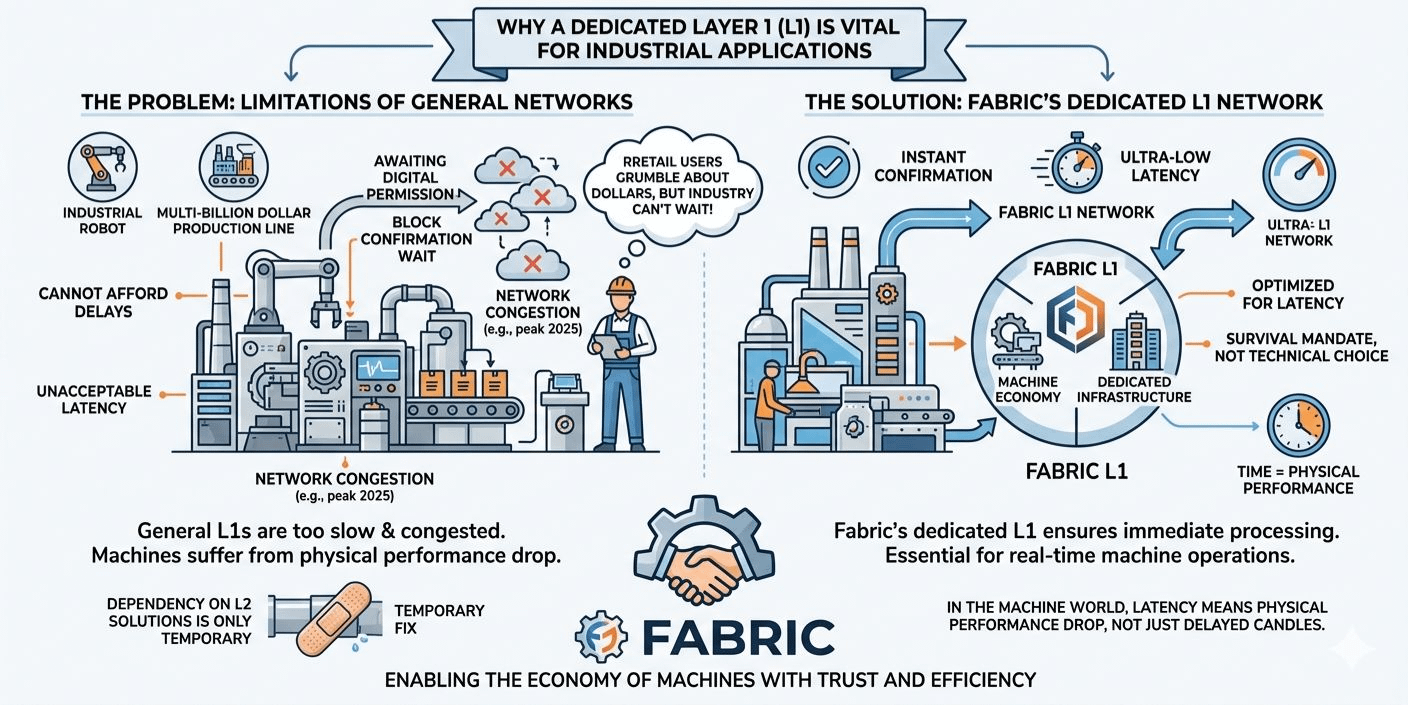 Most retail users might complain about paying a few extra dollars in fees, but my mind went somewhere else. What happens when an industrial robot depends on that same network? Can a billion-dollar production line afford to pause while waiting for a block confirmation just to receive a digital authorization?
This is where the Layer-1 challenge becomes clear. From my perspective, the network bottlenecks we saw during peak congestion in 2025 proved something important: relying on Layer-2 solutions can sometimes act as a temporary workaround rather than a permanent answer. For a system like Fabric — built around machines and robotics — moving toward its own L1 network may not be just a technical upgrade, but a matter of long-term viability. In the machine world, latency doesn’t simply delay chart candles; it directly affects real-world operational performance.
A Dedicated Infrastructure for Machines
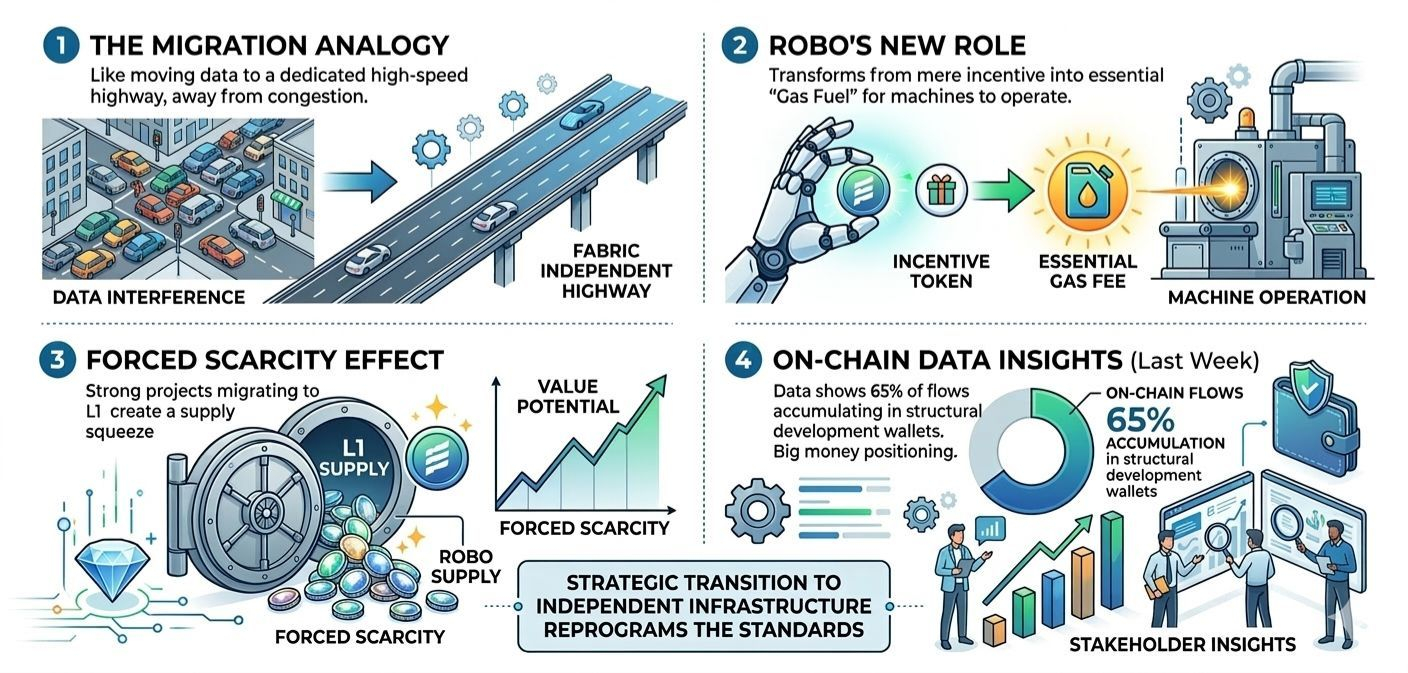
Think of Fabric’s potential migration as constructing a private high-speed highway instead of sharing crowded public roads. If Fabric controls its own chain, the $ROBO token would evolve from a simple incentive asset into the native gas currency powering the network itself — the fuel required for machines to execute tasks.
We’ve seen similar liquidity patterns before. When strong ecosystems launch their own Layer-1 networks, supply dynamics often tighten as tokens become structurally integrated into the system. Interestingly, data from last week showed that nearly 65% of on-chain flows were accumulating in wallets associated with development and infrastructure — a signal that larger participants may already be positioning for such a shift.
From an investment perspective, the real turning point could come if ROBO becomes a core operational asset within the network. History shows that when projects launch their own mainnets, liquidity and attention often follow. If ROBO ultimately becomes the exclusive resource required to execute robotic tasks, the token’s role could evolve from speculative value to functional economic infrastructure.
At 4:15 AM, while finishing my fourth cup of coffee, I found myself wondering whether the market would be willing to endure the challenges of migration in exchange for true independence.
Strategic Perspective
If Fabric were able to capture even 3% of global DePIN computing capacity through its own network, we wouldn’t simply be discussing tokenomics anymore — we’d be looking at the foundation of a machine-driven digital economy.
So the question becomes:
Should machines continue operating as guests on external networks, or is technical sovereignty the only path that guarantees uninterrupted production?
And if the migration begins, who captures the most value first — the developers building the infrastructure bridges, or the early investors who believed in the idea of independence before it materialized?