
I started reading about Proof of Robotic Work expecting the usual story.
In crypto we see it again and again. A new name. A new narrative. But underneath it is usually the same system. Stake tokens. Lock capital. Earn rewards.
So I assumed PoRW would be the same thing wearing a robotics costume.
That assumption did not last long.
The more I read the more something started to feel different. This was not designed to reward people for simply holding tokens. It was built to reward something much harder to fake.
Real work.
PoRW is not trying to decide which transactions belong on the blockchain. That job already belongs to Proof of Stake validators. Instead PoRW focuses on something much simpler and much more honest.
Did something actually happen in the real world
And if it did who deserves to be rewarded for it
That question changes everything.
The inputs to PoRW are not financial trades or wallet actions. They are real events happening outside the blockchain.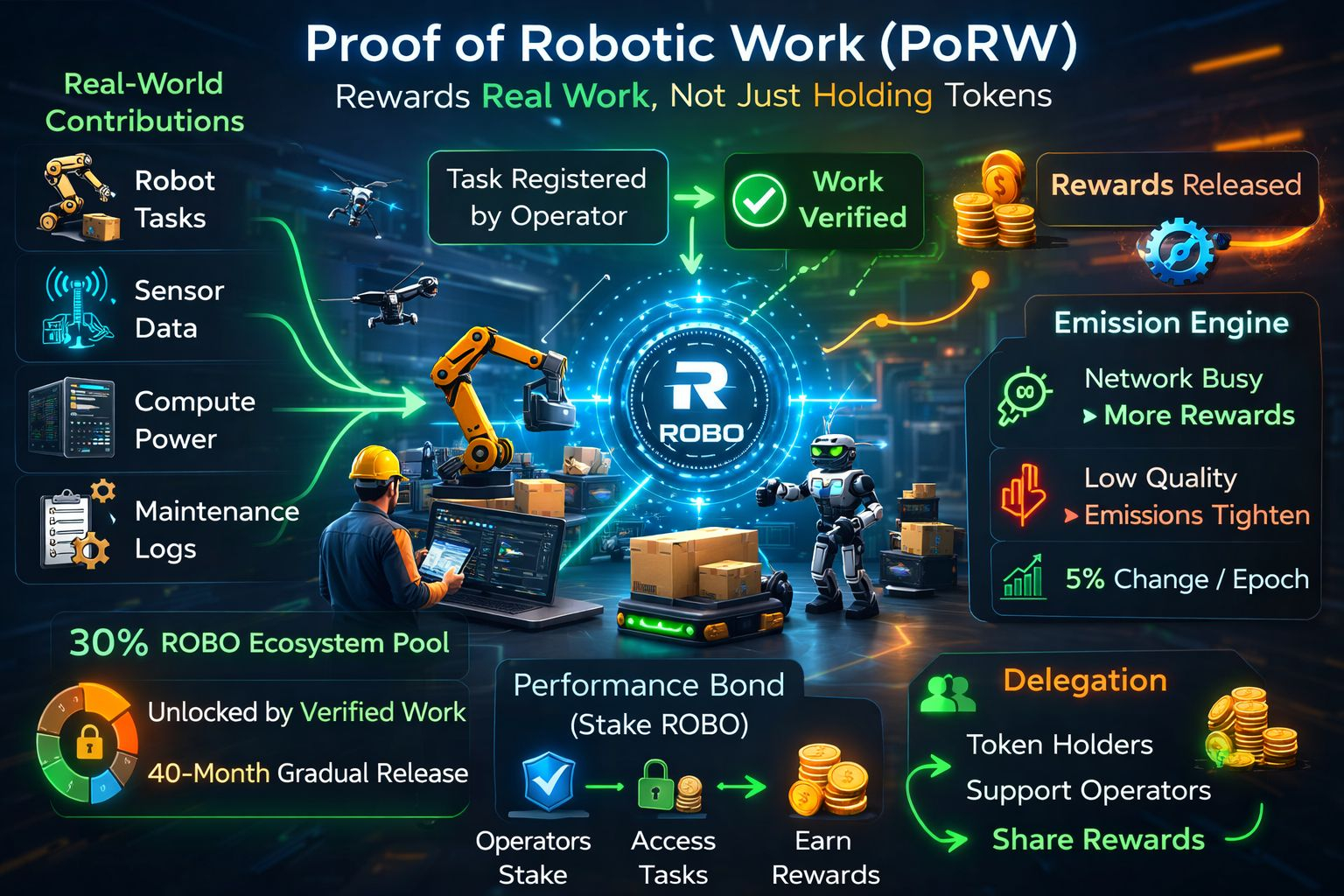
A robot completes a task inside a warehouse.
A machine sends verified sensor data.
A hardware node contributes compute power.
A maintenance event is logged and confirmed.
Each one becomes a contribution.
But the network does not blindly reward it.
Before rewards are released the system checks the proof.
A robot that finishes a job submits data from its sensors along with timestamps and task identifiers. The network compares that information with the original task registered by the operator.
If everything matches the work is confirmed. Only then do rewards move.
This is where PoRW quietly breaks away from the normal crypto reward model.
With staking rewards arrive whether anything meaningful happened or not. The network could be quiet and the emissions still flow.
PoRW flips that relationship.
No work means no rewards.
If robots are not completing tasks the ecosystem pool does not drain. It waits until something real actually happens.
That idea alone makes the system feel different.
One detail that caught my attention was the ecosystem allocation. Almost thirty percent of the entire $ROBO supply sits in this pool. It is the largest portion of the token distribution.
But it is not unlocked on autopilot.
Thirty percent became available at launch. The rest unlocks gradually across forty months but only through verified contributions.
That design says something important about what the network values.
Not speculation.
Not passive holding.
Actual output.
Before a robot can even start working there is another layer of responsibility. Operators must stake ROBO as a performance bond before their machines can register on the network.
Think of it as putting skin in the game.
The size of the bond determines the type of tasks the operator can access. Larger bonds open the door to higher value work. Poor performance risks the bond itself.
Accountability begins before the first job even starts.
Another piece of the system that deserves more attention is delegation.
Most people do not own robots. But they can still participate. Token holders can delegate their ROBO to strengthen an operator bond.
A stronger bond unlocks better opportunities for that operator. When the robots perform work the rewards are shared with those who helped power the bond.
Capital starts flowing toward productivity instead of sitting idle.
Above all of this sits the emission engine.
Instead of releasing a fixed amount of tokens the system adapts. It watches how busy the network is and how well the robots are performing.
If robots are underutilized emissions increase to attract more operators.
If quality drops emissions tighten to protect the network.
Changes are limited to five percent per epoch to prevent sudden instability.
It creates a feedback loop between real activity and token supply.
One future development makes the system even more interesting.
Later in the roadmap PoRW expands beyond simple task completion. Robots that provide verified sensor data environmental measurements and operational records will also earn rewards.
In other words the network begins rewarding information itself.
Data becomes work.
I started this research expecting another staking model with a robotics label attached to it.
What I found instead was a system trying to align token rewards with something much harder to fake.
Real output in the physical world.
In a market full of emissions driven by speculation that idea feels surprisingly rare.
And that alone makes PoRW worth paying attention to.