
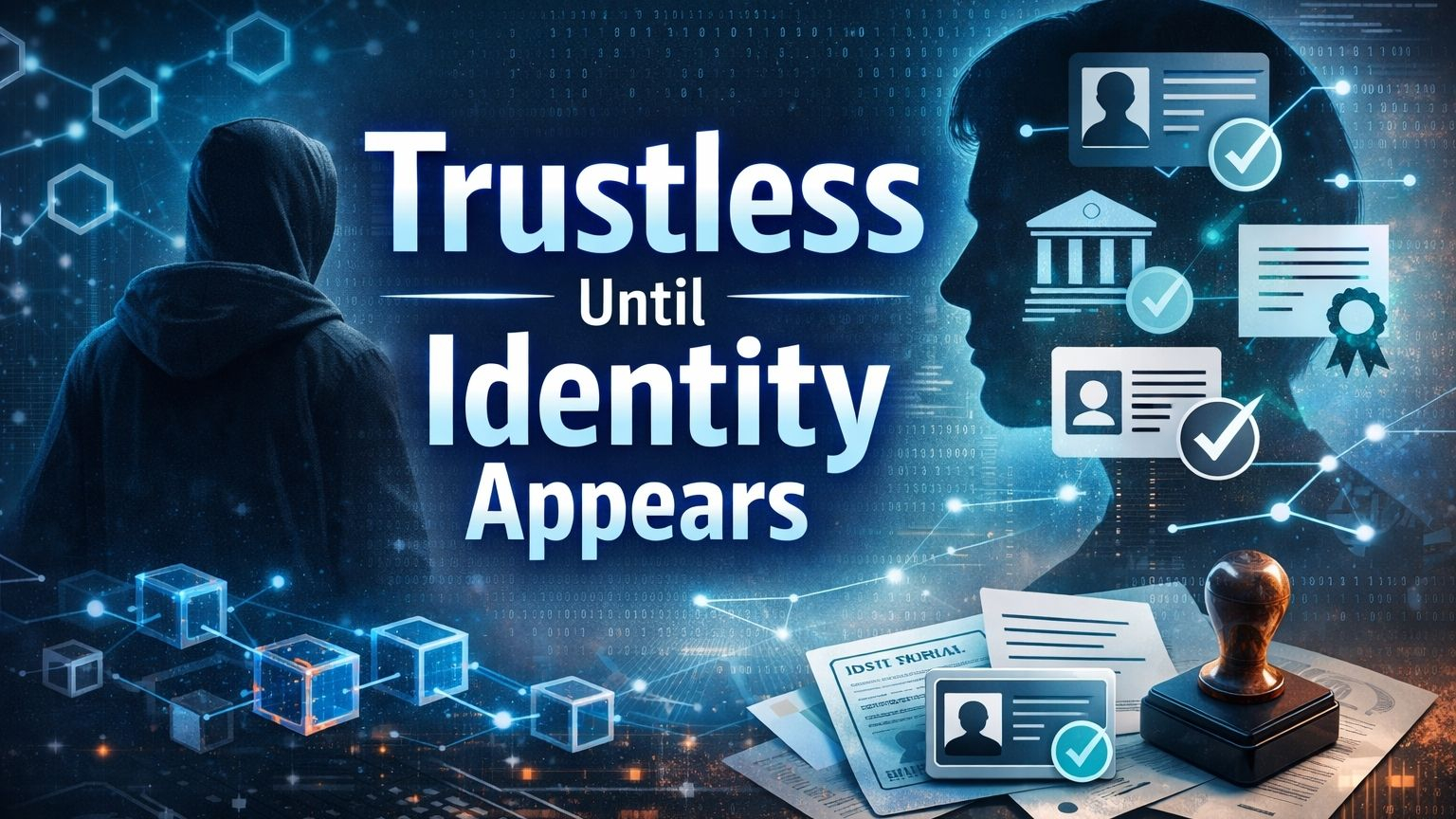
The word “trustless” gets repeated so often in crypto that it almost feels like a solved concept. But the more time I spend thinking about it, the less certain I am that everyone actually means the same thing when they say it.
In theory the idea sounds simple. Systems where rules are enforced by code instead of people. Transactions verified mathematically instead of relying on reputation or institutions. A world where participants don’t need to trust each other because the protocol guarantees fairness.
For payments, that idea worked surprisingly well. Blockchains proved that money could move without banks sitting in the middle of every transaction. Ownership could be verified directly by the network.
But identity is a very different kind of problem.
Money only needs to answer a straightforward question: does this address control these funds?
Identity asks something much more complicated: who is the person behind the interaction and why should anyone believe that claim?
The moment that question appears, trust quietly returns to the system.
A lot of decentralized identity discussions focus on exciting tools like wallets becoming identity containers, verifiable credentials, and zero-knowledge proofs that confirm facts without exposing the underlying data. Technically, these ideas are impressive and genuinely promising.
But underneath all that cryptography sits a question that never fully disappears:
Who verified the original information?
Take a basic example like proving someone is over eighteen. A system might allow the user to prove their age without revealing their birthday. That protects privacy and limits unnecessary data exposure.
But someone still had to confirm that age first. A document was checked. A credential was issued. Some authority validated the claim before it could ever be turned into a proof.
Cryptography protects the information afterward.
The origin of that fact still comes from the real world.
Which means the system was never completely trustless in the first place. It simply moved the location where trust lives.
That isn’t necessarily a weakness. What feels strange is how rarely it’s acknowledged. Crypto culture often frames progress as removing layers of trust entirely removing banks, removing intermediaries, removing institutions.
That works in systems that can remain fully inside the blockchain.
Identity doesn’t have that luxury.
Identity depends on events that happened outside the chain: birth records, diplomas, licenses, employment history. Blockchains can store or verify claims about those events, but they cannot create the truth behind them.
The chain can record facts.
But the world still has to produce them first.
And that’s exactly where trust slips back into the architecture.
Every identity framework eventually introduces issuers entities that confirm facts before they become credentials. Universities issue degrees. Governments verify citizenship. Companies confirm employment.
Once that happens, the system is no longer purely trustless. It becomes something more like a network of attestations.
Decentralization can improve this structure by spreading authority across many issuers instead of concentrating it in one place. Users collect credentials from different sources and present them only when needed.
That model is clearly healthier than a single centralized identity provider.
But it still involves trust just distributed across a broader ecosystem.
The more I watch identity experiments develop in crypto, the more I think the real challenge isn’t eliminating trust entirely. It’s limiting how far that trust extends.
Traditional identity systems didn’t break simply because verification existed. They broke because verification slowly turned into data accumulation. Each interaction demanded more documents, more exposure, more permanent records.
Identity gradually became a surveillance layer.
What privacy-focused systems are trying to build instead is something different.
Imagine a world where a fact about you is verified once. After that moment, you can prove it again and again without revealing anything else. No additional documents. No expanding data trail. Just a reusable cryptographic proof.
Trust still exists at the beginning.
But it doesn’t follow you everywhere.
This direction feels close to what privacy focused networks like Midnight are experimenting with as their ecosystem evolves. Not the removal of trust entirely, but the reduction of unnecessary disclosure.
That distinction matters more than it first appears.
If the goal is absolute trustlessness, identity will probably always look imperfect. But if the goal is minimizing exposure and giving users control over what they reveal, the architecture starts to make more sense.
Still, caution is healthy.
Crypto has a tendency to declare problems solved the moment a new primitive appears zero-knowledge proofs, decentralized identifiers, verifiable credentials. Each wave arrives with optimism that identity has finally been fixed.
Then real users arrive.
People want convenience. Businesses want data. Governments want oversight. Integration gets messy. Systems that looked elegant in diagrams start showing friction in practice.
That’s the real test for any identity design.
Not whether the cryptography works but whether the surrounding world is willing to cooperate with it.
Institutions still want authority over verification. Companies still monetize information. Users still choose simplicity over complexity whenever possible.
Those forces don’t disappear just because better mathematics exists.
So whenever I hear claims that crypto will create perfectly trustless identity systems, I pause.
Identity doesn’t begin in code.
It begins at a moment in the real world when someone verifies something about you.
That first act of trust cannot be erased by cryptography.
At best, it can be isolated.
And maybe that’s the real breakthrough worth pursuing.
Maybe identity never becomes fully trustless.
Maybe progress simply means learning where trust should stop.