
Ethereum (ETH) is the second-largest cryptocurrency in the world after , but its purpose goes far beyond being just digital money. Launched in 2015 by programmer and a team of developers, Ethereum introduced the idea of a programmable blockchain. This innovation allowed developers to build decentralized applications (dApps) that run on a global network rather than a centralized server.
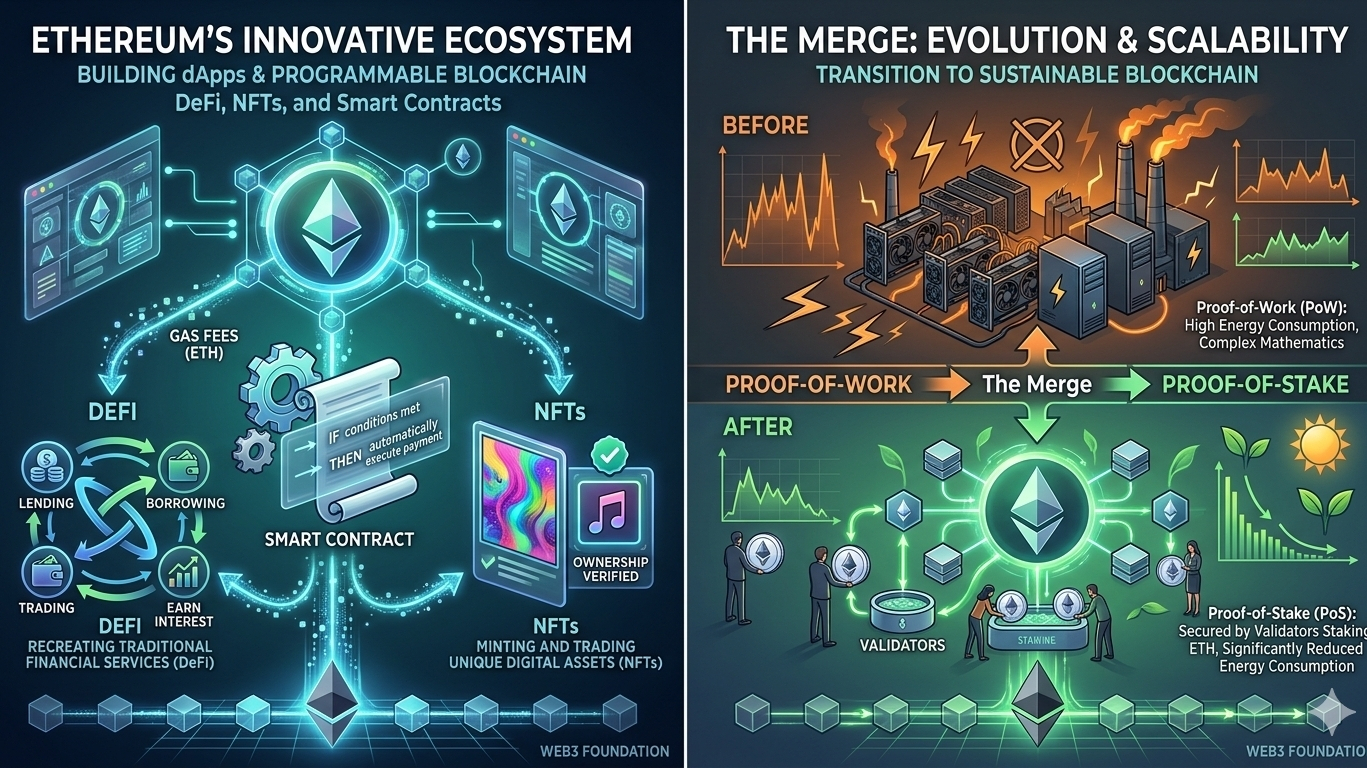
At its core, Ethereum is an open-source blockchain platform designed to support smart contracts. A smart contract is a self-executing program stored on the blockchain that automatically carries out actions when certain conditions are met. For example, a smart contract could release payment when a service is completed or automatically transfer ownership of digital assets. Because these contracts run on the blockchain, they are transparent, secure, and cannot be easily altered once deployed.
The cryptocurrency that powers the Ethereum network is called Ether (ETH). ETH is used to pay for transaction fees and computational services on the network. Every action on Ethereum, whether it is sending tokens, interacting with a decentralized application, or deploying a smart contract, requires a small amount of ETH as a fee. These fees are commonly known as gas fees, which compensate network participants who process and validate transactions.
One of Ethereum’s biggest contributions to the crypto ecosystem is enabling the creation of decentralized finance (DeFi). DeFi applications aim to recreate traditional financial services such as lending, borrowing, trading, and earning interest without relying on banks or centralized institutions. Through Ethereum-based protocols, users can access financial tools directly from their digital wallets while maintaining control of their funds.
Ethereum also played a key role in the rise of non-fungible tokens (NFTs). NFTs are unique digital assets that represent ownership of items such as artwork, music, collectibles, or virtual land. Because Ethereum’s blockchain can securely verify ownership, it became the most widely used network for minting and trading NFTs.
In its early years, Ethereum operated using a Proof-of-Work (PoW) consensus mechanism similar to Bitcoin. However, this approach required large amounts of computational power and electricity. To improve efficiency and scalability, Ethereum transitioned to Proof-of-Stake (PoS) in 2022 through a major upgrade known as “The Merge.” Under Proof-of-Stake, validators secure the network by locking up ETH as collateral rather than solving complex mathematical problems. This change significantly reduced the network’s energy consumption and opened the door for future upgrades.
Scalability has always been one of Ethereum’s biggest challenges. As more people use the network, transaction fees can increase and processing speeds may slow down. To address this, developers are working on layer-2 solutions and future upgrades that aim to increase throughput while keeping costs lower. These improvements are designed to make Ethereum more accessible for millions of users worldwide.
Another important aspect of Ethereum is its strong developer ecosystem. Thousands of developers around the world are building applications on Ethereum, making it the largest smart-contract platform in the blockchain industry. From decentralized exchanges and gaming platforms to identity systems and supply-chain tracking, Ethereum continues to expand the possibilities of blockchain technology.
Today, Ethereum is considered the foundation of Web3, a vision of the internet where users have more control over their data, identity, and digital assets. While other smart-contract blockchains have emerged, Ethereum remains one of the most trusted and widely used platforms in the crypto space.
In simple terms, Ethereum transformed blockchain from a system that only transfers value into a global platform for decentralized applications, shaping the future of finance, technology, and digital ownership.