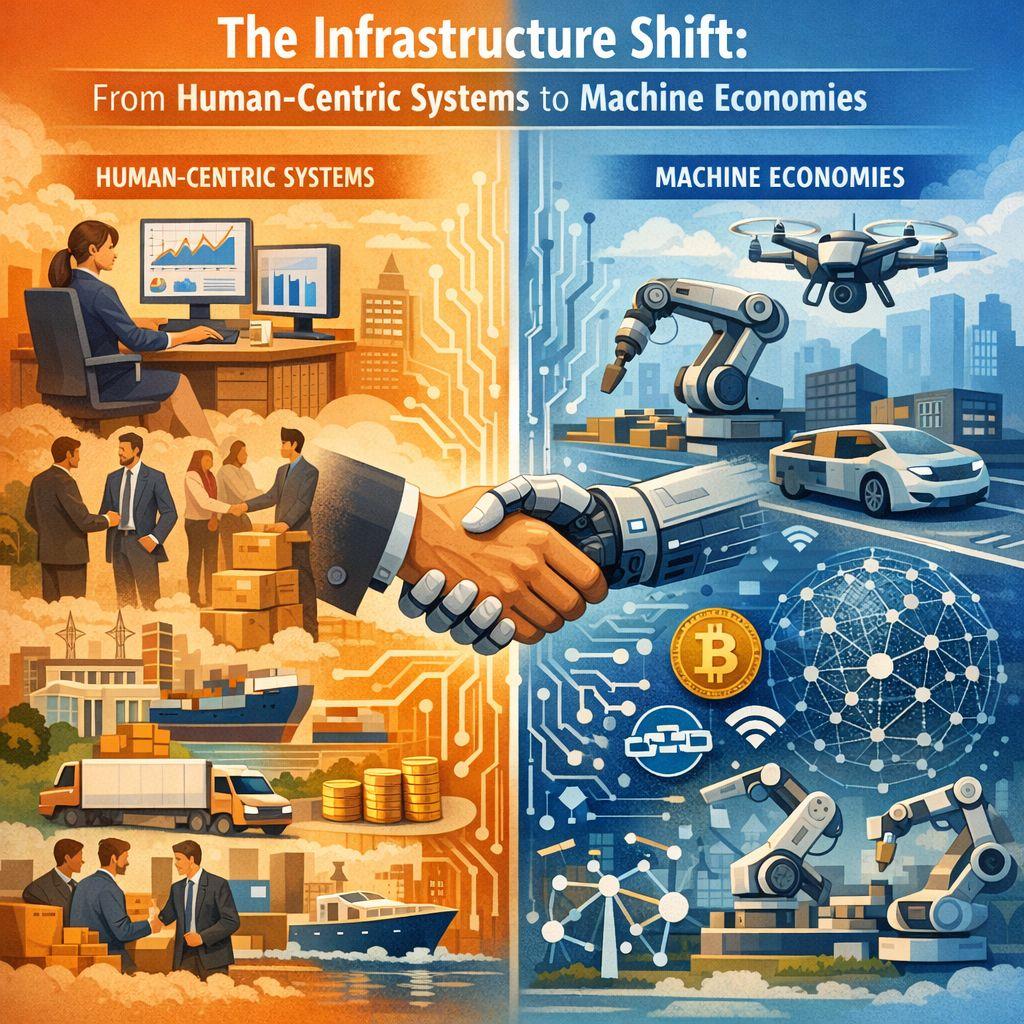
A few months ago, I watched a small machine in a workshop keep working long after everyone had left. No one told it to continue. No one checked on it. It just followed a set of instructions, quietly finishing what it started. That moment stayed with me—not because the machine was impressive, but because it didn’t need us in the way older systems used to.
That’s where this whole idea of a machine economy begins to feel real.
For a long time, infrastructure was built around human timing. You submit a request, someone processes it, another person verifies it. Even digital systems, for all their speed, were still designed with human checkpoints. There was always a pause somewhere, a place where a person looked, approved, or corrected.
Now that pause is starting to disappear. Not completely, but enough to notice.
Machines are being given the ability to act on conditions instead of instructions. That sounds like a small change. It isn’t. It shifts the entire flow of how systems behave. Instead of waiting, systems react. Instantly, sometimes a bit too instantly.
I think the uncomfortable part is that we’re not used to systems moving without us. We trust automation when it’s predictable—like a timer or a scheduled task. But this is different. This is systems making micro-decisions constantly, based on data we don’t always see.
There’s a logistics company I came across recently—not a big one, just a regional operation experimenting with automation. They added sensors to their delivery trucks. Nothing fancy, just location and condition tracking. At first, it was for visibility. Then they connected it to a contract system.
So now, if a delivery is late, the system doesn’t wait for someone to file a report. It adjusts the payment terms automatically. No emails. No calls. It just… happens.
Sounds efficient, right? It is. Until something slightly unusual occurs. A delay caused by weather might be treated the same as a delay caused by negligence. The machine doesn’t really care. It sees a condition, it executes a rule. That’s it.
And that’s where I start to hesitate a bit.
Because human systems, for all their slowness, have this messy layer of judgment. Sometimes inconsistent, sometimes frustrating, but still there. Machines don’t have that unless you force it into the design, and even then it feels… limited.
Another example, very different setting. Energy sharing between buildings. A friend of mine works on these small grid experiments. Imagine a cluster of houses with solar panels. During the day, one house generates more power than it needs. Another house, maybe running heavy appliances, needs extra.
Instead of routing everything through a central system, they let the houses “negotiate” energy transfers automatically. Prices adjust in real time. Energy flows where it’s needed.
It works. Actually, it works surprisingly well.
But he mentioned something interesting. People started feeling uneasy. Not because the system failed, but because they couldn’t follow what was happening. Prices changed too often. Decisions were too fast. It became hard to tell whether you were getting a fair deal or just reacting to a system that moved faster than you could think.
That stuck with me more than the technical success.
Because it highlights something subtle. When systems become machine-centric, understanding them becomes harder for humans. Not impossible, just… distant. You see the outcomes, not the process.
And maybe that’s fine, up to a point.
There’s also this question of responsibility that no one seems to answer clearly. If a machine executes a transaction, and something goes wrong, who takes the blame? The code? The person who wrote it? The company that deployed it?
In theory, it’s traceable. In practice, it gets blurry very quickly.
I’ve seen cases where systems behaved exactly as designed, and still caused problems. Not because the logic was wrong, but because reality didn’t fit neatly into the logic. That gap—between clean rules and messy situations—doesn’t go away just because machines are involved.
If anything, it becomes more visible.
Another thing that doesn’t get talked about enough is how rigid machine incentives can be. You tell a system to optimize for cost, it will chase the lowest cost every single time. No hesitation. No second thoughts.
Humans don’t do that. Or at least, not always. We compromise. We factor in things that aren’t written down—relationships, risks, gut feelings.
Machines don’t have that layer. And when you try to add it, it turns into another set of rules. Which means you’re back to the same problem, just more complicated.
Still, I get why this shift is happening.
There’s just too much happening now for human-centered systems to keep up. Too many devices, too many interactions, too much data moving around. At some point, you either let systems handle themselves, or you slow everything down to a crawl.
So we let them handle more.
But it comes with this quiet tradeoff. You gain speed, coordination, efficiency. You lose a bit of visibility, a bit of control. Not all at once. Gradually.
And maybe that’s why it feels slightly off sometimes. Not wrong, just unfamiliar.
We’re used to being inside the system, pressing buttons, making decisions, seeing cause and effect directly. Now we’re stepping outside, designing the rules, then watching from a distance.
Sometimes stepping back in when things break.
I’m not sure we’ve figured out that balance yet. How much control to keep, how much to let go. There’s no clear line. Some systems probably need more human involvement than others, but the direction is clear enough.
Machines are no longer just tools inside the system. They’re becoming participants in it.
And I keep wondering—when systems start running mostly on their own, do we actually understand them anymore, or do we just hope they’re behaving the way we intended?