


For years, one question has dominated crypto in the US:
Is this token a security or not?
Now, for the first time, the U.S. Securities and Exchange Commission and the Commodity Futures Trading Commission have released a detailed framework that begins to answer it.
And the implications are massive.
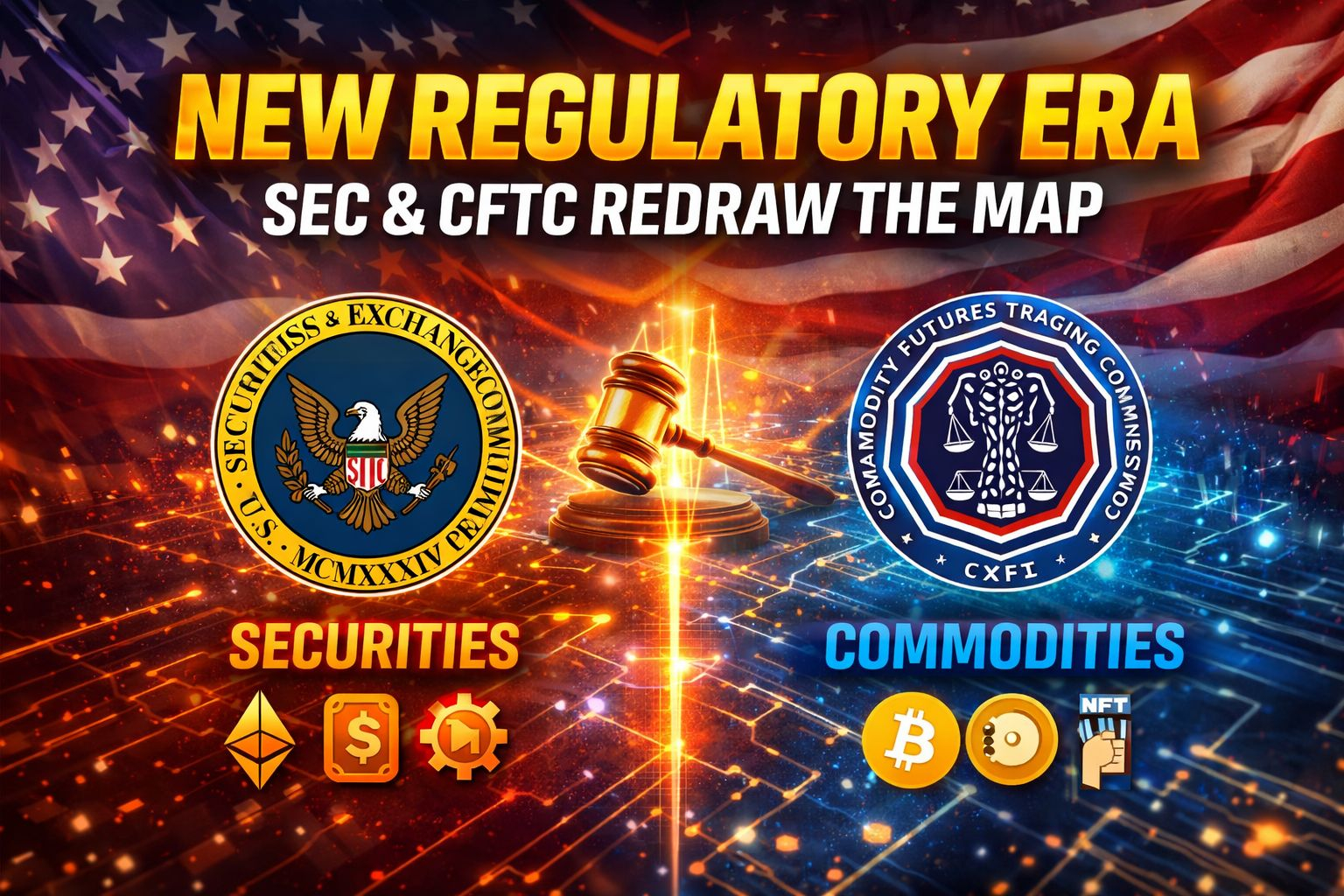
A Clearer Classification System Finally Arrives
Instead of treating crypto as one ambiguous category, regulators are now breaking it down into distinct groups based on function and behavior.
The key shift is simple but powerful.
Not all tokens are securities.
Some are now explicitly recognized as non-securities, depending on how they are used and what gives them value.
What Is NOT a Security Anymore?
Under this framework, several major categories are clearly separated from securities.
Digital commodities include assets whose value comes from how the network operates rather than from a team’s promises. This group includes major names like Bitcoin, Ethereum, Solana, XRP, and even memecoins like Dogecoin.
Digital collectibles cover NFTs and similar assets used for ownership, culture, or media. Think projects like CryptoPunks or in game items. Their value is tied to collectibility, not profit expectations from a centralized team.
Digital tools refer to tokens that serve a clear function inside a system. Examples include identity layers, domain names like ENS, or access tokens used within platforms.
Stablecoins, when structured properly under frameworks like the GENIUS Act, are also treated separately as payment instruments rather than securities.
On top of that, common crypto activities like staking, airdrops, mining, or wrapping are not automatically treated as securities transactions.
What Still Counts as a Security?
One category remains firmly under securities law.
Tokenized securities.
These include assets that represent traditional financial instruments like stocks or bonds, even if they are issued onchain. If the underlying asset is a security, putting it on blockchain does not change that.
The Most Important Idea: Tokens Can Evolve
This is where things get really interesting.
Regulators are acknowledging something the crypto industry has argued for years.
A token is not static.
In early stages, many projects raise funds, build products, and rely heavily on a core team. At that point, buyers may reasonably expect profits based on that team’s efforts, which makes the token look like a security.
But over time, if the network becomes decentralized and self sustaining, the source of value changes.
The token may transition into a commodity.
A good example is Ethereum. While it still has influential figures like Vitalik Buterin, the network no longer depends on any single entity to operate.
Its value now comes from usage, demand, and network activity.
That shift is exactly what regulators are starting to recognize.
Why Being a “Commodity” Changes Everything
The difference between being regulated as a security versus a commodity is huge.
Under the SEC, securities face strict requirements. Projects must register, disclose financial information, and exchanges need special licenses to list them. Retail participation can also be limited.
Under the CFTC, commodities are treated more lightly, especially in spot markets. Oversight focuses mainly on derivatives like futures and options.
This means fewer barriers for trading and innovation.
But it does not mean no enforcement. Fraud, manipulation, and market abuse are still subject to action.
The End of Legal Gray Zones?
Just two years ago, this level of clarity would have been almost impossible to imagine.
The lack of clear definitions led to lawsuits, enforcement actions, and uncertainty across the entire crypto industry.
Now, with a structured framework in place, the market may finally be moving toward a more predictable regulatory environment.
That does not solve everything overnight.
But it changes the direction.
Instead of asking whether crypto fits into old rules, regulators are starting to adapt the rules to fit how crypto actually works.
And that could mark the beginning of a very different phase for the industry.