
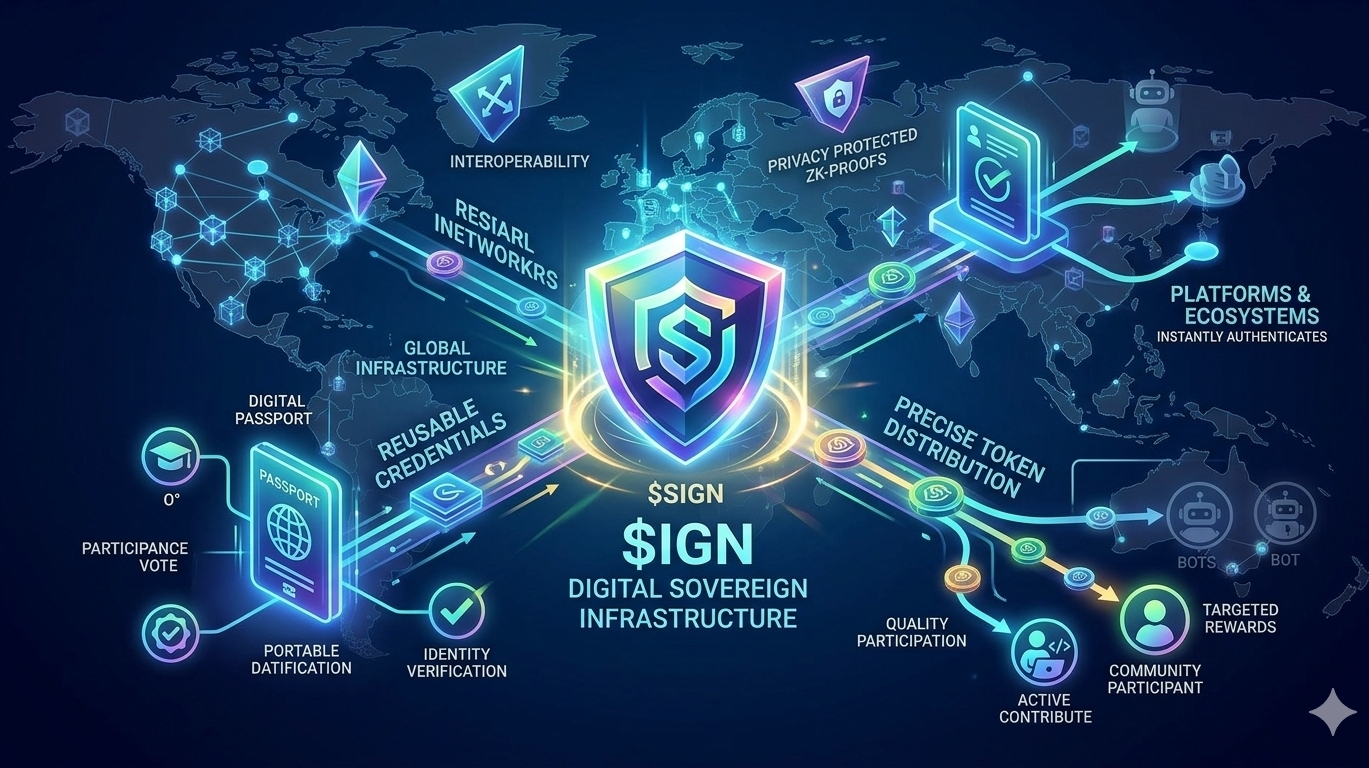
There is a quiet problem in the internet economy that most people don’t notice until it slows them down. Every time you sign up for a new platform, claim a reward, or try to prove who you are, you start from zero again. New forms, new checks, new delays. It feels normal, but it’s actually very inefficient.
Now imagine a system where your credentials—your identity, your achievements, your eligibility—can move with you across platforms. Not as screenshots or PDFs, but as verified digital proofs that anyone can check instantly. This is where global infrastructure for credential verification and token distribution starts to matter.
At its core, this idea is simple. Instead of every company verifying users again and again, verification happens once, and the result becomes reusable. It’s like having a digital passport that works everywhere, but without giving away your personal data each time. The system confirms that something is true, without exposing everything behind it.
This shift is already happening in parts of the crypto space. Developers are building tools that issue credentials as cryptographic proofs. These proofs can show that you completed a course, participated in a governance vote, or held a token for a certain period. You don’t need to explain yourself again. The proof speaks quietly on your behalf.
Token distribution connects closely to this. Projects often struggle to reward the right people. Airdrops, for example, have become messy. Bots farm rewards. Real users get overlooked. It’s not fair, and honestly, people are getting tired of it.
With better credential systems, distribution becomes more precise. Instead of sending tokens to random wallets, projects can target users who actually contributed—developers who pushed code, community members who stayed active, or early supporters who didn’t just flip tokens for quick profit. The quality of participation starts to matter more than just timing.
I remember trying to claim a token reward last year, late at night around 1:30 a.m., refreshing the page again and again because the system kept crashing. It felt chaotic, almost like a lottery. That kind of experience is exactly what better infrastructure is trying to fix.
There’s also a deeper layer to this. Trust. Not the marketing kind, but real, usable trust. When credentials are verifiable and portable, platforms don’t need to rely on guesswork. They don’t need to ask for too much information either. This reduces friction in a way that people can actually feel.
Some projects are already experimenting with reputation scores tied to on-chain activity. Others are building identity layers that separate personal data from verification logic. Governance systems are starting to use these credentials to give more weight to experienced participants. It’s still early, and not everything works smoothly yet. Some designs feel overcomplicated. Some are clearly rushed.
But the direction is clear.
Token utility also becomes more meaningful in this setup. Instead of being just a tradable asset, a token can represent access, reputation, or contribution. Holding it might mean something beyond price speculation. That’s the part many people miss when they only look at charts.
Still, there are challenges. Privacy needs to be handled carefully. Nobody wants a system that tracks everything they do. Interoperability is another issue. Different platforms need to agree on standards, and that takes time. Coordination is hard, even in decentralized communities.
And yes, some projects will pretend to solve this without actually solving it.
What’s interesting is how users are reacting. There’s a growing preference for systems that respect time and effort. People notice when rewards feel fair. They also notice when they don’t. Community sentiment shifts quickly in this space, sometimes faster than teams expect.
The idea of a global infrastructure sounds big, maybe even abstract. But in practice, it shows up in small moments. A faster signup. A fair reward. A smoother interaction. Less repetition. Less noise.
It’s not perfect yet, not even close. But you can feel the pieces coming together, slowly, unevenly, like something being built in real time without a clear blueprint. And somehow, that makes it more real.
