Most of crypto can execute.
Very little of it can reason.
And that gap is quietly becoming one of the biggest constraints on what this industry can actually become.
Crypto has spent years optimizing execution. Faster chains, cheaper transactions, modular stacks, parallelized environments, new virtual machines every cycle. The surface area of innovation looks impressive, but beneath it sits a more fundamental limitation that hasn’t been resolved: blockchains don’t understand context.
They process inputs, enforce rules, and move assets with precision. But they don’t interpret intent, they don’t adapt to nuance, and they don’t coordinate decisions across fragmented systems in a way that resembles real-world environments. The moment crypto tries to move beyond simple transfers, this limitation becomes visible.
A DAO can vote, but struggles to reason about off-chain realities. A protocol can execute logic, but cannot evaluate complex or evolving conditions. Users can sign transactions, but cannot safely delegate intelligent behavior. Systems can verify data, but they cannot compose understanding across multiple layers of information.
The result is an ecosystem that works mechanically, but not cognitively. And that shows up in subtle but important ways: rigid automation, fragmented workflows, and a persistent reliance on humans to interpret and coordinate what machines cannot.
There is a common assumption in crypto that better infrastructure is mostly about performance. Faster execution, lower latency, more throughput. But this framing misses something more important. The real bottleneck is not how fast systems can act. It’s how well they can decide what actions actually make sense.
Traditional systems are built around layered decision-making. Data is interpreted, context is applied, rules evolve, and outcomes are continuously evaluated. In crypto, most of that layer is missing. What exists instead is deterministic execution without adaptive reasoning. Machines can do exactly what they are told, but nothing beyond it.
This creates a strange imbalance. We have systems capable of executing nearly anything, but only if every step is predefined with precision. That works for simple interactions, but it breaks down as complexity increases.
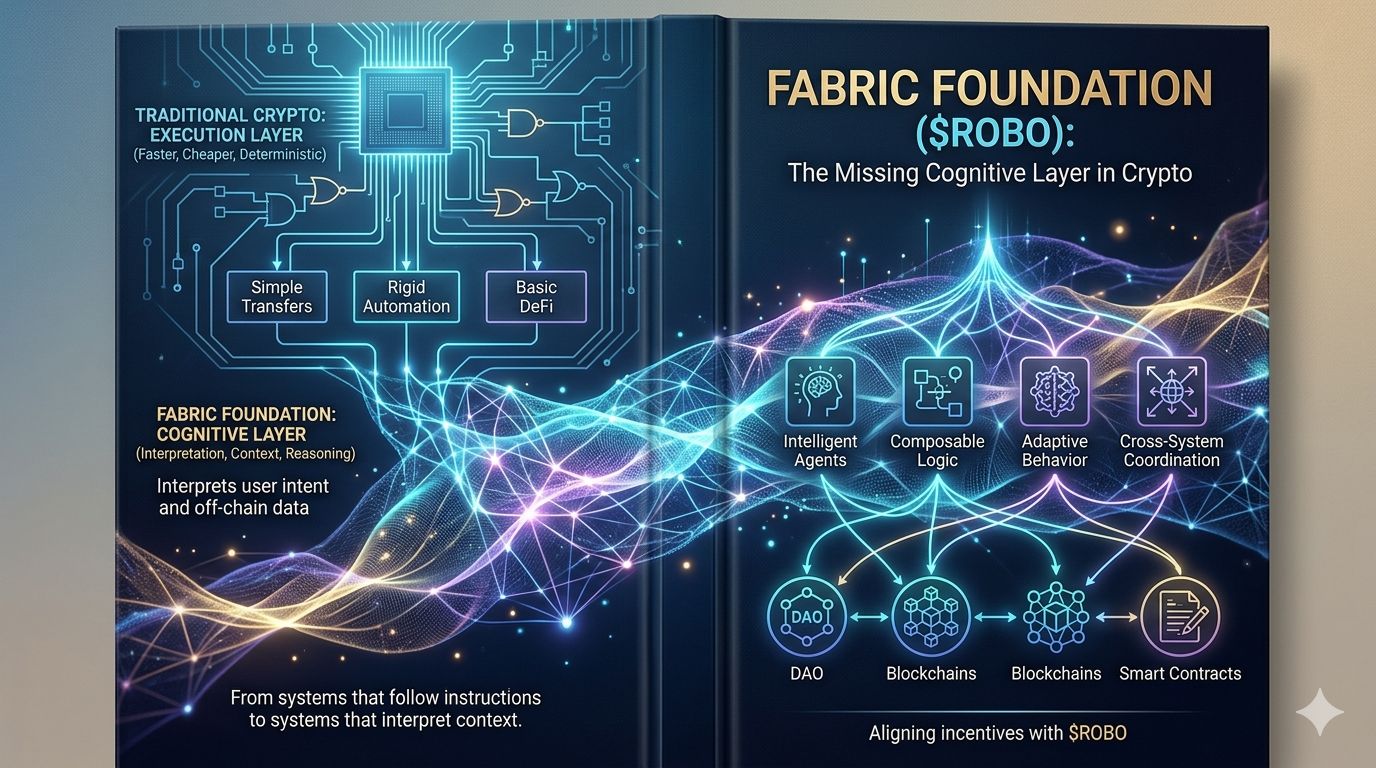
Fabric Foundation sits inside this gap. It does not try to compete on speed or scaling, and it does not present itself as another execution layer. Instead, it focuses on enabling systems to move beyond rigid instruction and toward contextual behavior.
The idea is not to replace blockchains, but to extend them. To introduce a layer where interpretation, coordination, and adaptive logic can exist without breaking the verifiability that makes crypto useful in the first place. It is less about building a better machine, and more about teaching the machine how to think in constrained environments.
At a practical level, Fabric approaches this through a system built around intelligent agents and composable logic. Instead of static contracts that execute fixed instructions, it introduces programmable agents that can act on behalf of users or systems. These agents are not just reactive, but capable of adjusting behavior based on inputs, conditions, and context.
External data is not simply fed into contracts as raw input. It is structured and interpreted, allowing systems to respond in ways that reflect more than binary conditions. Different agents can interact with each other, creating layered decision-making rather than isolated execution paths. Actions remain verifiable, but they are no longer limited to rigid, pre-defined flows.
The role of the $ROBO token sits within this coordination layer. It aligns incentives between participants, agents, and infrastructure, acting less as a speculative asset and more as a mechanism for organizing behavior across the system.
The core shift is subtle but significant. Moving from systems that follow instructions to systems that can interpret context changes the type of problems crypto can attempt to solve.
That shift, however, comes with real trade-offs. As systems become more flexible, they also become harder to predict. Determinism has been one of blockchain’s strongest properties. Introducing adaptive behavior creates tension with that reliability.
Security becomes more complex. Verifying outcomes is easier than verifying reasoning processes. The more autonomy agents have, the more important it becomes to define clear boundaries of trust. There is also the challenge of standardization. For a system like this to matter, it cannot exist in isolation. It needs integration across wallets, developer environments, and existing protocols.
There is also a timing question. Crypto is still struggling with usability at a basic level. Adding a cognitive layer may be necessary in the long run, but it introduces complexity into an ecosystem that is not yet fully mature.
What Fabric is really pointing toward is a broader transition in crypto’s evolution. The first phase was about trustless execution. Proving that systems could run without centralized control. The next phase may be about trust-minimized coordination.
Execution answers whether an action can be performed reliably. Coordination answers whether that action should be performed at all, given the context. That second question is significantly harder, because it involves incomplete information, competing incentives, and changing environments.
In traditional systems, humans fill this gap. They interpret, decide, and adjust. But decentralized systems do not scale well when humans are required to constantly intervene. The responsibility shifts toward infrastructure.
This is where the idea of intelligent, composable agents becomes relevant. Not as a replacement for users, but as an extension of their intent. A way to encode not just what should happen, but how decisions should adapt as conditions change.
The timing of this shift aligns with where the market is moving. Simple use cases are no longer enough. Payments, swaps, and basic DeFi interactions are understood. The next layer involves autonomous agents, multi-step workflows, and systems that interact with each other without constant human input.
These are not execution problems. They are decision-making problems. And without infrastructure that can handle that complexity, crypto risks becoming a system that moves value efficiently, but cannot organize it meaningfully.
Still, it is entirely possible for this direction to fail. Not because the idea lacks merit, but because execution is difficult. Combining flexibility with verifiability is one of the hardest problems in distributed systems. There are also social constraints. Developers may resist added complexity, users may hesitate to trust autonomous behavior, and competing approaches may fragment attention.
History has shown that good ideas in crypto do not guarantee adoption. Timing, integration, and usability often matter more than architecture alone.
What Fabric Foundation represents is not a finished solution, but an exploration of a boundary that crypto has not fully crossed yet. The boundary between systems that enforce rules and systems that can navigate ambiguity without losing reliability.
Crypto has already proven that machines can operate without trust.
What remains uncertain is whether they can operate with judgment.
If that becomes possible, the scope of what decentralized systems can do expands significantly.
If it doesn’t, it will reinforce a more sobering conclusion.
Execution was never the final layer. It was just the easiest one to build.@Fabric Foundation #robo #ROBO $ROBO