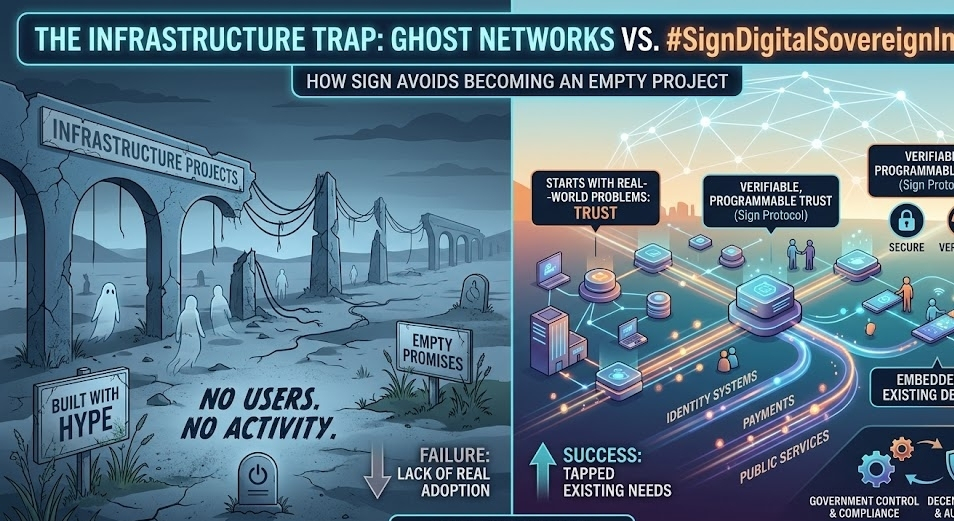
#signdigitalsovereigninfra $SIGN @SignOfficial

There’s a quiet graveyard in tech that nobody really talks about. It’s full of “infrastructure projects” that sounded powerful on paper—but never got used. No users, no activity… just empty networks. People call them ghost networks.
And honestly, #SignDigitalSovereignInfra could’ve easily gone down that same path.
Because here’s the thing: building infrastructure is the easy part. Getting people to actually use it? That’s where most projects fail.
What makes Sign interesting is that it doesn’t start with hype—it starts with a real-world problem. Governments, institutions, even financial systems all struggle with one core issue: trust. Not emotional trust, but verifiable, programmable trust.
That’s where the Sign Protocol comes in. Instead of building another flashy app, it focuses on something deeper—creating a system where data, identity, and actions can be verified across different systems.
Think of it like this: instead of asking “Who are you?” every time, the system already knows—securely and privately.
But here’s the key difference. Many projects build tools and hope users show up. Sign flips that. It embeds itself into things people already need—identity systems, payments, public services.
That’s how you avoid becoming a ghost network. You don’t wait for adoption—you plug into existing demand.
There’s also a practical layer people often overlook: governments need control, compliance, and auditability. Pure decentralization sounds great online, but in the real world, it has limits. Sign’s approach blends both—giving institutions control while keeping the system verifiable.
It’s not perfect, of course. Adoption will still take time. Systems like this always do. But at least it’s solving something real, not just chasing trends.
And maybe that’s the biggest takeaway.
Infrastructure doesn’t fail because it’s too early. It fails because it forgets why it exists in the first place.
Sign, at least for now, seems to remember.