
I don’t get pulled in by privacy narratives anymore. I watch what breaks when systems are forced to operate under real conditions.
Most systems don’t fail at launch. They fail when real usage starts shaping their behavior instead of controlled assumptions.
Crypto has been assuming that privacy can be layered on top without consequences. That it’s just another feature waiting to be integrated cleanly. That was never true.
The real problem isn’t the lack of privacy. It’s the cost of maintaining it without breaking everything else.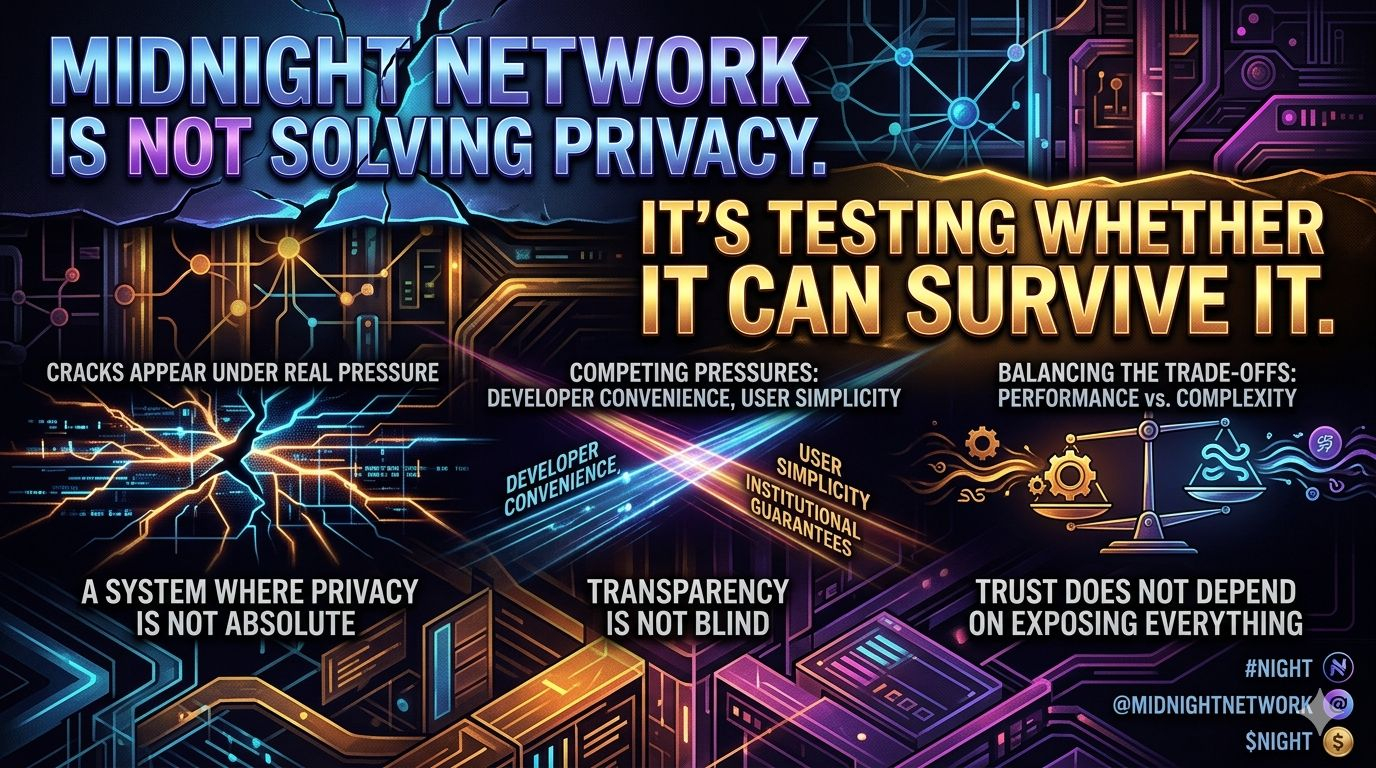
The moment real users, real data, and real stakes enter the system, everything changes. Performance slows down. Complexity increases. Tradeoffs stop being theoretical and start becoming visible.
That’s where Midnight Network becomes interesting.
Not because it promises privacy.
But because it seems built to handle the pressure that privacy introduces.
Most blockchains were designed around visibility. That decision made sense early on. It created trust in an environment that had none. But as systems evolve, that same transparency starts creating friction instead of reducing it.
You don’t need to reveal everything to prove something is valid. You just need to reveal enough.
That’s the space Midnight Network is moving into.
Not full opacity. Not blind transparency.
But controlled disclosure.
And that’s where things get harder.
Because the moment you move into selective disclosure, new questions start to surface:
Where does private computation actually happen?
Who defines what counts as sufficient proof?
What ensures that hidden data isn’t influencing outcomes in ways users can’t verify?
And what happens when trust depends on components that aren’t fully visible?
These are not edge cases. These are structural risks.
Crypto has a habit of solving the visible layer and assuming the rest will hold. That assumption works until the system is exposed to real pressure.
And pressure doesn’t arrive all at once.
It builds gradually.
Developers start optimizing for convenience.
Users demand simplicity.
Institutions require guarantees.
Those forces don’t align cleanly. They never have.
What matters now is not how Midnight Network looks in isolation, but how it behaves when those pressures start competing with each other.
Because good architecture doesn’t guarantee durability. It only delays failure.
We’ve seen systems that looked coherent until they were scaled. Systems that made sense conceptually but struggled when integrated into a broader ecosystem. Crypto doesn’t reward ideas. It rewards systems that can survive friction.
Midnight Network will have to prove that privacy doesn’t become overhead.
That controlled disclosure doesn’t introduce hidden points of failure.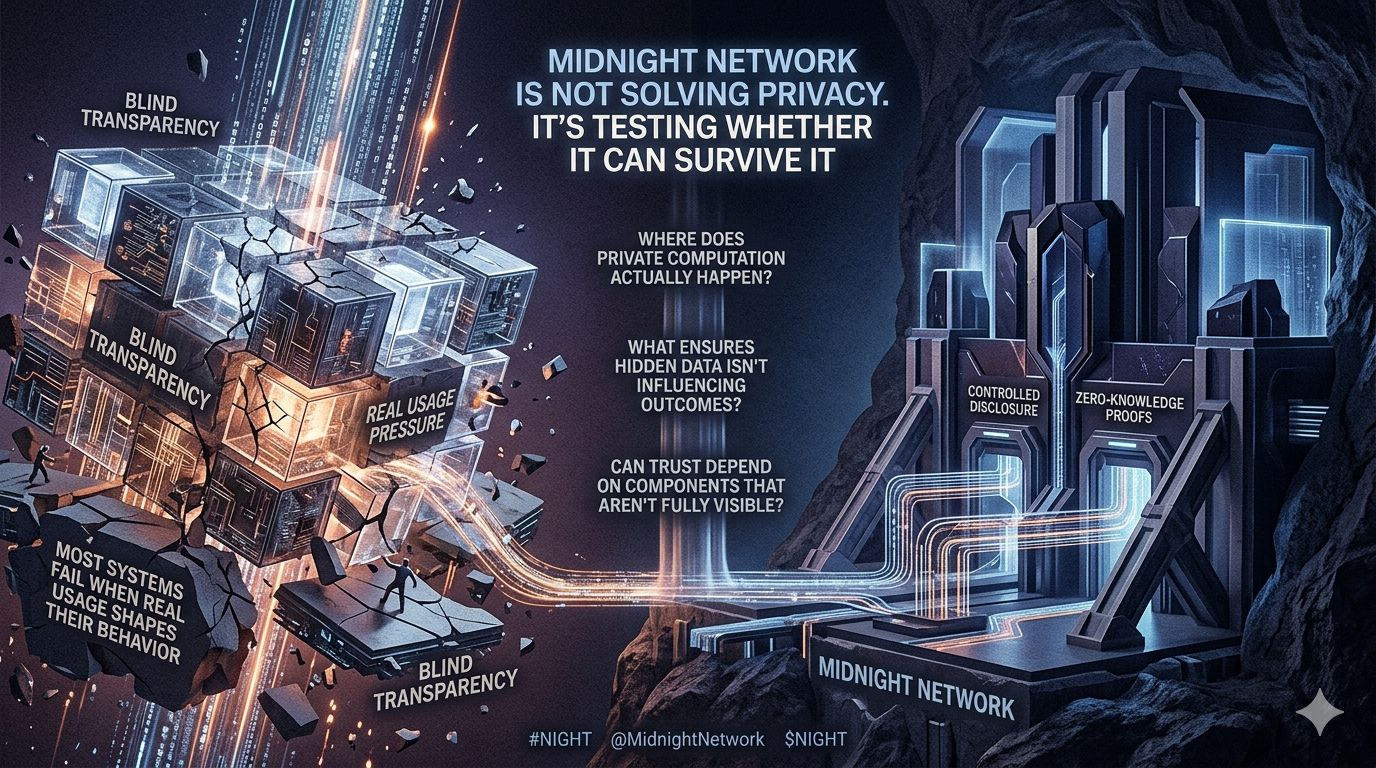
That it can maintain consistency even when different stakeholders pull it in different directions.
Maybe it works. Maybe it doesn’t.
But if it succeeds, it won’t be because it introduced a new narrative.
It will be because it managed to hold a balance that most systems fail to maintain:
A system where privacy is not absolute.
Transparency is not blind.
And trust does not depend on exposing everything.
The real question is:
Can Midnight Network hold that balance when it actually matters?
#night #NIGHT @MidnightNetwork $NIGHT
