
We live in a world where everything happens online, yet proving something basic — your degree, your identity, your eligibility for an airdrop — is still annoyingly hard, slow, or sketchy. Governments struggle with cross-border paperwork. Web3 projects wrestle with fair token drops that don’t turn into drama. Everyone wants the same thing: real trust without the middlemen, delays, or scams.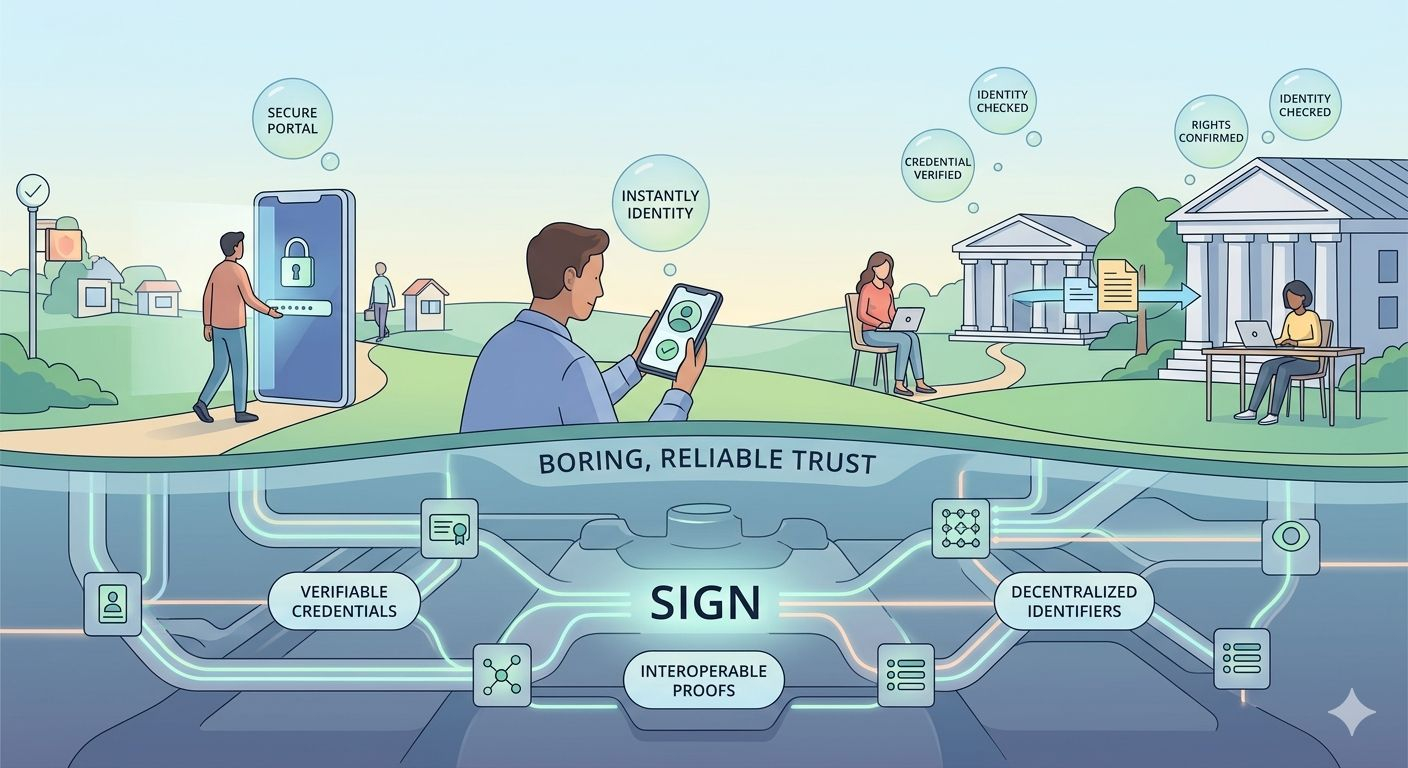
That’s exactly what SIGN is quietly building.
It’s not another flashy chain or hyped token launch. It’s infrastructure — the boring-but-essential kind that actually matters long term. At its core, SIGN gives people and organizations a clean, reliable way to issue, verify, and reuse digital proofs (attestations) across almost any major blockchain: Ethereum, Solana, Base, BNB Chain, TON, Starknet — you name it.
Imagine getting a digital diploma, a residency certificate, or proof your wallet meets certain criteria. A university, employer, DAO, or government can verify it instantly — no back-and-forth emails, no blind trust in random databases. No central authority holding your data hostage. No oversharing. Just verifiable truth. It builds on global standards like verifiable credentials and decentralized identifiers, combined with privacy tech like zero-knowledge proofs.
Then there’s the token side — where many people first notice SIGN, especially as ecosystems start forming around emerging projects like $SIREN that tap into this infrastructure layer.
TokenTable handles airdrops, vesting, unlocks, team allocations, and community rewards — all the messy distribution problems Web3 projects usually struggle with. It has already processed over $4B in tokens to more than 40 million wallets across hundreds of projects. This isn’t theory — it’s live, large-scale infrastructure, and projects like $BR are part of that broader movement benefiting from more transparent and reliable distribution systems.
What stands out most is transparency. When rules are on-chain and verifiable, trust naturally follows. People participate with confidence. Communities become stronger. Tokens start to feel less like speculation and more like real economic tools.
And it’s not just crypto-native use.
Governments are already building on SIGN — including the UAE, Thailand, and Sierra Leone — with use cases ranging from digital identity systems to residency programs and programmable grants.
If it succeeds at scale, SIGN could become one of those invisible systems we rely on every day — like TCP/IP — quietly powering how we prove who we are, what we’ve earned, and what we’re entitled to.
In a world full of noise, that kind of reliable, invisible trust might be the real revolution.
@SignOfficial #SignDigitalSovereignInfra $SIGN
