
I have spent a lot of time over the few years working on ideas that sounded great on paper but did not work well when real people used them. Digital identity was one of those ideas. At first it seemed like it would be really useful. If wallets could prove who you are systems would be safer and more efficient.. When I started working on actual projects I realized that it was not that simple.
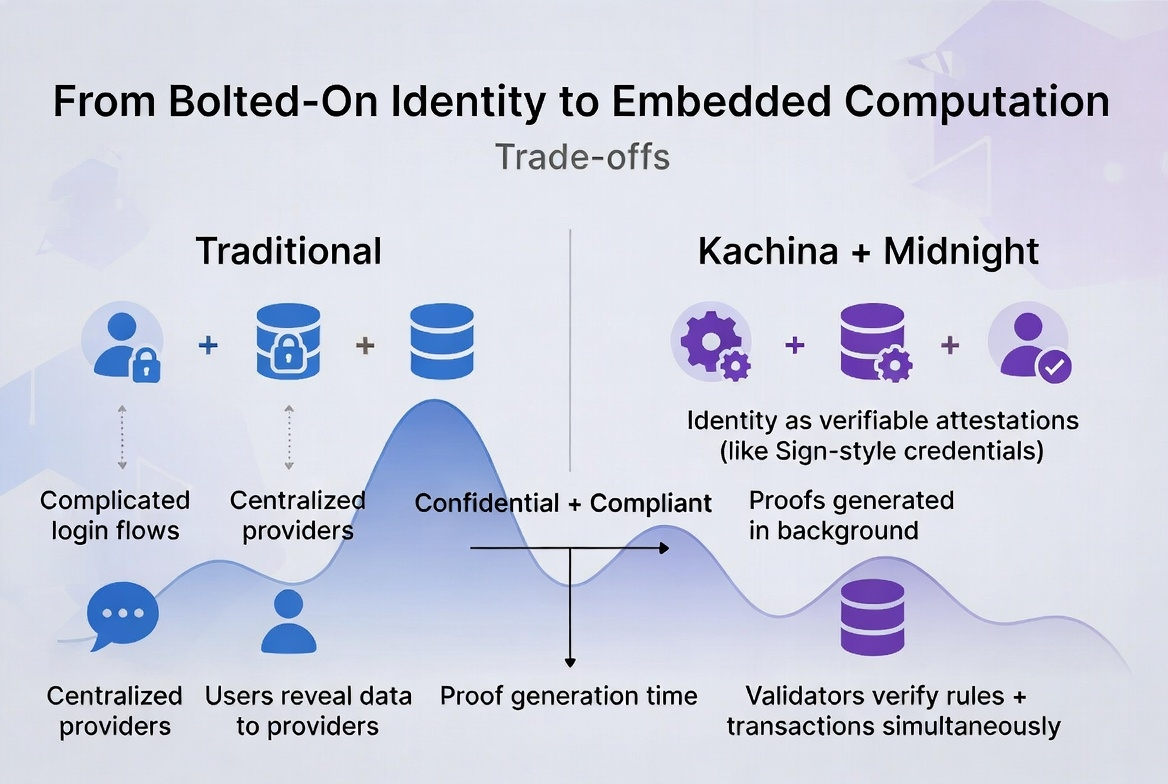
The problem was that identity systems were either controlled by one company or they were too complicated for users. Most solutions did not work well because of this. What changed my mind was when I started testing systems where identity was not a feature. Instead it was part of how transactions were made and verified. This made me look at Midnight and its Kachina Proving System in a way.
I realized that identity is not something you add on top of a system. It is a part of how the system works. On the surface digital identity seems straightforward. You prove something about yourself and the system reacts.. In practice every step of the process can cause problems. Who gives you your identity? How is it stored? How often does it need to be updated? These questions do not go away just because we use cryptography.The Kachina Proving System is different. When I tested Midnights transaction flow I saw that identity is not something you show to the system. It is proven as part of the transaction itself. The system does not ask you to reveal who you are. It asks you to prove that you meet conditions and it does so without sharing unnecessary information. This may seem like a difference but it changes how the system works.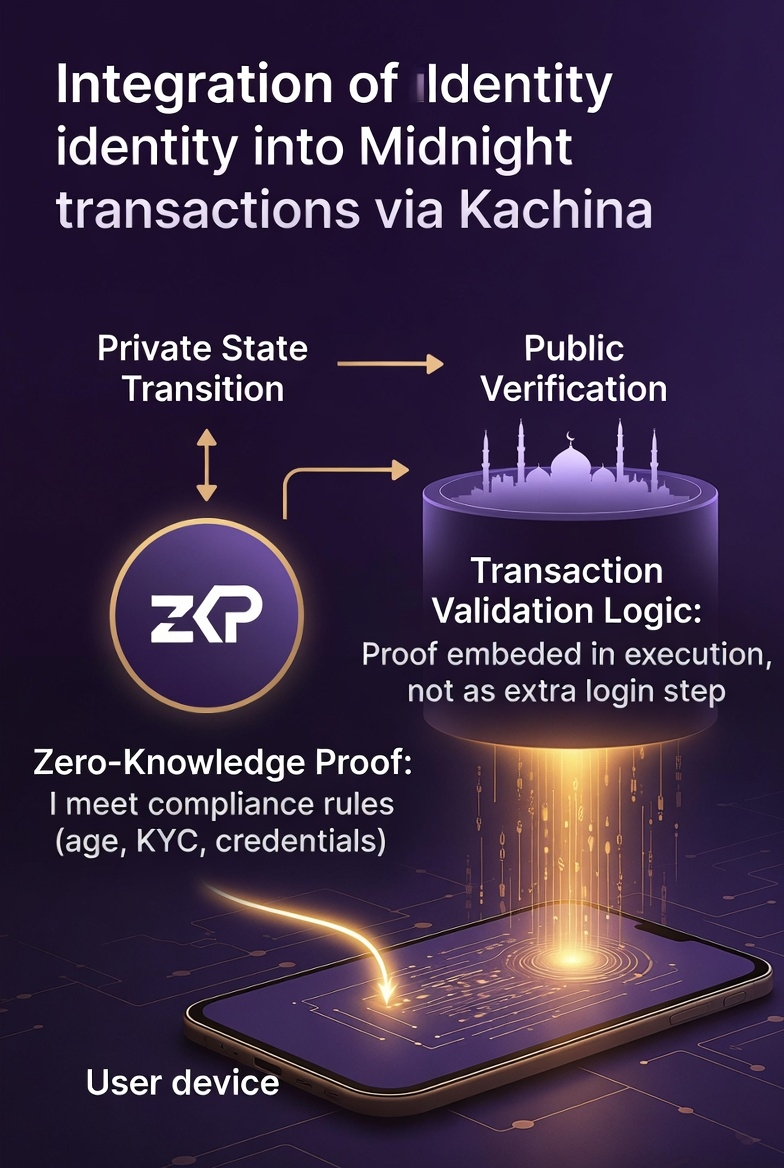
I noticed that these proofs are part of the transaction execution. Of adding identity as extra information the proving system makes it part of the validation logic. This means that validators are not just checking balances or signatures. They are verifying that the transaction respects rules, including identity rules without seeing the raw data. This is where confidential computation becomes real.Course there are trade-offs. Generating proofs takes time and computational power. I saw this when I repeated the private transactions and got slightly different confirmation times. The system felt a bit unpredictable unlike systems. This unpredictability is the cost of guarantees. The question is whether the system can manage this cost without affecting the user experience.
The Kachina Proving System helps balance this. It acts as the engine that makes these identity-aware computations possible at scale. Of treating zero-knowledge proofs as an add-on it integrates them into the execution pipeline. This reduces the gap between what developers design and what users experience. The proofs are still there. They are in the background, where infrastructure should be.
This is where midnight becomes more interesting. Midnight approaches identity not as a profile but as a set of verifiable attestations. When you combine this with a proving system like Kachina identity stops being something you present. Starts being something the system continuously validates. You do not log in with identity. You work within it.
In terms this changes how we think about trust. Applications no longer need to store user data or rely on centralized identity providers. Instead they can depend on proofs that certain conditions are met. Users control what is revealed while institutions get guarantees about compliance and authenticity. It is a shift from trust based on disclosure to trust based on verification.Validators play a role in maintaining this system. They are not just securing the network. They are responsible for verifying proofs that encode both transactional and identity-related logic. This raises the bar for participation. Creates a more meaningful incentive structure. Token rewards are tied not to uptime or stake but to the ability to process and validate these computations efficiently.
Looking at this from a Middle Eastern perspective adds another layer. Governments in the region are moving quickly toward transformation especially in areas like financial infrastructure and identity systems. The difference is that many of these initiatives are designed with integration in mind from the start. Identity is not an afterthought. It is built into payment systems, regulatory frameworks and public services.
If systems like Midnight and Kachina can align with this approach the implications are significant. Of adding privacy and identity to existing infrastructure they could become part of the foundation. This would allow for systems where compliance and confidentiality are not in conflict but are enforced simultaneously through cryptography.
At the time the market does not always reward this kind of depth. There is still a tendency to focus on narratives rather than usage. Tokens like $Arb have seen trading activity often driven by speculation around ecosystem growth and scaling narratives. Trading volume and holder counts can look impressive. They do not necessarily reflect how deeply integrated a system is into real workflows.
What I try to pay attention to instead are signals. Are developers building applications that rely on these proving systems in -trivial ways? Are users interacting with them repeatedly not once? Is there a growing base of validators of handling the computational demands? These are metrics to track but they are more indicative of long-term viability.
There is also the risk of valuation getting of adoption. When expectations are based on what a system could enable than what it currently supports it creates a fragile equilibrium. If usage does not catch up the narrative eventually loses momentum. I have seen this pattern repeat times to be cautious whenever a project is described as inevitable.What would success look like for something like the Kachina Proving System? It is not a spike in attention. It is almost invisible integration. Transactions that include identity constraints without users noticing. Applications that rely on computation as a default, not a feature. Validators that continue to operate while handling increasingly complex proofs.
On the side the warning signs are also clear. If activity remains concentrated around speculation than usage if developer engagement starts to decline or if the cost of proving continues to create friction that users can feel the system risks becoming another example of promising infrastructure that never quite found its place.
What I have come to appreciate is that real infrastructure does not announce itself. It shows up in repetition. In systems that people use without thinking about the layers beneath them. The Kachina Proving System, at least from what I have seen far is moving in that direction. It is not trying to make identity louder. It is trying to make it disappear into the flow of computation.
That more than anything is what makes me pay attention now. Not the narrative,. The moments where the system works quietly in the background doing exactly what it was designed to do. The Midnight and Kachina Proving System is not a project. It is a way of thinking about identity and how it can be part of the system not something you add on top. The Kachina Proving System is trying to make digital identity a part of the computation itself not a separate feature. This is what makes it interesting, to me. $NIGHT #night @MidnightNetwork $ARB