This is one of them.
People have been talking for years about fixing identity online, making credentials portable, cutting out repetitive verification, and building systems where proof can move more easily than it does now.
Every time it comes up, the promise sounds familiar.
A better system.
A cleaner system.
A system where your credentials follow you.
A system where your information can be verified without forcing you to repeat the same process again and again.
A system where access and distribution happen because the rules are clear, not because someone manually checked a spreadsheet and replied to an email three days later.
And honestly, that all sounds good because the current system is exhausting.
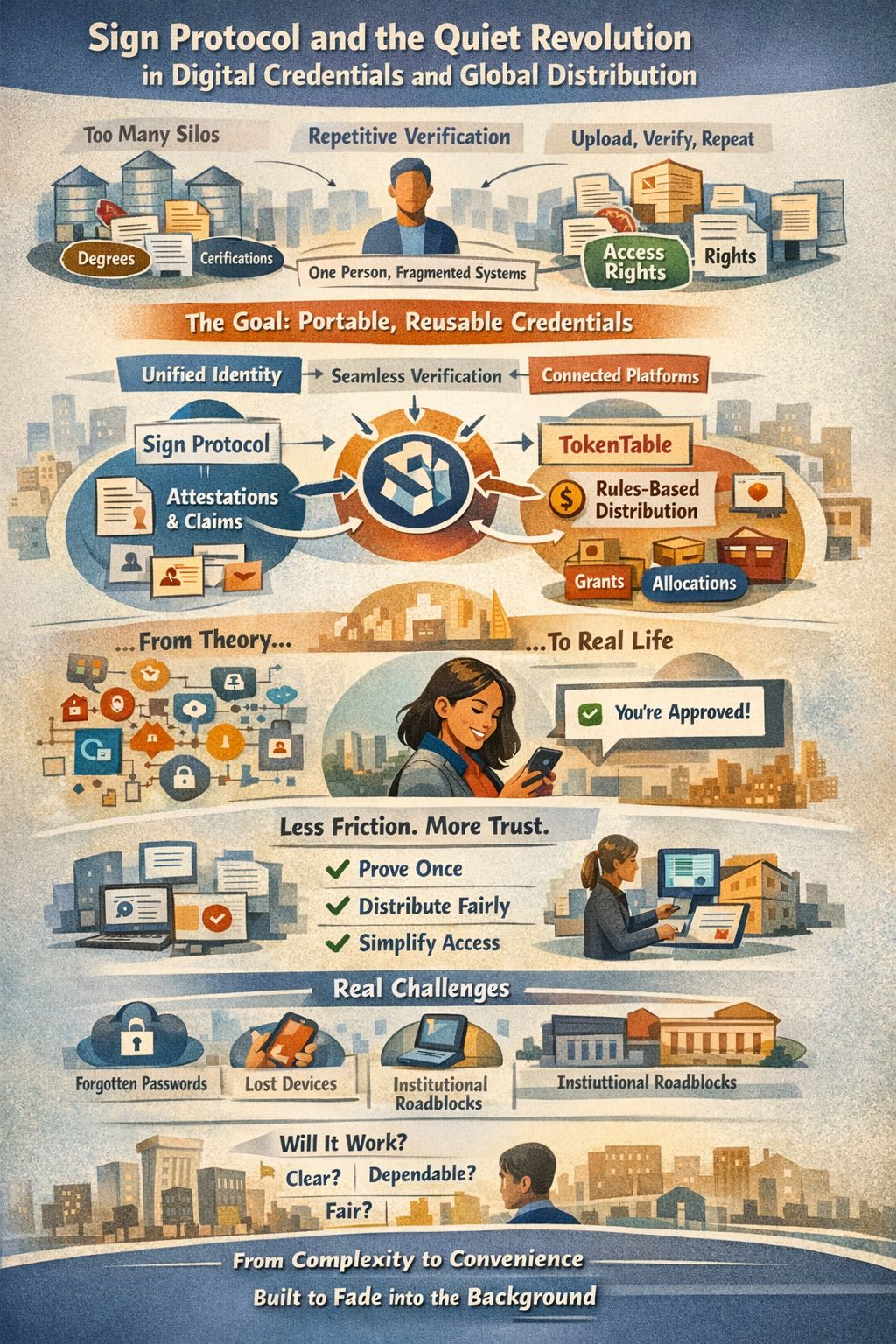
Right now, proving something as basic as who you are, what you’ve done, or what you qualify for is still far more awkward than it should be. You upload documents to one platform, then upload the same documents somewhere else. One service wants a PDF. Another wants a link. Another asks you to verify through some third-party system you have never heard of. You wait for confirmation emails, reset passwords, dig through old files, and try to remember which version of a certificate or record a particular platform wants this time.
It is not dramatic. It is just tiring.
And that is exactly why this whole category remains interesting in the first place. Not because of the tech language. Not because of the token angle. Because the actual problem is real.
There is something deeply broken about living in a world where your degree, your certifications, your work history, your eligibility, your access rights, your reputation, and your identity all sit in different silos that barely speak to each other.
You are still the same person, but every system acts like it is meeting you for the first time.
Every institution wants its own version of you.
Every platform builds its own gate.
Every verification flow starts to feel like a new obstacle instead of part of one connected digital life.
That is the gap Sign is trying to fill.
At the center of it, the idea is fairly simple.
Build a system where credentials and claims can be issued in a structured way, verified in different places, and reused when needed instead of being trapped inside one platform. Then connect that system to distribution, so once someone has proven they are eligible for something, whether that is access, a grant, an allocation, a reward, or some kind of financial benefit, the next step can happen without forcing everything back into manual review and patchwork admin work.
That is the broad promise.
And to be fair, it is not built around a fake problem. The need is real.
Sign’s ecosystem is built around two main pieces. Sign Protocol is the attestation layer, the part designed to create and verify structured claims. TokenTable handles the distribution side, where those verified claims can feed into allocations, vesting, unlocks, grants, and other forms of programmable distribution.
More recently, Sign has started framing the whole system under a broader model called S.I.G.N., which it describes as something bigger than a narrow crypto tool, more like an infrastructure layer spanning identity, money, and capital.
That shift matters because it changes the tone.
It suggests the project wants to be seen less as a product and more as infrastructure. Not something flashy sitting on top of a trend, but something foundational sitting underneath systems where proving things matters, where authorization matters, and where moving value depends on rules, records, and verifiable evidence.
That is the stronger version of the thesis.
And honestly, it is a stronger version than the lazy “put it on-chain and everything gets fixed” argument that so many projects keep falling back on.
Because the truth is, nobody really cares whether something is on-chain if using it still feels annoying.
That is the part this whole sector often forgets.
Most people do not wake up caring about decentralization. They care about less friction. They care about not having to prove the same thing six times in six different formats. They care about not feeling like one small mistake could lock them out of something important. They care about not being trapped in the same repetitive verification loop every time they move between platforms or systems.
If a better infrastructure layer can genuinely reduce that pain, then yes, it matters.
If it just adds more steps, more jargon, and more strange wallet behavior, then it has missed the point completely.
That is why Sign is interesting, but also why it still deserves skepticism.
On paper, the architecture makes sense. Sign Protocol allows builders to define schemas, issue attestations, and anchor claims in ways that are meant to be reusable across different environments. In the bigger picture, it fits into a growing movement around portable and machine-verifiable credentials.
The world has been moving in this direction for a while.
Not just crypto, but the broader digital identity space as well.
There is a growing recognition that people need ways to prove things digitally without restarting from zero every single time. That is not some niche obsession. It is a real systems problem, and more organizations are slowly being forced to acknowledge it.
So Sign is not building in a vacuum.
If anything, the space is becoming more relevant, not less.
The harder question is whether a system like this can become usable enough to matter outside highly motivated technical circles.
That is where everything gets messy.
Because the hard part is never just the protocol.
The hard part is real life.
Real life is people forgetting passwords.
Real life is someone losing a phone.
Real life is a user clicking the wrong thing because the prompt looked unfamiliar.
Real life is someone not understanding whether they are signing in, approving access, or confirming a transfer.
Real life is institutions dragging their feet, changing policies, or insisting on their own process even when a shared system already exists.
That is where these systems either become useful or collapse under their own assumptions.
A lot of digital identity projects start sounding smarter than they feel. They can explain the cryptography. They can explain the standards. They can explain why the architecture is elegant.
But if the user experience still feels tense, confusing, or fragile, most ordinary people are not going to care how technically sound the backend is.
They are just going to avoid it.
That is the pressure Sign is under too.
What it is trying to build only matters if it becomes easier than the thing it replaces.
Not more advanced.
Not more impressive.
Easier.
That is the real standard.
TokenTable is probably one of the more practical parts of the whole system because it brings the conversation down from theory into action.
It is one thing to say a credential should be portable.
It is another thing to say that once eligibility is proven, distribution can happen in a clean, rules-based way instead of through ad hoc spreadsheets, manual lists, one-off scripts, or scattered claim systems.
That is where the project starts to feel grounded.
Because distribution is where these systems stop being abstract.
Once value is involved, the details matter more.
Who gets what.
Under what conditions.
When claims open.
Whether access can be revoked.
Whether an allocation was based on the right credential.
Whether mistakes can be corrected.
Whether the whole process still makes sense to the person at the receiving end.
Those are not side questions.
That is the actual work.
And that is why this category has more weight than it sometimes gets credit for. It is not really about making credentials sound futuristic. It is about trying to replace repetitive, messy, disconnected proof systems with something more stable. Something that lets evidence travel more cleanly. Something that lets systems verify without constant duplication. Something that makes distribution feel procedural instead of chaotic.
That is a worthwhile goal.
But there is still a tension running through all of it, and Sign is not exempt from that tension.
The project increasingly presents itself as infrastructure for identity, money, and capital systems. At the same time, it still lives inside a tokenized ecosystem, with staking, incentives, unlock schedules, and all the market attention that comes with that.
Both things are true at once.
The infrastructure story is growing, but the token story has not disappeared.
That does not automatically weaken the project, but it does complicate how people see it.
A lot of people are understandably tired of systems where the most visible activity ends up being about the token rather than the utility.
And that is a fair concern.
A credential network should not need market excitement to justify its existence. The utility has to stand on its own. A degree is not more meaningful because a token sits next to it. A compliance check is not more humane because it plugs into an ecosystem asset. A distribution system is not automatically better just because it is wrapped in crypto language.
So the real test for Sign is not whether it can keep attention.
It is whether it can quietly become useful.
That is what real infrastructure does.
It fades into the background.
It stops asking users to constantly think about the machinery.
It becomes dependable enough that people only notice it when it fails.
And that is still the challenge here.
Can this kind of system become boring in the best possible way?
Can it become clear enough for normal people?
Can it survive the messiness of institutions?
Can it handle recovery, change, revocation, updates, disputes, and ordinary user mistakes without falling apart?
Can it make credential portability feel natural instead of experimental?
Can it make distribution feel fair and understandable instead of technical and distant?
Those questions matter more than any diagram.
Because if the answers turn out to be yes, then this category becomes much more than a niche corner of digital infrastructure. It becomes part of how digital systems actually work.
Quietly.
Invisibly.
Usefully.
Something people rely on without needing to understand the entire stack underneath it.
And if the answers turn out to be no, then it risks becoming one more ambitious framework that made perfect sense in theory but never fully settled into normal life.
That is why Sign is worth watching, but not worshipping.
The problem it is trying to solve is real. The architecture is more thoughtful than average. The timing makes sense. The surrounding world is slowly moving toward more portable forms of digital proof. The distribution layer gives the idea practical weight.
But none of that changes the most important truth:
People do not adopt systems because they are philosophically elegant.
They adopt them because they reduce hassle.
Because they save time.
Because they feel trustworthy.
Because they make something annoying feel simple.
That is the bar.
And if Sign ever clears it, then what it is building could matter far beyond the circles already paying attention.
Not because it sounded revolutionary.
Because it finally made something difficult feel normal.
#SignDigitalSovereignInfra @SignOfficial $SIGN