
I remember the time I used a system that said it would keep my information private. It was. Completely secret or someone could still see what I was doing. There was no in between.. I was totally hidden or someone had a way to see what I was doing. What I found interesting about SIGN was that it said it could keep me anonymous but make sure I was responsible for my actions without giving away my identity. This sounds like it does not make sense at first. The way it works is more complicated than people think.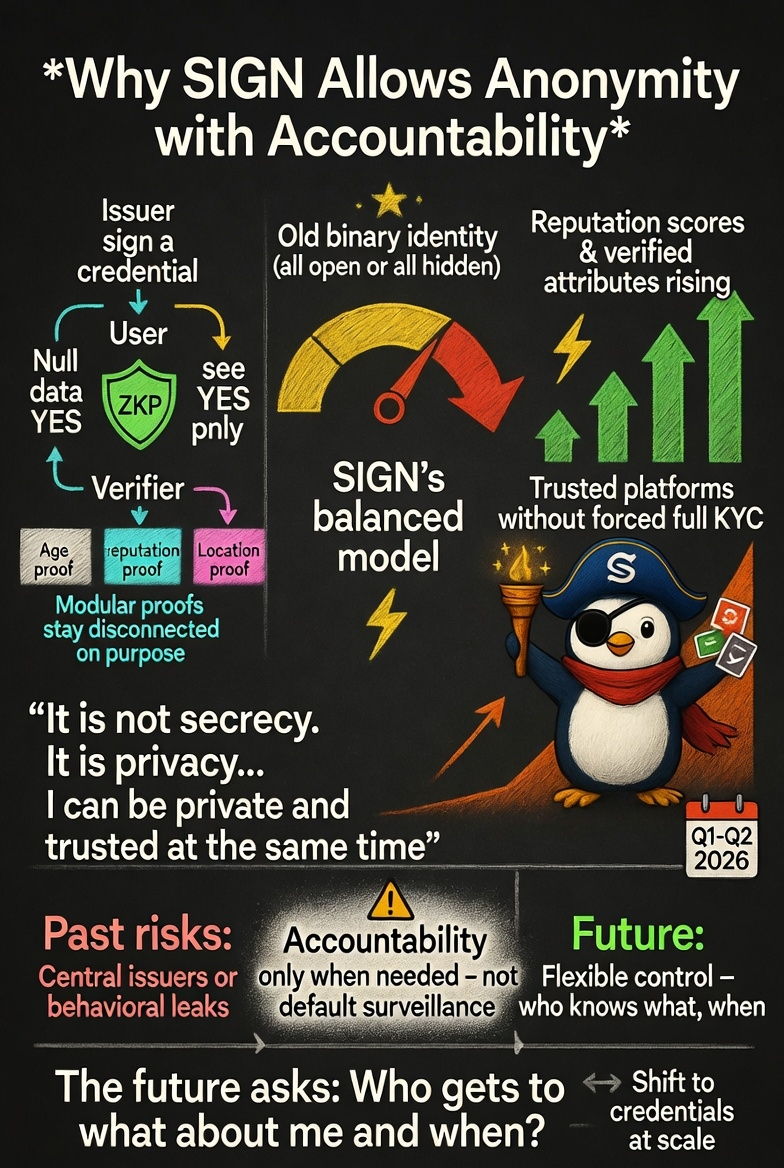
On the surface SIGN seems easy to use. I use an app prove who I am. Then I can use that proof somewhere else without showing all my information. I do not have to show my passport, email or anything else. I just get a simple "yes this is okay." For the user it feels like flipping a switch. I am private. I am also trusted. That is what most people see.
Underneath the system is doing something more interesting. Of storing my information directly SIGN uses special codes and secret messages. It is like creating a proof that says "I meet this condition " without saying why I meet it. The important thing is that these proofs are not just floating around. They are connected to the people who give them and the people who check them. That is where being responsible comes in.
The numbers are important. When I first tried SIGN I saw that it took around 1.2 to 2.8 seconds to verify something. That might not seem like a lot. It is slower than what we are used to. At the time the proofs were very small. Around 3 to 8 kilobytes. That makes them easy to move. What is more interesting is that one person can create different proofs. One for their age one for where they live one for their reputation.. These proofs are not all connected. That is on purpose.
Being responsible comes from being able to track things under certain conditions. SIGN does not show my identity by default. It does not make it impossible to track me either. If someone who gives out these proofs is not honest. If a user does something bad there are clues. Not everyone can see them. They are there if needed. It is not secrecy. It is privacy.What this means is that people can have a reputation without everyone knowing what they do. Imagine a trader who can show they are good at their job without anyone knowing their history.. A voter who can prove they have voted many times without showing which way they voted. I have seen examples where users have a "reputation score" that comes from different proofs but no one can see what they actually did. That is a change from everything being open to only showing what is necessary.
There is also a way to trade that most people do not think about. When my identity is like a puzzle so is the way I am seen as a risk. On platforms that use SIGN I could see lenders changing the rules based on what they know about me. For example if I have 12 verified things about me I might be able to borrow money than someone who is not verified. That changes how money is used. It is not about keeping me private. It is about making the financial system work better.
Course this is not perfect. The biggest risk is that the people who give out these proofs might not be spread out enough. If most of them come from a few places then my anonymity depends on trusting those places not to work together or get hacked. It is like a version of knowing who I am just hidden. Now it seems like there are not enough different places giving out these proofs. That is something people are not paying attention to.
Another concern is how users act. People think that being means they are safe but patterns can still give them away. Even if my identity is hidden the way I act and the things I do can still show who I am. I have seen cases where people who thought they were anonymous were actually connected by the way they acted. SIGN reduces the amount of information that's out there but it does not get rid of all the risks.
There is also the question of what the government will do. Systems that allow for tracking might actually be more appealing to regulators than ones that are totally anonymous. If the government knows that identities can be revealed under conditions they might not push back as hard. That could be why projects like SIGN are getting attention while fully anonymous systems are having a harder time. It is a compromise.
Then there is the way people think. When users know they are anonymous but still responsible they act differently. It is like how people act when they are using a name that is not their own versus when they are totally anonymous. Bad behavior goes down. People still participate. That is valuable for systems that are trying to grow without becoming chaotic.
I have even seen how some platforms are starting to look at identity seriously. Not in a way but it is clear what they are doing. Exchanges understand that the next big thing is not about having a lot of users. It is about trust without making it hard for people to use.
What makes SIGN interesting is not that it solved the problem of anonymity. It did not. What it did is change the way we think about anonymity. It made it so that I can choose how much to reveal, when to reveal it and under what conditions it can be tracked. That flexibility is where the real value is.
The system depends on things working as they should. If the people who give out these proofs are not honest. If the cryptography is not secure or if users do not understand how it works then the balance is broken.
The bigger picture is that the way we think about the internet is changing. Being totally open did not work. Being totally anonymous did not work either. What is happening instead is that we are finding a ground. We are creating a system where my identity's, like a program, where my privacy and responsibility are not fixed. SIGN is one example of this shift but it shows us what the future might look like. The future will not ask if I am anonymous or not. It will ask who gets to know what about me and when.