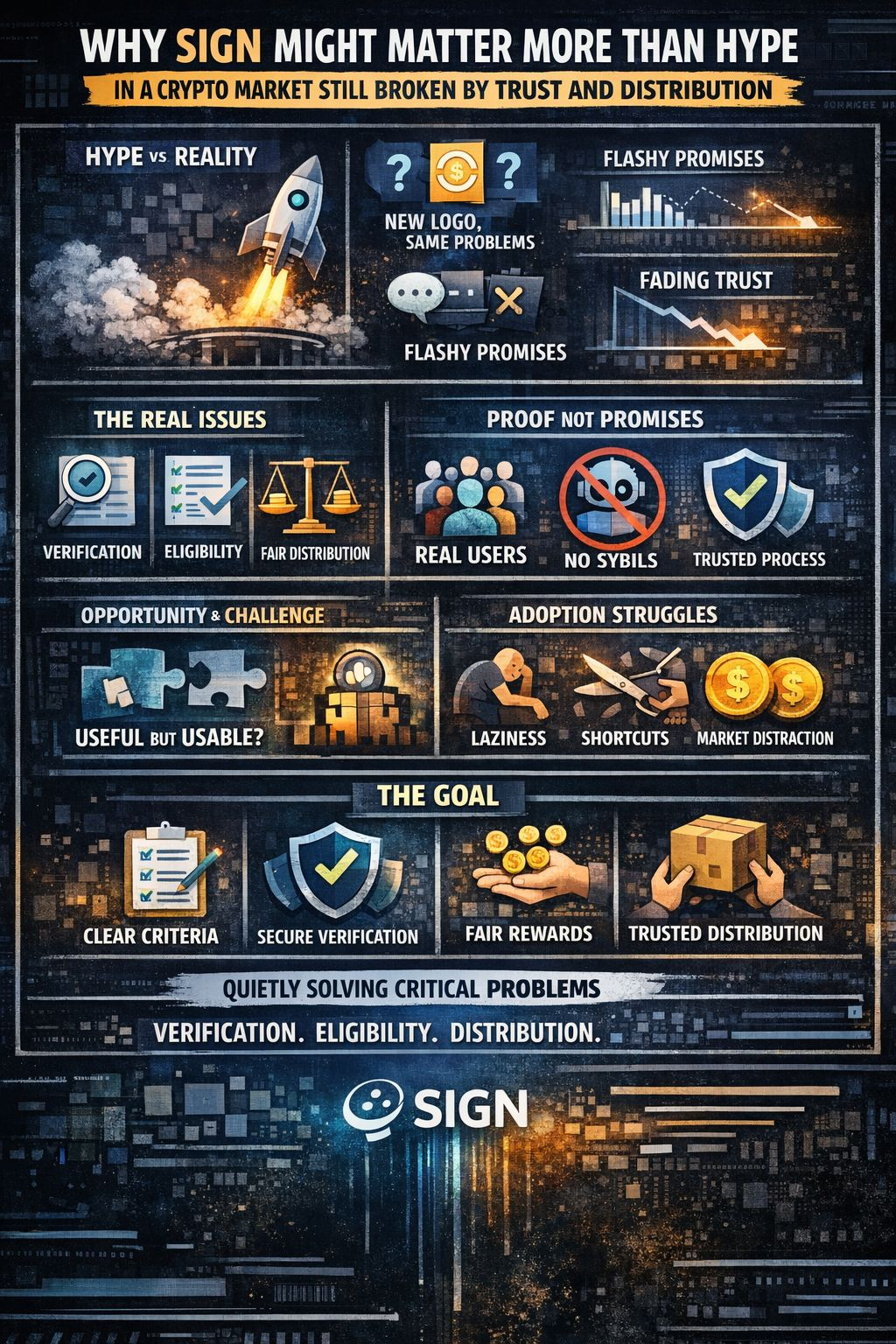
Lately, every time I open crypto, it feels like I’m watching the same story repeat with better branding.
A new logo. A cleaner narrative. A fresh wave of people saying this is the project that changes everything. After a while, it all starts to feel familiar in the worst way. Different names, same promises, same inflated certainty. The language evolves, but the pattern rarely does.
That’s probably why SIGN caught my attention differently.
Not because it felt explosive. Not because it came wrapped in the usual “this fixes the entire stack” energy. It stood out because it felt quieter than that. More specific. More grounded. Like it was focused on one of those parts of crypto most people ignore until it fails in public.
And honestly, that might be exactly why it matters.
Crypto has become incredibly good at manufacturing excitement. What it still struggles with is building systems that make sense once real people start using them. Not bots. Not farmers. Not wallets optimized to squeeze every possible incentive out of a launch. Real people. People who arrive late, misunderstand the rules, click the wrong thing, miss a snapshot, fail a verification step, or simply want to know whether a process is fair before they trust it.
That’s usually where the cracks start showing.
And that’s the lane SIGN seems to be stepping into.
What makes it interesting is that it is not trying to sell another giant replacement story. It is not presenting itself like some grand reset for crypto. It seems far more focused on a problem the industry keeps running into and keeps pretending is secondary: verification tied to distribution.
That does not sound glamorous. It is not the kind of thing that dominates timelines or pulls in easy hype. Nobody wakes up excited about credential infrastructure, eligibility logic, or distribution mechanics. But that’s also the point. The parts of a system that matter most are often the least marketable.
Verification is boring until an airdrop gets farmed.
Eligibility is boring until users start arguing over who deserved access.
Distribution logic is boring until millions of dollars are involved and nobody trusts the criteria anymore.
Then suddenly the “boring” layer becomes the only thing anyone wants to talk about.
That is where something like SIGN starts to feel more relevant than it first appears. Because a lot of the biggest failures in crypto are not really failures of imagination. They are failures of coordination. Failures of proof. Failures of process. Failures of deciding who qualifies, how that gets verified, and whether anyone can trust the result once incentives get messy.
And incentives always get messy.
That’s the part I keep coming back to. Crypto still talks like its biggest problems are mainly technical in the obvious sense. Everyone wants to talk about speed, modularity, abstraction, interoperability, intent layers, or whatever the market is currently pretending will solve everything. But a lot of the actual pain shows up somewhere else.
Who actually qualifies for a reward.
How do you verify that fairly.
How do you stop sybil behavior without turning everything into a surveillance system.
How do you prove someone met a condition without exposing more than necessary.
How do you distribute value without the whole process becoming a strange mix of spreadsheets, opaque rules, retroactive edits, and trust-me-bro administration.
That is the stuff people skip past because it sounds dry. But dry problems become serious problems very quickly when money, access, and reputation are involved.
That is why SIGN feels directionally right to me.
The way I see it, it is not really about identity in the vague, overused crypto sense. It is more about proving things in a way that can actually be operational. Proving a wallet completed a certain action. Proving a user qualifies for an allocation. Proving that some condition was met under rules that can be checked later. Attaching structure to who gets what, and why, instead of leaving that logic scattered across one-off systems and half-trusted processes.
And if that sounds obvious, it probably should.
A lot of the infrastructure crypto actually needs feels obvious the moment it is pointed out. The problem is that obvious things are easy to ignore when the market is busy chasing louder narratives.
Airdrops alone are enough to show why this matters.
Every cycle, the pitch sounds familiar. Reward real users. Distribute fairly. Recognize early participation. Strengthen the community. Then the claim process opens and the whole thing starts unraveling. Sybil farming appears. Wallet splitting appears. Bots find the edges. Criteria change. Users feel cheated. Teams get defensive. Everyone suddenly has a different definition of what “fair” was supposed to mean.
At that point, it is no longer just a token distribution issue.
It is a verification issue.
Because if you cannot verify who did what, or who qualifies for what, then there is no such thing as fair distribution. There is only distribution with better branding around it.
That is a big part of why SIGN feels more relevant than it might seem on the surface. It is not trying to solve some abstract future problem. It is looking straight at a current one the space still has not handled particularly well.
At the same time, this is where I pause.
Because I have seen plenty of ideas in crypto that made complete sense and still went nowhere.
Not because the code was bad. Not because the design was flawed. But because adoption is brutal. People say they want better systems, but they do not always want the extra structure that comes with them. Teams say they care about fairness, but not every team wants a process that becomes more visible, more rigid, or harder to quietly adjust. Users say they want cleaner flows, but the second something adds friction, a meaningful number of them disappear.
That is the real challenge for any infrastructure project.
It is not enough for SIGN to be useful. It has to be usable. Easy enough to integrate. Easy enough to trust. Easy enough to fade into the background. Because infrastructure does not win by being talked about all the time. It wins when people barely notice it is there, but the system works better because it is.
That is a much harder test than having a good concept.
And that is why SIGN is not only competing with other projects in the verification or identity space. It is competing with human behavior. It is competing with laziness, with opportunism, with bad incentives, with the industry’s habit of preferring shortcuts over discipline.
That is a tougher opponent than any protocol category.
Crypto users are not uniquely irrational, but they are predictable in one important way. If there is a shortcut, someone will take it. If there is a loophole, someone will search for it. If there is one extra step in the process, some percentage of users will drop off immediately. That is what makes this category difficult. You can build something elegant and still lose if no one wants the discipline that comes with using it properly.
Still, I keep coming back to the same feeling: this direction makes more sense to me than another round of oversized promises about abstract scale.
Crypto already has enough spectacle.
What it seems to need more of is better infrastructure for trust, evidence, coordination, and eligibility across the systems that already exist. Not trust in the emotional sense. Trust in the operational sense. Can this be verified. Can this be audited. Can this be checked later when people start asking hard questions. Can this hold up when the incentives get weird.
That is the less glamorous side of building, but it is also the side that matters more as the industry matures.
Because eventually every system has to deal with reality.
Not ideal users.
Not ideal incentives.
Not ideal conditions.
Reality.
And reality is where the messy details show up.
That is why I think SIGN matters more than its level of hype might suggest. It is pointed at a layer most people only notice when it fails, but once it fails, you realize how much depends on it.
That said, I am not looking at it like some magic missing piece. Crypto does not get fixed in one move. It never works like that. Even if SIGN is building something genuinely useful, that still does not guarantee broad adoption. It does not guarantee teams will integrate it well. It does not guarantee users will care. It does not guarantee the market will value it for what it actually does instead of just treating it like another token to trade around.
That disconnect between building and market behavior is still one of the biggest structural problems in crypto.
A project can be useful and still get ignored.
A project can be well designed and still lose momentum.
A project can solve a real problem and still fade because the broader environment never cared enough to use it properly.
That happens all the time.
So the healthiest way to look at SIGN, at least for me, is somewhere in the middle. Not dismissive. Not overly impressed. Just attentive. It feels like one of those projects that makes sense in a grounded way, and now the real question is whether that usefulness can become sticky.
That is a much harder test than people like to admit.
The more I sit with it, the more I think SIGN matters because it is focused on something practical.
Not glamorous.
Not theatrical.
Practical.
It is treating credentials, verification, and distribution as real infrastructure problems instead of side issues. And I think that instinct is probably right. The space does need more attention on those layers and less obsession with whichever abstract narrative happens to be trending this month.
If SIGN succeeds, I doubt it will look dramatic. It probably will not be one of those moments where everyone suddenly agrees it changed the game. It will look quieter than that. More like a system that slowly gets used in more places because it helps things run a little better in the background.
Fairer distributions.
Clearer eligibility.
Less sybil noise.
More confidence that rules actually mean something.
That is the ideal version.
The less ideal version is probably what crypto usually does. Partial adoption. Mixed execution. Some strong integrations, some forgettable ones, some overpromising, some misuse, and a market that still mostly cares about price before product.
That outcome feels realistic too.
And that is kind of where I land with it.
I do not think SIGN is easy to categorize yet. It sits in that uncomfortable space where the idea feels more mature than the attention around it, but the future still depends on whether enough people actually show up and use it.
That “if” is doing a lot of work.
But if I had to choose between watching another flashy scalability narrative and watching a project try to make verification and distribution less broken, I would rather pay attention to the second one.
Because in crypto, the gap between something that sounds good and something that actually holds up under pressure is massive.
Most of the time, we do not realize which one we are looking at until much later.
SIGN feels like one of those projects sitting right in that gap. Not guaranteed. Not flawless. Not something I would romanticize too quickly. Just a quiet piece of infrastructure trying to solve a very real problem in a market that usually prefers louder distractions.
And maybe that is exactly why it is worth watching.
#SignDigitalSovereignInfra @SignOfficial $SIGN