The Bigger Picture You Need To Know First
This isn't just a simple trade agreement. The Strait of Hormuz has been in a full crisis since February 28, 2026, when the United States and Israel launched joint military strikes on Iran, which also resulted in the death of Iran's Supreme Leader Ali Khamenei. In retaliation, Iran's Islamic Revolutionary Guard Corps issued warnings prohibiting vessel passage through the strait, leading to an effective halt in shipping traffic.
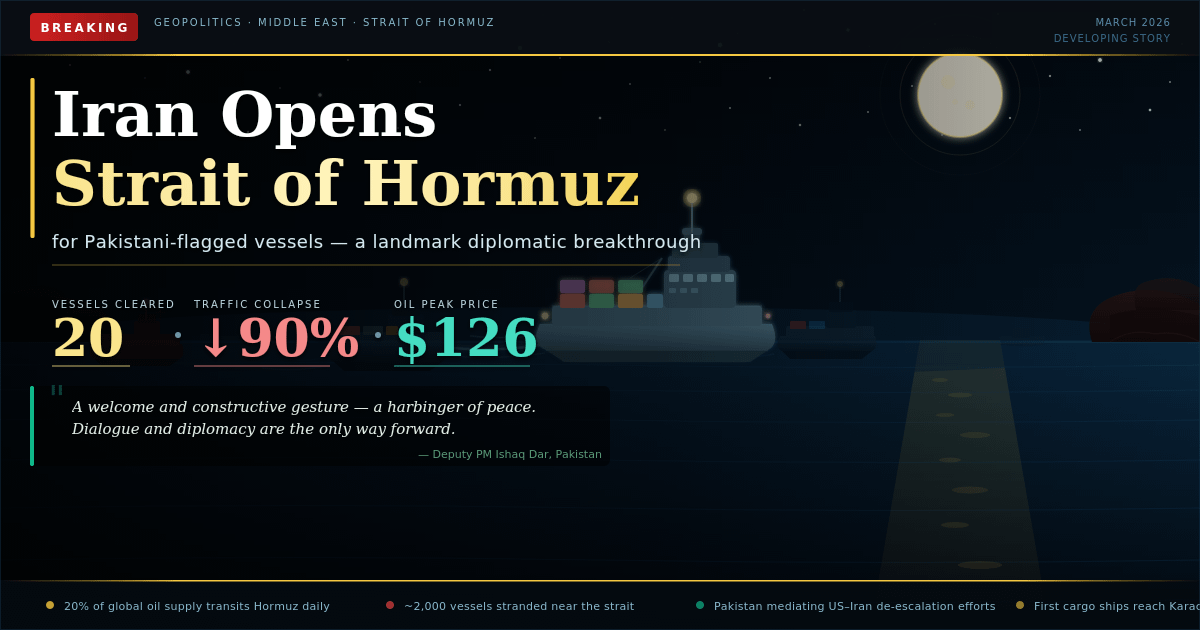
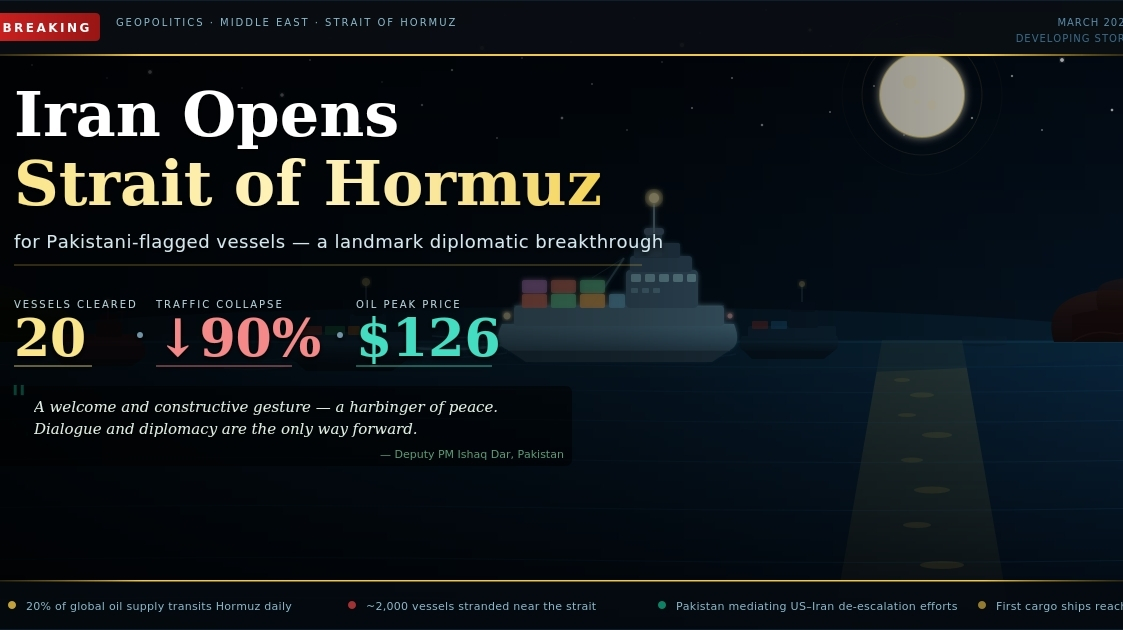
Maritime traffic dropped by 90 percent through the waterway, and only about 150 vessels have made it through since the war began — roughly one normal day's traffic. The World Trade Organization described it as the worst global trade disruption in 80 years.
What Pakistan Did
While the world watched nervously, Pakistan quietly got to work. Pakistan stepped up its diplomatic efforts since the start of the US-Israel and Iran conflict to help de-escalate tensions in the Middle East. As a result, President Donald Trump postponed planned military strikes on Iranian power plants following diplomatic efforts.
Pakistan is set to host a quadrilateral meeting on the Middle East war on Sunday, with top diplomats of Türkiye, Pakistan, Egypt, and Saudi Arabia meeting in Islamabad to discuss ongoing efforts to de-escalate heightened tensions.
The Deal
Iran agreed to allow 20 Pakistani-flagged vessels to pass through the Strait of Hormuz, with Deputy Prime Minister Ishaq Dar calling it a "welcome and constructive gesture" by Iran and "a harbinger of peace" that will help restore stability in the Middle East.
Two specific Pakistani cargo ships — Multan, a general cargo ship, and P-Akili, carrying over 80 million litres of crude oil — have already crossed and are en route to Karachi, expected to dock at Karachi Port on March 31. Iranian authorities provided an escort until the vessels cleared the strait's flashpoint line.
Pakistan Is Not Alone
Iran has begun permitting passage to so-called friendly nations. Included in that bloc are China, Russia, India, Iraq, and Pakistan. Malaysia and Thailand have also said Iran has allowed their ships to sail through the strait.
However, the process is far from simple. Ships seeking passage must submit their cargo details, crew lists and destinations to IRGC-approved intermediaries, receive a clearance code, and be escorted through Iranian territorial waters. At least two vessels have paid for the privilege, reportedly $2 million a crossing, settled in Chinese yuan.
Why This Matters Globally
The disruption affected about 20% of the world's daily oil supply and significant volumes of liquefied natural gas, with Brent crude oil prices surpassing $100 per barrel for the first time in four years, rising to $126 per barrel at its peak.
Nearly 2,000 vessels are stranded close to the narrow strait, which is located between Iran on its north side and Oman and the United Arab Emirates on its south side.
Bottom Line
Pakistan's diplomatic success with Iran is a significant win — not just for trade, but as a signal that dialogue is still possible. Dar stated that "dialogue, diplomacy, and confidence-building measures are the only way forward." With Pakistan now mediating between major powers, this small passage of 20 ships could be the first crack of light in one of the most dangerous global crises of 2026. 🇵🇰