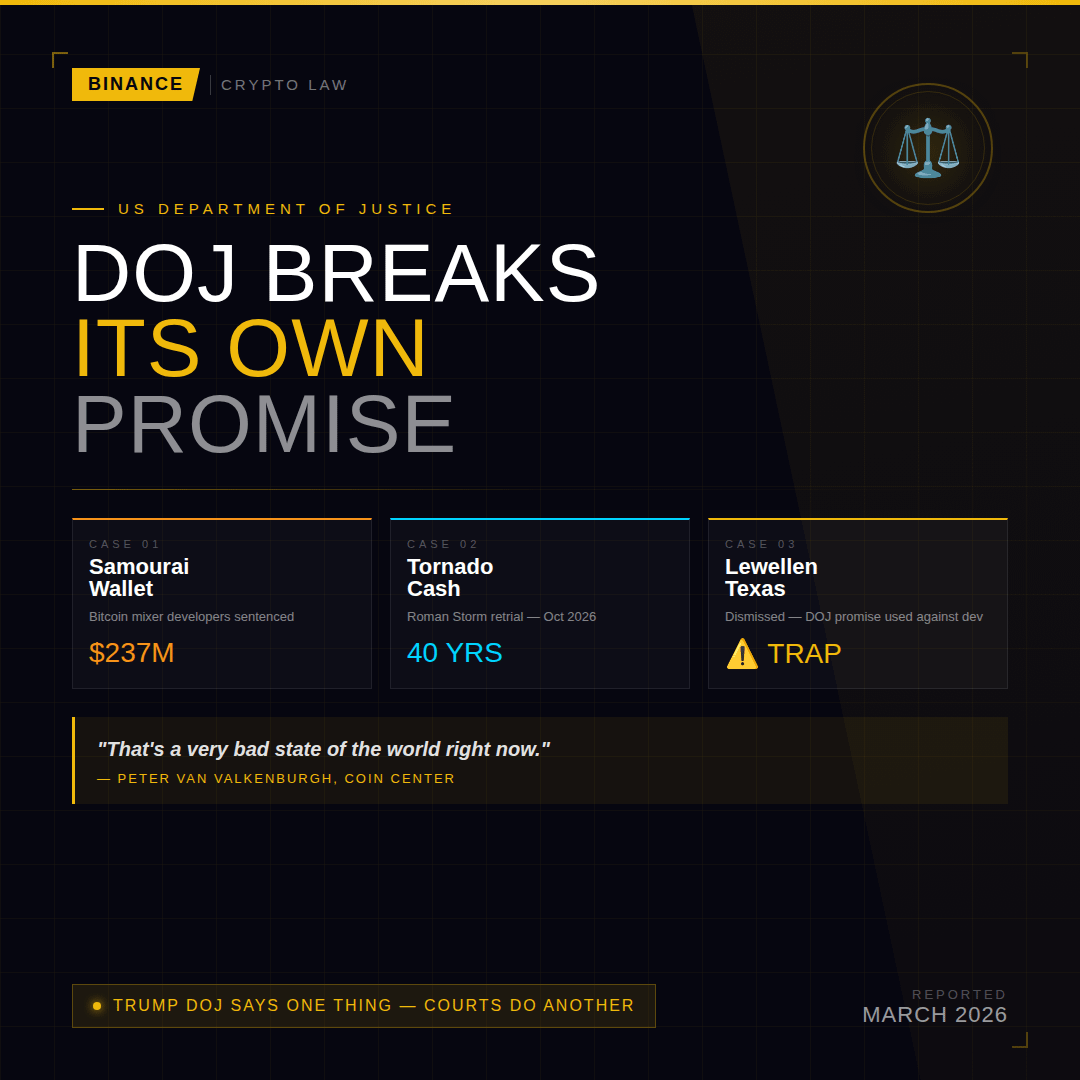
The Core Contradiction
The Trump administration entered office with clear promises — the DOJ would not target crypto software developers. Yet in March 2026, that promise is colliding hard with reality. The Trump DOJ has said it won't prosecute crypto software developers, but it's doing so anyway — and getting "binding legal clarity" has become a major concern for crypto advocacy groups.
🔨 Case 1 — Samourai Wallet: $BTC Developers Sentenced
Prosecutors stated that Keonne Rodriguez and William Lonergan Hill developed and marketed Samourai Wallet as a $BTC mixer, allowing users to conceal illicit funds. The DOJ accused them of facilitating more than $237 million in illegal transactions, including funds linked to darknet markets, hacks, and exploitation rings.
Rodriguez's defense team argued that Samourai was not a criminal enterprise but a privacy-focused $BTC wallet that helped users protect their identities. Defense lawyers warned the verdict could discourage developers from building security tools, stating: "This isn't a licensing glitch — it's a war on privacy."
⚡ Case 2 — Roman Storm: Tornado Cash Retrial Scheduled
US prosecutors are seeking a new trial for Tornado Cash developer Roman Storm, asking a federal judge in Manhattan to schedule proceedings for October 2026. The Justice Department wants to retry Storm on money laundering and sanctions conspiracy charges after a jury last August failed to reach a verdict on those counts.
The case centers on Tornado Cash, a crypto mixer that authorities say was used to obscure more than $1 billion in illicit funds, including activity linked to North Korea's Lazarus Group. If convicted on the remaining counts, Storm could face up to 40 years in prison.
Storm questioned the move publicly, stating: "The government's response? Try again to make writing code a crime."
🏛️ Case 3 — Michael Lewellen: Texas Court Dismissal
A federal judge in Texas dismissed a lawsuit against the DOJ brought by software developer Michael Lewellen, who said he feared being prosecuted for creating his own privacy tool. The judge ruled that because the Trump DOJ has said it doesn't plan to prosecute crypto developers, the man had no standing to claim "a credible threat of prosecution."
This ruling backfired badly on the crypto community. By making statements in support of software developers but still going after some of them anyway, the Trump DOJ appears to have now stuck policy leaders between a rock and a hard place.
🧠 The Bigger Legal Question
The bigger question is whether the US government's newer, softer rhetoric on digital assets actually changes anything when a flagship case is already in motion.
The DOJ's approach challenges the long-standing crypto community belief that code is speech and that developers should not bear criminal liability for third-party misuse. This case could establish a precedent with far-reaching consequences for the development of privacy tools and decentralized applications.
The Free Roman Storm campaign says total defense funding rose above $5 million by January 2026, and argues the case could set a precedent for holding developers liable for how third parties use non-custodial, open-source software.
💬 Industry Verdict
Peter Van Valkenburgh, executive director of Coin Center, warned: "Michael wants to build good tools that can be used for privacy. It is very plausible that those tools will be used for money laundering, and that then somebody will come and prosecute him." He concluded: "That's a very bad state of the world right now."
> The DOJ says one thing. The courts are doing another. Until binding legal clarity arrives, every crypto privacy developer in America is building under a legal cloud.