

Look, I’ve been staring at this Sign project for a while now—digging through their docs, reading the tea leaves of their government deals, watching the community either hype it or dismiss it as just another "DID play." And honestly? I think most people are looking at it completely backward.
They see "identity," they yawn, they move on.
But that’s not what this is. Sign isn’t a passport project. It’s a payout project.
Let me walk you through what I’m seeing, because once you grasp the actual engine under the hood, you realize this thing is trying to solve one of the messiest, most overlooked problems in the entire crypto space—and it’s doing it by partnering with actual countries.
The Big Misread: It’s Not About Who You Are, It’s About What You Get
Here’s the thing that keeps bothering me about how people talk about Sign. Everyone gets stuck on the identity layer. They hear "verifiable credentials" or "DID" and their eyes glaze over because we’ve seen a hundred projects promise a decentralized identity revolution that never came .
But I think that’s missing the point entirely.
If you actually look at what Sign does—not what it says it does, but what it processes—you’ll notice something interesting. By the end of 2024, their TokenTable product had already distributed over $2 billion in tokens to more than 40 million addresses . That’s not theory. That’s money moving. That’s millions of people getting paid.
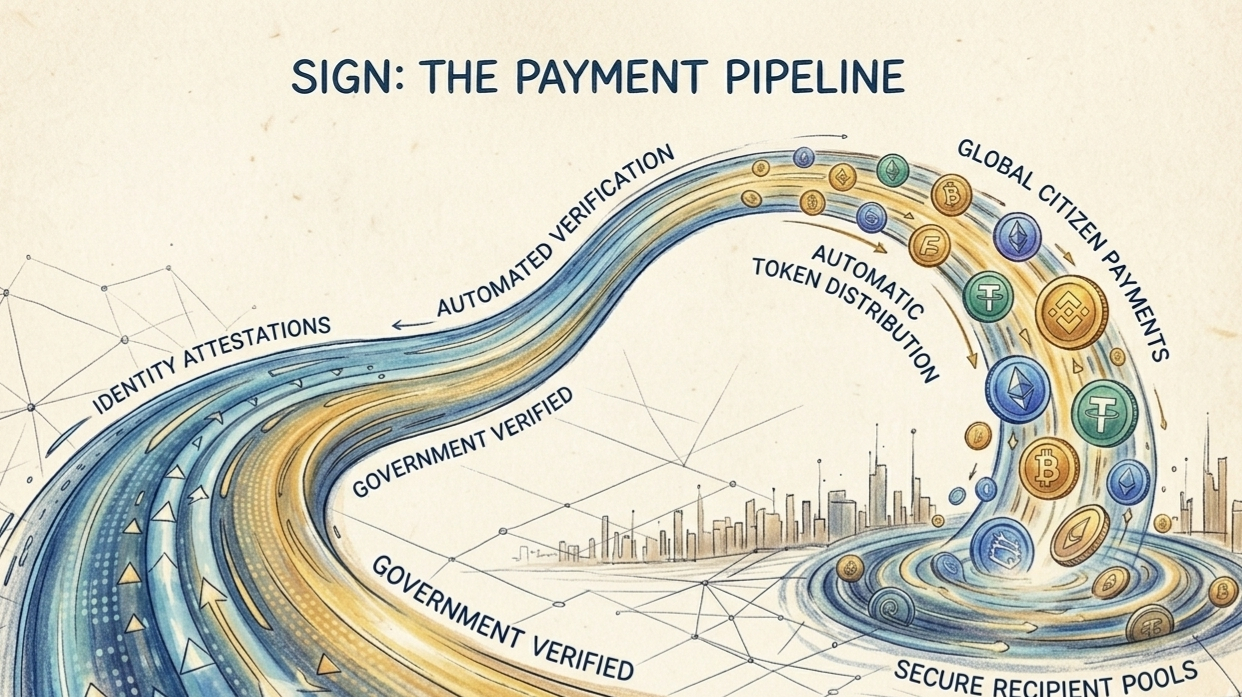
So here’s my take: Sign isn't an identity protocol that happens to distribute tokens. It’s a distribution protocol that uses identity to know where the money should go.
That shift in framing changes everything.
The Pipeline, Not the Passport
Most projects in this space focus on the front end. They build pretty interfaces, they talk about user sovereignty, they sell you on the idea of owning your data. And look, I’m not against any of that. But what happens after the verification? What happens when you’ve proven you’re a real person, or a contributor, or a citizen?
In most systems today? Chaos.
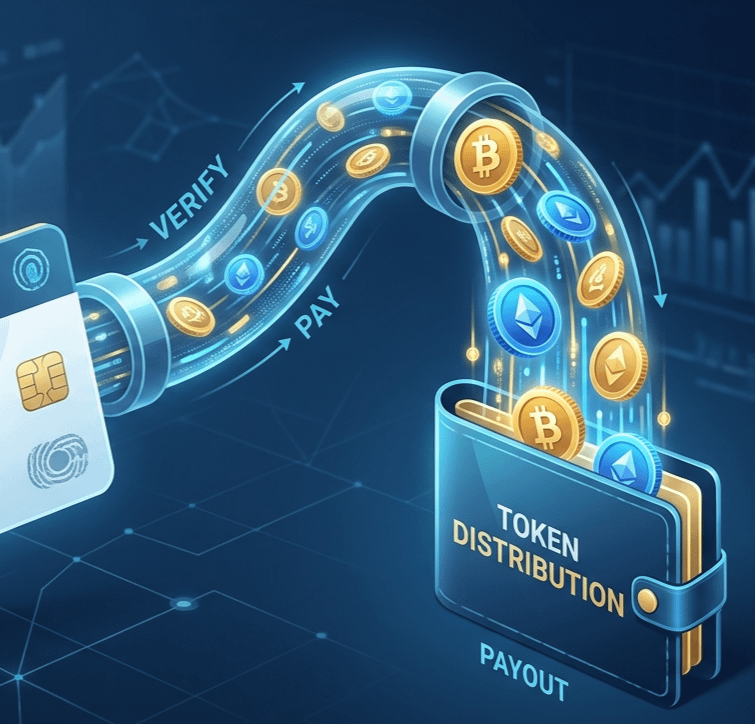
Someone has to manually check a spreadsheet. Someone has to approve a payment. Someone has to reconcile on-chain activity with off-chain records. It’s slow, it’s error-prone, and it’s completely at odds with the "programmable money" promise of crypto.
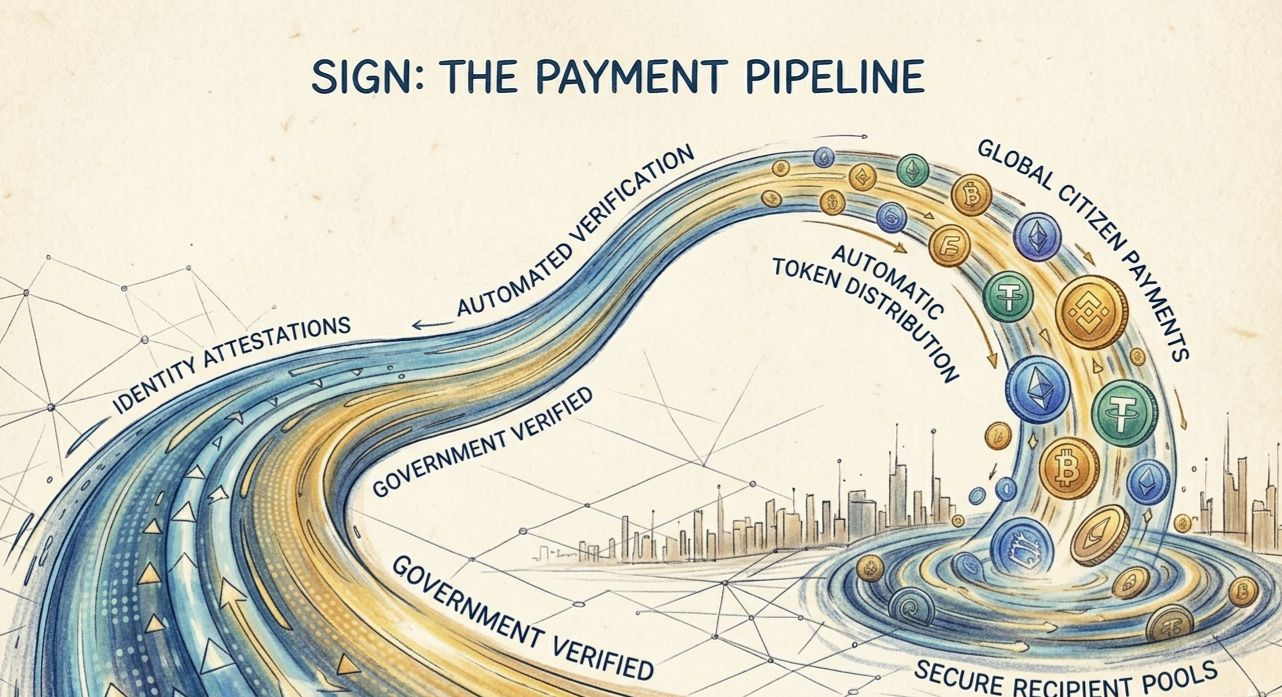
What Sign is building—and what I don’t think gets enough credit—is a pipeline. You’ve got the proof layer (Sign Protocol), the distribution engine (TokenTable), and the identity layer (SignPass) all wired together . You prove something on one end, and on the other end, money comes out. No manual review. No "the check is in the mail." Just execution.
That’s powerful. And it’s also terrifying, because if the logic is wrong, or the proof is forged, or the distribution glitches—you lose trust instantly. There’s no human in the middle to catch the mistake.
The Government Pivot: Smart or Desperate?
This is where my skepticism kicks in a little, but also where I get genuinely curious.
In late 2024 and throughout 2025, Sign pivoted hard toward governments. They rebranded S.I.G.N. as "Sovereign Infrastructure for Global Nations" . They signed a deal to help develop Kyrgyzstan’s CBDC . They partnered with Sierra Leone on a blockchain-based digital ID and stablecoin system . They even launched something called Sign Pass—an on-chain passport that, for 2 ETH, grants permanent residency in Sierra Leone .
On one hand, this is brilliant. Governments have the exact problem Sign solves: they need to verify who people are, and they need to get money or services to them efficiently. A national ID system tied to programmable payments? That’s not a niche crypto use case. That’s infrastructure.
On the other hand… I worry. Governments move slowly. They have legacy systems. They have political cycles. And they have a well-documented history of promising blockchain adoption that never materializes beyond a press release.
But here’s what gives me pause—in a good way: Sign reportedly generated $15 million in revenue in 2024 . That means they’re not just burning through VC money and hoping for adoption. They’re actually getting paid for something.
So maybe the government play isn’t desperation. Maybe it’s just the only market large enough to need what they’re building.
The Token: Fuel or Distraction?
Let’s talk about $SIGN, because we have to. Every project has a token these days, and most of them are thinly veiled attempts to monetize attention.
Sign’s tokenomics are… interesting. Ten billion total supply, with 40% allocated to community incentives . That’s a lot of tokens aimed at getting people into the ecosystem. They did an airdrop via Binance in April 2025, and the initial trading volume was over $200 million on day one . So there’s clearly interest.
But here’s my philosophical hang-up with tokens in systems like this: they change behavior in ways you don’t expect.
If you attach a token to verification—if you pay people for making attestations or for using the protocol—you’re no longer measuring truth. You’re measuring economic incentive. And those two things are not the same.
I’ve seen it happen before. A project launches with noble intentions, adds a token to "align incentives," and suddenly everyone is optimizing for the token price rather than the system’s usefulness. The credential becomes performative. The proof becomes a means to an end, not evidence of anything real.
Sign seems aware of this. Their whitepaper emphasizes governance and long-term alignment. But awareness and execution are different things. I’m watching closely to see if the token ends up strengthening the system or corrupting it.
The Credibility Compression Problem
This is the part that keeps me up at night, philosophically.
Every credential is a compression. You take a complex reality—someone’s contribution history, their identity verification, their eligibility for a program—and you squash it down into a simple attestation: "This person is X."
That compression is necessary. Without it, you can’t scale. You can’t automate. You can’t build systems that operate at the speed of software.
But compression loses information. It strips away context. And context is where trust lives.
If I prove I contributed to an open-source project, but I was toxic to the community—that doesn’t show up in the attestation. If I prove I’m a citizen of a country, but I’m under sanctions—that’s a separate check. The credential is clean. The reality is messy.
Sign’s architecture allows for schemas and trust registries . You can define what counts as a valid attestation, who can issue it, and under what conditions. That helps. But it doesn’t solve the fundamental problem: every system that simplifies reality will be gamed by people who understand the simplification better than the reality.
That’s not a knock on Sign specifically. That’s a truth about all credentialing systems, on-chain or off. But in crypto, where the incentives are financial and the stakes can be high, the gaming gets more intense.
The Usability Cliff
Let me be real with you for a minute.
Most crypto projects are a nightmare to use. You need to understand gas fees, wallet signatures, network switching, private keys… the list goes on. And that’s just for basic interactions.
Sign is asking governments and enterprises to integrate their infrastructure. That means onboarding non-crypto-native teams, training them on attestation schemas, managing DIDs, and debugging smart contract interactions.
There’s a study I came across recently about identity-based software signing tools—not Sign specifically, but similar systems. The researchers looked at thousands of GitHub issues and found that most of the friction came from verification workflows and configuration surfaces . In plain English: the hard part wasn’t the cryptography. The hard part was making the system easy to use.
Sign’s documentation is actually quite good—they have a clear getting-started guide, they support multiple chains, and they offer APIs for querying attestations . But good docs don’t equal good user experience. And user experience is what determines whether people actually adopt the system or just dabble with it and walk away.
I worry that Sign is building for the ideal user—the one who reads the whitepaper, understands the architecture, and appreciates the technical elegance—rather than the real user, who just wants the thing to work without thinking about it.
The Sovereignty Trade-Off
This is the paradox that sits at the heart of Sign’s value proposition.
They’re selling sovereignty. Your identity, your credentials, your attestations—you control them. They’re not locked into a platform’s database. You can take them elsewhere. That’s the promise of decentralized identity, and Sign is delivering on the technical side .
But sovereignty comes with responsibility. If you control your own keys, you’re also responsible for not losing them. If you control your own credentials, you’re responsible for keeping them secure. And most people—most governments—would rather offload that responsibility to someone else.
We see this everywhere in crypto. People don’t want to manage their own private keys. They want a custodian. They want convenience. They want someone to blame if something goes wrong.
So here’s the question I keep circling back to: If Sign succeeds in giving people true sovereignty over their digital identity, will anyone actually want it?
Or will the market choose the easy button every time, even if it means trusting a centralized platform with their data?
I don’t have an answer. But I think Sign’s long-term success depends on how they answer that question.
The Real Test: Not Technology, But Trust
I’ve been in and around crypto long enough to know that technology is rarely the limiting factor. We can build almost anything at this point. The hard part is trust.
Sign is trying to build a system where trust is encoded into the infrastructure—where you don’t have to trust the platform because the proofs are verifiable, the distribution is automated, and the records are immutable.
That’s the dream, anyway.
The reality is messier. Trust is social. It’s relational. It’s built over time through consistent behavior, not through cryptography. You can have a mathematically perfect attestation system, and if people don’t believe in the issuers or don’t trust the verification process, it’s worthless.
Sign seems to understand this. Their government partnerships aren’t just about revenue—they’re about legitimacy. If a central bank trusts Sign enough to use it for a CBDC, that sends a signal. If a national government puts its digital ID system on Sign’s infrastructure, that’s a powerful endorsement .
But endorsement isn’t the same as adoption. And adoption isn’t the same as trust.
What I’m Actually Watching For
If you’ve made it this far, you’re probably wondering: do I think Sign is going to succeed or fail?
I don’t know. And anyone who claims they do is lying.
But I can tell you what I’m watching for over the next year or two:
Distribution volume. TokenTable has already moved billions. Can they scale that to hundreds of billions? Can they handle the complexity of government benefit programs, with all their edge cases and exceptions?
Government retention. The Kyrgyzstan and Sierra Leone deals are nice. But are they one-off announcements, or the beginning of a real network effect? Are other governments signing up?
User experience. Does Sign become easy enough that a random developer—not a blockchain expert—can integrate it without pulling their hair out?
Token behavior. Does $SIGN become a speculative vehicle that distracts from the protocol’s utility, or does it genuinely align incentives and drive participation?
The credibility question. Can Sign build a system where attestations actually mean something—where the signal doesn’t get drowned out by noise and gaming?
The Bottom Line
Sign is trying to do something genuinely hard. They’re not just building another identity protocol. They’re building the plumbing for how trust, verification, and payments intersect at scale.
That’s not glamorous work. It’s not going to generate the kind of hype that sends a token to a 100x in a month. But it is the kind of work that, if done right, becomes invisible infrastructure—the thing everyone uses and no one thinks about.
And maybe that’s the highest compliment I can give. Sign doesn’t want to be the star of the show. They want to be the stage.
Whether they can build that stage, and whether anyone will perform on it… that’s the story I’m watching unfold.
This is my read on the project as of now. Not financial advice. Just someone trying to understand where the real value—and the real risk—actually is.
$SIGN @SignOfficial #SignDigitalSovereignInfra
