
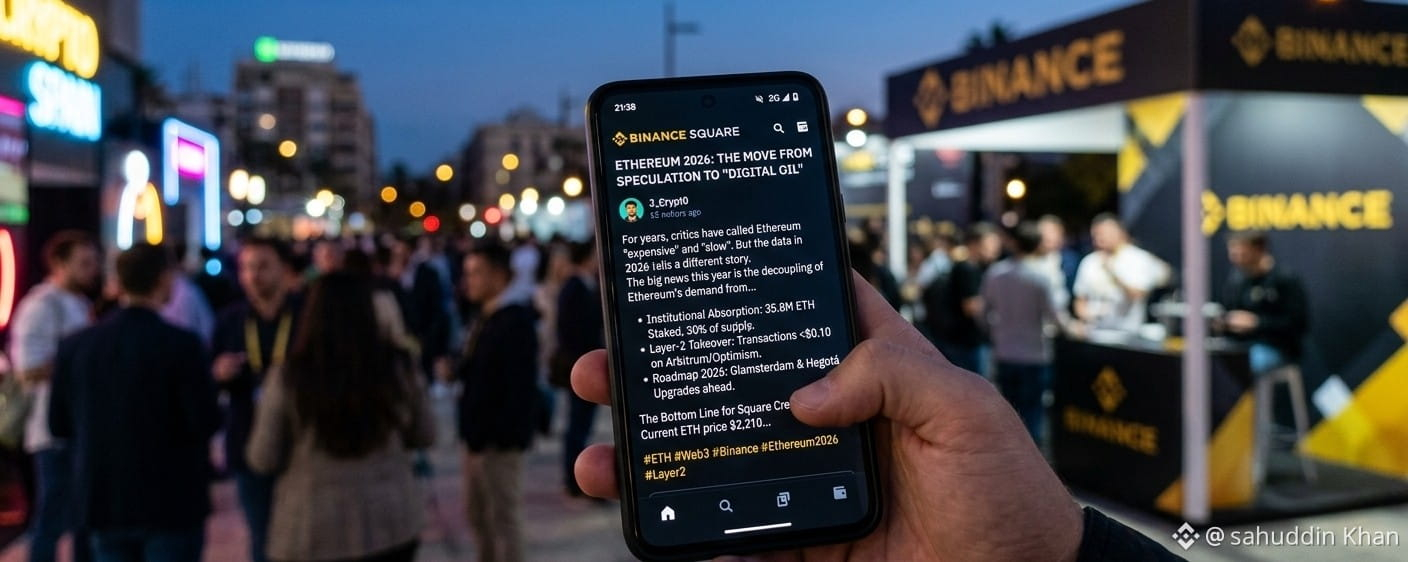

For years, critics have called Ethereum "expensive" and "slow." But the data in 2026 tells a different story. Ethereum is no longer just a playground for retail speculation; it has become the institutional settlement layer for the global economy.
1. The Institutional Absorption 🏦
The big news this year is the decoupling of Ethereum’s demand from retail hype. Between Spot ETH ETFs (holding ~$13B in AUM) and publicly traded "Ethereum Treasury" firms, institutional entities are now absorbing more ETH than the network issues.
Key Stat: Roughly 35.8 million ETH (nearly 30% of supply) is now staked, reducing the "sellable" liquid supply on exchanges to its lowest level since 2016.
2. The Layer-2 Takeo Layer-1 (L1) has successfully transitioned into a security backbone. Over 90% of retail activity—DEX trading, NFTs, and gaming—now happens on L2s like Arbitrum, Optimism, and Base.
The Result: Transactions that used to cost $50 now cost less than $0.10, yet they still burn$ETH on the mainnet, supporting the long-term value of the token.
3. The 2026 Roadmap: Glamsterdam & Hegotá 🛠️
The $ETH Foundation recently unveiled its protocol priorities for the year. The upcoming Glamsterdam upgrade (H1 2026) aims to fix MEV (Miner Extractable Value) fairness and boost censorship resistance. Following that, the Hegotá upgrade will introduce Verkle Trees, a massive technical leap that makes running a node easier and the network more decentralized.
The Bottom Line for Square Creators:
The current price (around $2,210) is being tested by macro uncertainty, but on-chain usage is at an all-time high. When the gap between strong fundamentals and muted price action finally closes, the breakout could be violent.
#Ethereum✅ $ETH #ETH #Layer2 #Crypto2026 #SmartContracts #BinanceSquare #Web3