
A few days ago I was watching someone play a farming game while half-checking prices on another screen. They weren’t really focused on the crops. What caught my attention was how quickly they moved rewards out of the game the moment they earned them. No pause. No attachment. Just earn, route, move on. It felt less like playing and more like managing a flow.
That stayed in my head longer than it should have.
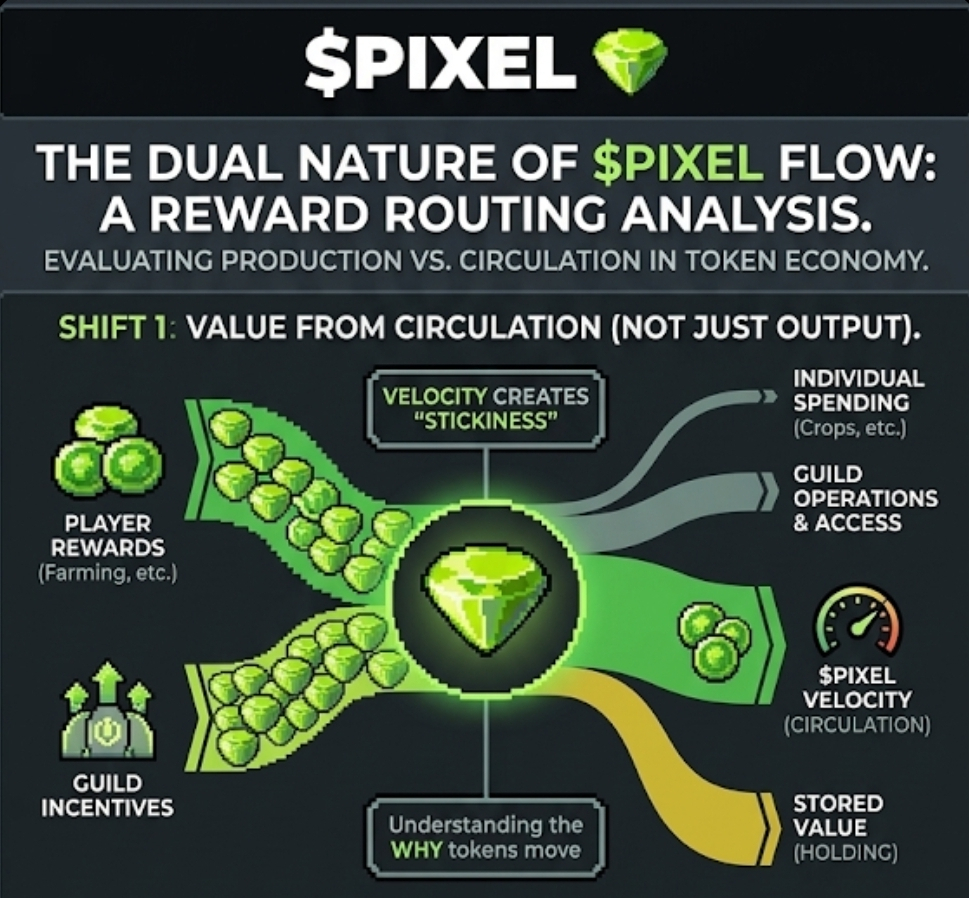
When I look at $PIXEL now, I don’t really see it as a simple in-game reward anymore. It still plays that role, sure. You farm, you earn, you spend. That part is obvious. But there’s something else forming underneath. The token feels like it’s slowly turning into a way to direct where rewards go next, not just something you collect at the end of an action.
I might be overthinking it. But then again, small shifts like this are usually where things start.
There’s this idea I keep circling around. Not very clean, not fully formed. The value of a token doesn’t always come from how much is produced. Sometimes it comes from how often it has to move. That difference is easy to miss. One is about output. The other is about circulation. And circulation has a strange kind of stickiness if it’s real.
Guilds are where this becomes noticeable. At first glance, they look like social features. Groups, coordination, shared activity. Nothing new. But then you notice that access and operation often require $PIXEL. That one condition changes the behavior quietly. Now rewards are not just earned individually and left there. They are pulled into a structure. Routed through a group. Sometimes even controlled by it.
And suddenly, the token is not just sitting in someone’s balance. It’s part of a path.
I’ve seen similar patterns outside gaming. On Binance Square, for example, content doesn’t just exist on its own. There are ranking systems, dashboards, AI tools evaluating originality and relevance. You write something, but you also kind of shape it for the system without fully realizing it. Over time, people stop asking “what do I want to say?” and start asking “what will this trigger in the algorithm?”
It’s subtle. No one says it out loud.
If $PIXEL becomes central to how rewards are routed, I think a similar shift happens. People won’t just play for rewards. They’ll play in a way that fits the routing system. Join certain guilds. Time actions differently. Move rewards where they multiply better. It starts to feel less like a game loop and more like a structured flow system.
That doesn’t mean it’s bad. Actually, it could be the opposite.
If the routing layer is flexible, if it reduces friction instead of forcing steps, then $Pixel becomes something like infrastructure. Not flashy, not talked about much, but always in use. Those systems tend to last longer because they are tied to behavior that repeats naturally. You don’t need to convince someone every time. They just keep using it.
But I can’t ignore the other side. There’s always another side.
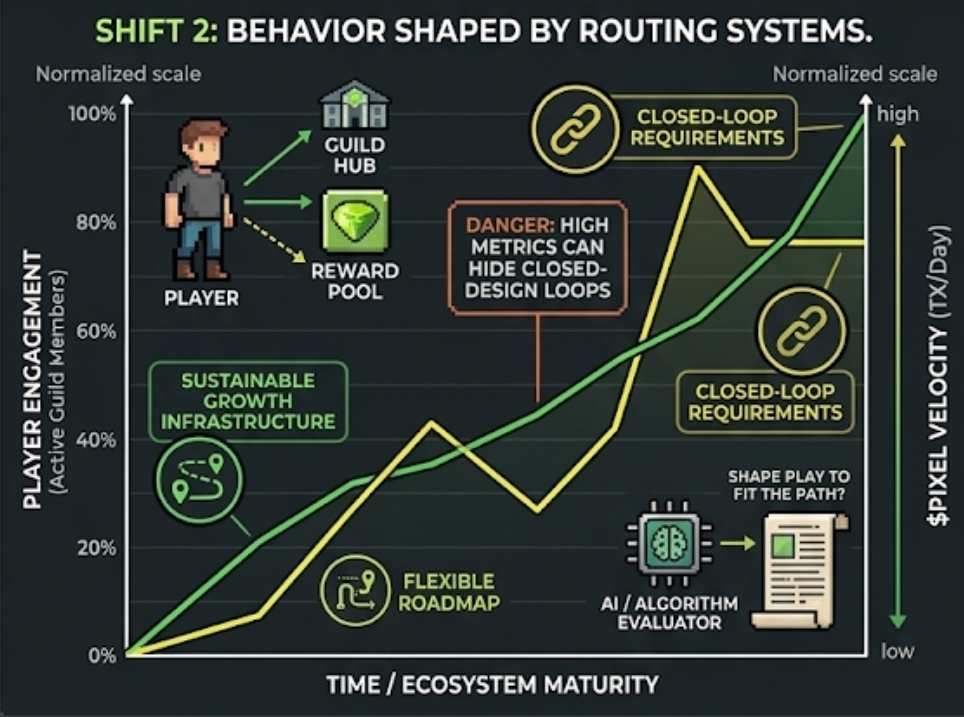
If too many actions require $Pixel just to function, then usage starts to look stronger than it really is. You get loops that feed themselves. Earn, spend, re-enter. It looks active on the surface. Dashboards light up. Metrics improve. But the underlying behavior might not be expanding. Just circulating inside a closed design.
I’ve fallen into that trap before, thinking high activity meant real demand. It doesn’t always.
What makes this harder to read is that routing isn’t very visible. You can count tokens. You can track transactions. But understanding why they move is different. Two systems can have the same numbers and completely different realities underneath. One driven by choice. The other by requirement.
And I think that’s where $Pixel sits right now. Somewhere in between.
There’s a version of this where the token becomes genuinely useful because it helps organize value across players and groups. Rewards move smoothly. Coordination improves. People use it because it makes things easier. That version has weight. It builds over time.
Then there’s the other version where everything depends on it by design, and the system quietly trains behavior around it. That version can look strong for a while. Until it doesn’t.
I don’t think we’re at a clear answer yet. It still feels early, a bit messy, not fully settled. But the shift itself is interesting. Less about earning rewards, more about deciding where they go. Less about the moment of payout, more about the path after it.
And maybe that’s the part people aren’t really watching. Not the rewards themselves, but the routes they are forced to take… or choose to take.