
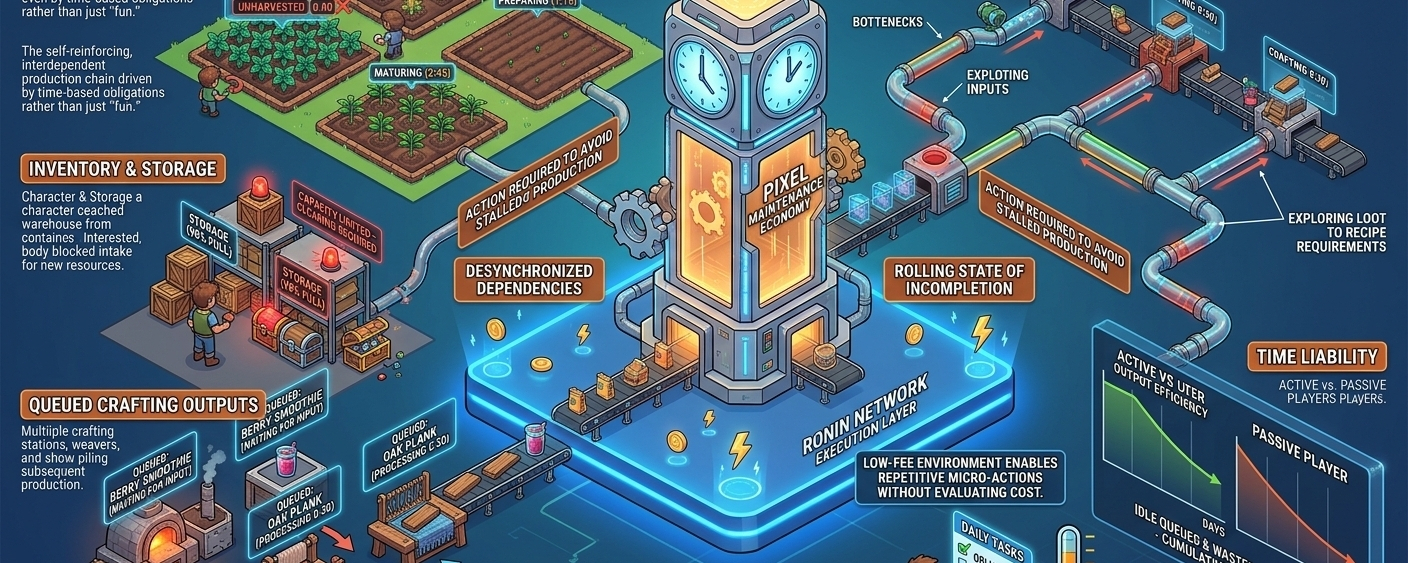
Pixels does not retain players because it is “fun enough.” It retains them because it leaves things unfinished on purpose. Farming cycles tied to real-time timers, limited inventory slots, and queued crafting outputs accumulate into a personal backlog that players must actively manage. Crops that mature and sit unharvested block new planting cycles, idle crafting queues delay downstream production, and capped storage forces constant clearing. The core loop is not consumption but maintenance, where every action creates another small obligation that cannot be passively ignored.
The mechanism works because farming, exploration, and creation are interdependent but desynchronized. Crops mature on fixed timers, exploration yields inputs required for recipes, and crafting chains unlock further dependencies rather than final outputs. A harvested crop may be needed for a recipe that is still locked behind exploration, while exploration produces items that overflow limited storage if not immediately used. This creates a rolling state of incompletion driven by system constraints, not player choice. Players are not logging in to start something new; they are logging in to avoid stalled production, wasted yield cycles, and blocked inventory capacity.
This structure effectively converts time into a liability. Missing a farming cycle does not destroy assets, but it delays the entire production chain, reducing output per unit of time. Idle crafting queues mean lost throughput, and uncollected resources cap future generation. The penalty is opportunity cost, not punishment, but it compounds across systems. The longer a player stays away, the more inefficient their setup becomes relative to active players.
Ronin is critical because this model depends on frequent, low-value interactions. Harvesting, replanting, crafting, and moving items are repetitive actions that would become economically irrational if each carried meaningful transaction cost. Ronin’s low-fee environment ensures that micro-actions remain effectively costless, allowing players to execute dozens of maintenance steps without evaluating each one. The system only sustains if the marginal cost per action is negligible while the cumulative output of maintaining cycles remains materially higher than ignoring them.
The trade-off is the removal of clean stopping points. Because outputs feed back into new inputs and storage is constrained, players rarely reach a state of completion where no action is required. This reduces the sense of finality and can shift behavior from intentional play to habitual checking. The same loop that drives retention can create fatigue when players perceive their backlog as obligation rather than optimization.
There is also a fragility tied to perceived value. If the economic reward for maintaining cycles declines, whether through PIXEL token emission changes or reduced in-game demand for outputs, the incentive to clear backlogs weakens. Since the system relies on continuous participation, even small drops in perceived return can lead to skipped cycles. Once players fall behind, the backlog loses urgency and becomes easier to abandon entirely.
What appears to be a casual open-world experience is structurally a self-imposed task system governed by timers, caps, and interdependent production chains. Pixels does not rely on constant novelty; it relies on persistent inefficiency if left unattended. Its moat is the ongoing cost of inaction, enforced by system design and made viable by an execution layer where repetition is cheap enough to @Pixels sustain at scale.
